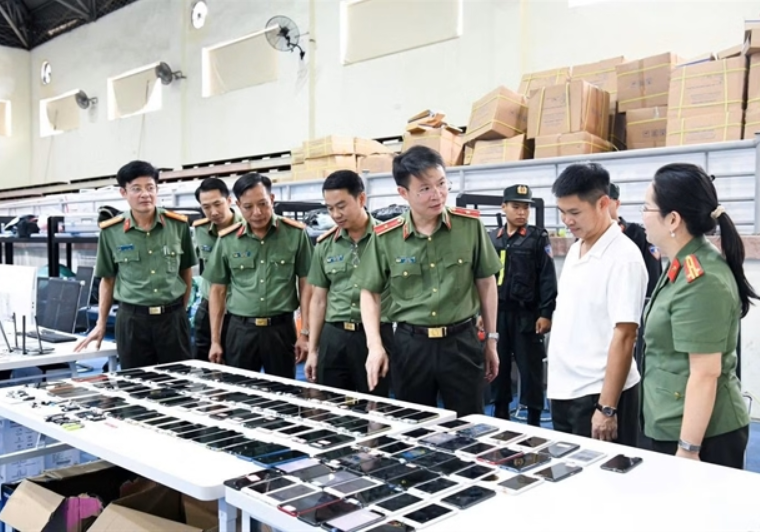
Vietnamese authorities in Phu Tho province have successfully disrupted what investigators describe as an organised attempt to transplant a transnational online fraud enterprise from Cambodia across the border into Vietnam. The police action, announced on Thursday June 18, resulted in charges against four individuals, including a 37-year-old Chinese national identified as Zhao Wei Zhong, who served as the primary architect of the relocation scheme. The case represents a significant enforcement victory against what officials characterise as a sophisticated cross-border crime network with roots in Cambodia's well-documented cybercriminal underworld.
The investigation revealed that Zhao Wei Zhong had been dispatched to Vietnam under explicit instructions from overseas-based operatives who were seeking to establish a foothold in the country as Cambodia intensified its own crackdown on internet-based fraud operations. The assignment given to Zhao was expansive in scope: he was tasked with acquiring suitable residential properties, arranging transportation infrastructure, and laying groundwork for the anticipated arrival of personnel from fraudulent companies already operating in Cambodia. This preparation phase, according to investigators, represented the critical early stages of an operational transition that could have positioned Vietnam as a new hub for cybercriminal activities targeting both regional and international victims.
Zhao's prior experience made him a logical choice for orchestrating this enterprise. His background included work at Chinese-administered scam operations based in Cambodia, where he had cultivated relationships with individuals who would ultimately assist in the Vietnamese phase of the operation. Among those recruited were Tran Thi Thu Huong, 24, and Dình Nam, 27, both natives of Bac Ninh province in northern Vietnam. Police determined that Zhao deliberately sought out these two Vietnamese nationals specifically because they could provide essential services that foreign operatives could not easily access: translation capabilities to bridge language barriers, driving services to facilitate movement and logistics, and reconnaissance skills necessary to identify and evaluate potential locations for housing the incoming workforce.
The network expanded to include Nguyen Thanh Long, a 43-year-old resident of Hanoi, who assumed responsibility for coordinating logistical elements of the relocation plan. Long's role appeared to focus on the administrative and infrastructure dimensions of transplanting the operation, potentially arranging supplies, utilities, and other necessities required for a functional call centre. The involvement of multiple support personnel indicates that what authorities initially detected was not merely a spontaneous criminal venture but rather a methodically planned operation with clearly delineated responsibilities among team members.
The detection and disruption of this scheme before its operational phase commenced represented a significant achievement in Vietnam's ongoing efforts to combat transnational cybercrime. Investigators conducted extensive evidence-gathering before moving to prosecute, ensuring that charges would be substantiated and that potential legal challenges could be preempted. On June 17, authorities in Phu Tho filed formal charges against three of the four suspects: Zhao Wei Zhong, Tran Thi Thu Huong, and Nguyen Thanh Long were all accused of organising the illegal stay of foreign nationals within Vietnamese territory. All three were remanded into pretrial detention, a custody measure that reflects the seriousness with which authorities regard the alleged offence.
Dình Nam, the fourth accused, faced identical charges relating to his role in facilitating the foreigners' illegal presence. However, his case received differentiated legal treatment: rather than being held in detention, Nam was placed under a movement restriction order, a less stringent enforcement measure that confines him to his residential location pending the continuation of proceedings. This distinction may reflect either evidentiary factors distinguishing his culpability from that of his co-defendants or tactical prosecutorial decisions regarding the strength of evidence against each individual.
The physical evidence recovered during operations against the network proved both voluminous and revealing about the scale of the intended operation. Police seized 73 computers, equipment central to any functioning call centre operation, alongside 134 mobile phones that would have been utilised for fraudulent communications targeting victims. Additionally, investigators recovered 34 USB storage drives and 20 Wi-Fi routers, technical infrastructure essential for establishing secure, distributed communications capacity. The confiscation of this equipment quantity suggests that the operation, had it proceeded to completion, would have possessed substantial capacity to conduct simultaneous fraudulent schemes across multiple victim profiles and geographic markets.
The case illuminates broader patterns of regional cybercrime migration within Southeast Asia. As individual countries strengthen their enforcement capabilities and law enforcement coordination improves, criminal enterprises increasingly seek jurisdiction transitions rather than cessation of operations. Cambodia has experienced sustained international and domestic pressure to address its role in hosting online scam networks, a reputation that has damaged both the nation's international standing and its legitimate economic interests. The discovery of Vietnamese efforts to establish alternative bases reflects how criminal entrepreneurs attempt to circumvent geographical enforcement obstacles by establishing operations in jurisdictions perceived as offering lower enforcement risk or weaker detection capabilities.
For Malaysia and other regional economies, the case serves as a cautionary indicator of transnational cybercriminal network behaviour. These enterprises routinely establish multiple operational sites across Southeast Asia, creating redundancy in case any single location faces law enforcement action. Malaysian authorities have previously encountered similar schemes involving personnel relocation and infrastructure preparation for call centre fraud operations. The operational details revealed in the Vietnamese investigation—the recruitment of local facilitators, the acquisition of residential properties as operational bases, the stockpiling of communications equipment—represent a template that could potentially be replicated across other regional jurisdictions, including Malaysia.
The prosecution of this network also reflects evolving international cooperation frameworks addressing cybercrime within Southeast Asia. While the investigation was conducted by Vietnamese authorities, the exposure of transnational operational networks typically involves intelligence sharing and coordinated intelligence activities across multiple countries. The recovery of equipment and documentation associated with the operation will likely provide investigators with forensic intelligence regarding the broader network structure, potential victim bases, and operational methods that can inform regional enforcement strategies. Vietnamese prosecutors will face the challenge of constructing cases that establish criminal culpability despite the operational stage at which the intervention occurred—the suspects had not yet commenced actual fraud activities within Vietnam, requiring prosecutors to establish criminal intent and preparation through circumstantial and direct evidence of planning activities.
Longer-term implications for regional security include the likely redoubling of enforcement efforts in both Cambodia and Vietnam to prevent the re-establishment of similar networks. The incident may accelerate bilateral law enforcement cooperation specifically targeting cybercriminal enterprises, as both governments share interest in preventing their territories from becoming havens for transnational fraud operations. For citizens and businesses in Malaysia and throughout the region, the case underscores the persistent threat posed by organised cybercriminal networks that maintain sophisticated organisational capabilities, geographic flexibility, and demonstrated willingness to invest substantial resources in establishing operational infrastructure across multiple jurisdictions.