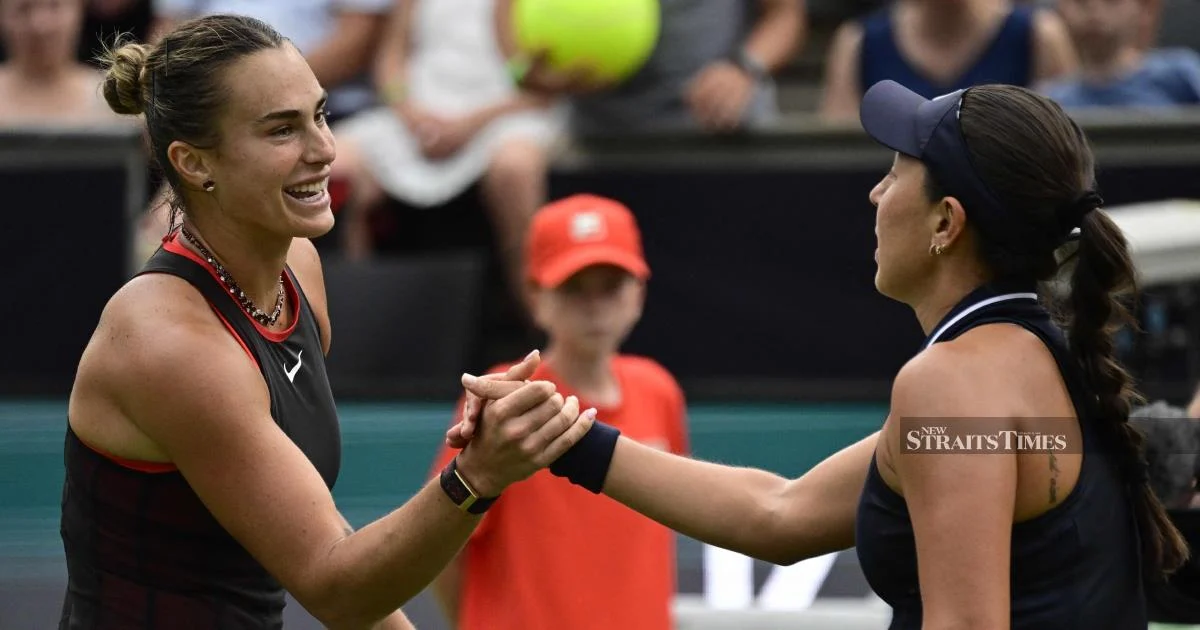
American Jessica Pegula delivered a commanding performance against world number one Aryna Sabalenka on the grass courts of Berlin, advancing to the tournament final with a 6-2, 6-7 (4-7), 6-0 victory. The result marks Pegula's second appearance in the championship match at this prestigious grass-court event, highlighting her resurgence as a competitive force in women's professional tennis during the peak summer season.
The semi-final clash showcased contrasting fortunes for the two players, with Pegula finding her rhythm on the demanding grass surface whilst Sabalenka struggled to maintain consistency. The opening set proved decisive, with Pegula seizing an early advantage and converting it into a commanding 6-2 scoreline that suggested a potential rout was imminent. However, Sabalenka, despite her ranking and recent form, demonstrated the resilience expected of a world number one by fighting back in the second set, forcing the contest into a tiebreaker.
The tie-break itself became a pivotal moment in the match's trajectory. Playing out at 4-7, the decider swung in Pegula's favour, who managed to edge the contest 7-4 in the tiebreaker format. This second-set victory proved psychologically significant, as it prevented Sabalenka from levelling the match and building momentum. Instead, it appeared to deflate the Belarusian's confidence going into the decisive third set, where Pegula would complete her remarkable turnaround with an emphatic bagel.
The final set illustrated the gulf that had emerged between the competitors by that stage. Pegula's dominance manifested in a 6-0 shutout, a result that underscore her superior execution and strategic awareness on grass. The American's ability to dictate play from the baseline and construct points methodically proved too much for Sabalenka to counter, suggesting that the grass surface may have neutralised some of the world number one's typical advantages. This third-set performance particularly vindicated Pegula's approach and her willingness to press her advantage once established.
For Southeast Asian tennis enthusiasts and regional readers, Pegula's progression carries notable significance. The American's success on grass courts adds another dimension to her career trajectory and reinforces the competitive depth within women's professional tennis beyond the traditional Roland Garros and US Open dominators. Her return to a Berlin final after previous experience at this tournament demonstrates consistency at a specific venue, a quality that distinguishes champions from occasional winners. Furthermore, her capacity to defeat the top-ranked player in the world provides meaningful context about the current state of women's tennis parity.
Sabalenka's exit, whilst disappointing, should not be interpreted as a fundamental weakness in her game. Rather, the grass-court environment presents unique challenges that differ markedly from the hard courts where Sabalenka typically dominates. The surface's lower bounce and faster pace can favour different technical skillsets than those required on cement. The world number one's difficulty in adapting her normally aggressive serving and ground-stroke style to grass is not unprecedented and reflects the sport's inherent format variations.
From a tournament perspective, Pegula's ascendancy to the final ensures competitive intrigue in the championship match. Her opponent will be determined in the other semi-final encounter, but whoever advances will face an American player now playing with considerable confidence after dismantling the circuit's highest-ranked competitor. This momentum could prove decisive in what promises to be a compelling final.
The Berlin WTA tournament represents one of the sport's historic grass-court championships, maintaining traditions extending back decades. Pegula's presence in the final adds American representation to the event, continuing a legacy of successful American participation in this prestigious competition. Her path through the draw, culminating in the defeat of Sabalenka, demonstrates the depth of talent required to succeed on this surface and earn the right to compete for the title.
As the final approaches, Pegula will likely maintain her grass-court focus with eyes on the All England Club and Wimbledon later in the season. The confidence generated from consecutive impressive performances on this surface—particularly the scalp of the world number one—will undoubtedly carry into preparation for tennis's most prestigious tournament. Her Berlin final appearance suggests she possesses the form and mindset to remain competitive throughout the grass-court calendar.
For Malaysian and regional readers following women's tennis, Pegula's breakthrough provides a narrative of perseverance and technical excellence worthy of appreciation. The match's quality and the magnitude of the comeback demonstrate why the sport captivates audiences globally. Whether Pegula can convert this momentum into a Berlin title awaits resolution in the championship match, but her semi-final victory has already accomplished something significant: proving that even against the world's top-ranked player, sustained excellence and adaptability can prevail.