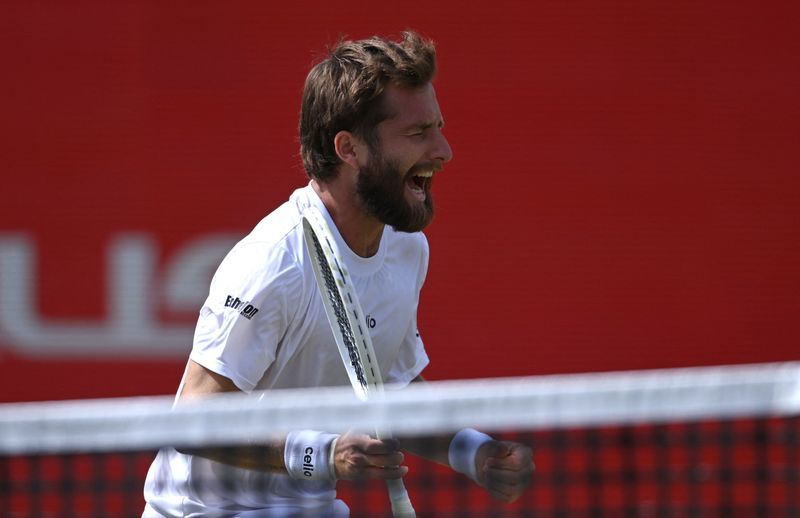
French tennis player Corentin Moutet has been stripped of nearly all his earnings from the Queen's Club Championship after incurring a substantial fine for his conduct during a live post-match interview. The ATP imposed a $40,000 penalty on the 27-year-old following his expletive-laden remarks made on court to BBC interviewers immediately after his first-round victory over fellow Frenchman Giovanni Mpetshi Perricard. The financial consequence is particularly striking given that Moutet earned only $43,000 for advancing to the second round, meaning the fine effectively wipes out his tournament winnings.
The incident occurred when Moutet, currently ranked world number 36, was discussing his match performance with the BBC interviewer on court. During the conversation, he used profanity to describe being struck with an ace on match point, when his opponent unleashed a 142mph second serve past him. When the interviewer politely requested he refrain from repeating the expletive, Moutet continued the behaviour, uttering the same swear word three additional times before the interview was terminated. The broadcast team subsequently issued apologies to both the crowd in attendance and television viewers across the United Kingdom and beyond.
In the immediate aftermath, Moutet attempted to downplay the incident through a statement posted on Instagram, claiming he had simply been joking around. However, the ATP took a more serious view of the situation, classifying his conduct as unsportsmanlike and issuing the substantial fine accordingly. The governing body's decision reflects an increasingly stringent approach to player behaviour during broadcast interviews, where profanity can reach audiences across multiple continents and demographics. Moutet has subsequently lodged an appeal against the fine, indicating he disputes the severity of the punishment or the characterisation of his actions.
The timing of the sanction compounds Moutet's disappointment at Queen's Club, as he failed to build momentum following his opening-round victory. In the second round, he suffered a straight-sets loss to Spain's Alejandro Davidovich Fokina, ending his tournament run prematurely. This early exit meant the fine represented not merely a reduction in his earnings but a near-complete forfeiture of financial reward for the event. For professional players operating outside the top tier of world rankings, such penalties carry genuine financial implications, particularly when tournament earnings constitute essential revenue for funding coaching, travel, and training expenses.
This latest disciplinary matter fits into a broader pattern of behavioural concerns that has dogged Moutet's career trajectory. In 2022, he was defaulted from the Adelaide International after directing expletives at the umpire during a match against Serbia's Laslo Djere. That incident represented one of tennis's more serious disciplinary outcomes, resulting in immediate removal from the tournament. The same year, the French Tennis Federation took the additional step of withdrawing support from Moutet, citing ongoing issues with his conduct and professional standards. These cumulative incidents suggest a player struggling to maintain composure under competitive pressure.
For Malaysian and Southeast Asian tennis followers, Moutet's case illustrates the evolving standards of professionalism in international sport. Unlike contact sports where intensity and aggression are somewhat accommodated, tennis broadcasts reach global audiences in real time, with every utterance potentially broadcast live to millions. The sport's governing bodies have increasingly recognised that on-court behaviour, particularly during high-profile media interactions, carries implications for the sport's image and marketability. This reflects broader societal shifts toward accountability for public figures and the amplifying effect of modern broadcasting.
The Queen's Club Championship itself stands as one of British tennis's most prestigious events, steeped in tradition and expectations of decorum. The tournament attracts elite players and significant media attention in the lead-up to Wimbledon, making it a showcase event for professional conduct. Moutet's conduct therefore occurred at a particularly high-profile moment, with international media coverage guaranteed. The incident underscores how easily a player's entire tournament narrative can be dominated not by on-court performance but by off-court behaviour, overshadowing genuine athletic achievement.
From a Southeast Asian perspective, the case reflects how international sports governance has become increasingly robust and consistent. Regardless of a player's nationality or ranking, violations of conduct standards are met with consequences. This transparency and universality of standards is important for the credibility of professional tennis and helps maintain the sport's standing across diverse markets and audiences throughout Asia. Young players in the region observing these disciplinary actions understand that professional tennis demands not only technical excellence but also emotional regulation and respect for the broadcast environment.
Moutet's decision to appeal the fine suggests he may argue either that the penalty was disproportionate or that the conduct did not warrant classification as unsportsmanlike. The outcome of this appeal process will carry significance for how future similar incidents are adjudicated. If successful, it could suggest the ATP will recalibrate its enforcement approach; if unsuccessful, it will reinforce that broadcast profanity carries substantial financial consequences. Either way, the case serves as a cautionary reminder to professional players that microphones and cameras are always active during post-match interviews, and that moments of frustration can have lasting financial and reputational consequences.