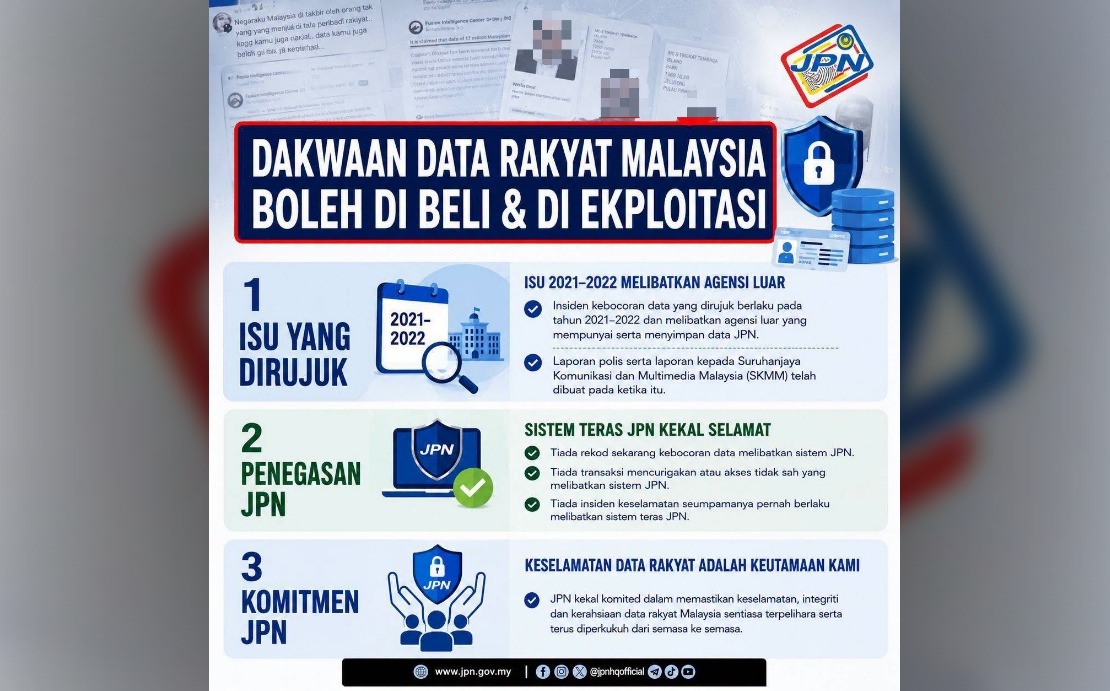
The National Security Council (MKN) has moved to dispel concerns about a personal data leak spreading across social media, stating that the compromised information originates from cybersecurity breaches that occurred before 2022 and bears no connection to any operational platform currently in use. Through the National Cyber Security Agency (NACSA), the council issued a formal statement addressing the viral claims, emphasising that the data was unlawfully obtained through cyber intrusions targeting various systems in the years preceding 2022 and has since been redistributed without proper authorisation across digital channels.
The repackaging and distribution of this older compromised data represents a continuation of cybercriminal activity rather than evidence of fresh security failures. NACSA underscored that the act of providing, sharing, or enabling access to information obtained through illegal means constitutes a criminal offence under Malaysian legislation, regardless of whether the hosting service operates from within the country's borders or from offshore locations. This clarification serves as an important reminder to the public that complicity in the distribution of stolen data carries serious legal consequences under the nation's legal framework.
Authorities have already mobilised a coordinated response to contain the breach's spread. NACSA, working alongside MyNIC and the Personal Data Protection Department, has engaged international service providers to identify, remove, and block access to the websites hosting the compromised information. These proactive measures aim to prevent further circulation and limit the number of individuals who might access the stolen data through these channels. The multi-agency approach reflects the complexity of managing cybersecurity threats that often cross jurisdictional boundaries, requiring cooperation with international partners who control the infrastructure hosting the unlawful content.
Parallel to the containment efforts, the Royal Malaysia Police has commenced digital forensic investigations in coordination with NACSA to trace the origins of the current distribution and identify individuals responsible for spreading the data. These investigations will focus on establishing the chain of custody for the compromised information and determining whether any Malaysian entities or individuals are directly involved in the unauthorised redistribution. The law enforcement dimension of this response signals the government's commitment to holding perpetrators accountable through criminal prosecution rather than relying solely on technical mitigation.
The MKN issued a stern advisory to Malaysian citizens, cautioning them against seeking out or utilising services that provide access to unlawfully acquired information. The council emphasised that participating in such activities not only facilitates the perpetuation of cybercrime but also places individuals in violation of local law. This guidance reflects broader efforts to cultivate a culture of digital responsibility among the general population, encouraging citizens to understand their role in either combating or enabling cybercriminal networks. The framing of data acquisition as a conscious choice with legal ramifications underscores that ignorance of the data's illicit origin does not absolve users of responsibility.
The incident has reignited discussions about legislative gaps in Malaysia's cybersecurity framework. The government is advancing the Cyber Crime Bill, which will introduce enhanced provisions and more substantial penalties for a range of cybercriminal activities. Once tabled in Parliament, this legislation will specifically criminalise unauthorised access to or damage of computer systems and programmes undertaken without lawful authority or legitimate justification. Additionally, the bill will formally define identity theft—encompassing the unlawful use of another individual's identity with criminal intent—as a distinct offence, closing loopholes that previously allowed perpetrators to evade prosecution.
Already in effect since August 2024, the Cyber Security Act 2024 has established mandatory security protocols for entities managing National Critical Information Infrastructure (NCII). These organisations must implement comprehensive protective measures, including adherence to codes of practice, conducting thorough risk assessments, and performing regular security audits. The legislative evolution reflects a strategic shift toward proactive security requirements rather than reactive responses to breaches, establishing clear standards that organisations must meet to protect sensitive national assets from cyber threats.
In addressing public concerns about identity verification systems, the MKN clarified the operational nature of MyDigital ID, which has surpassed 16 million registrations across the country. Rather than functioning as a centralised repository for personal data, MyDigital ID operates as an authentication mechanism that verifies user identities in real time by connecting directly to the National Registration Department's records. This architecture reduces the concentration of sensitive information in a single accessible location, thereby minimising the potential impact of any breach involving the platform itself. The distinction between data storage and identity verification is crucial for public understanding of the system's security posture.
The widespread integration of MyDigital ID across government and private sector applications—including telecommunications companies and banking institutions—aims to fortify digital transaction security on a national scale. By standardising identity verification through a government-backed system, Malaysia seeks to reduce opportunities for fraudsters to impersonate legitimate users or establish fake accounts. The expansion of MyDigital ID adoption represents a deliberate strategy to create a more secure digital ecosystem where multiple sectors rely on a consistently verified identity authentication mechanism rather than disparate, potentially less rigorous verification methods.
The MKN reaffirmed the government's strategic priority of ensuring that digital transformation benefits extend to all Malaysians while maintaining robust security standards. Both NACSA and the council emphasised their readiness to identify, assess, and respond to emerging cybersecurity threats with the full array of technical, investigative, and legal tools at their disposal. This positioning reflects a commitment to continuous vigilance rather than a perception that the immediate crisis has been entirely resolved. The ongoing nature of cybersecurity challenges demands sustained institutional attention and regular updates to both technology and policy frameworks to maintain effectiveness against evolving threat methodologies.