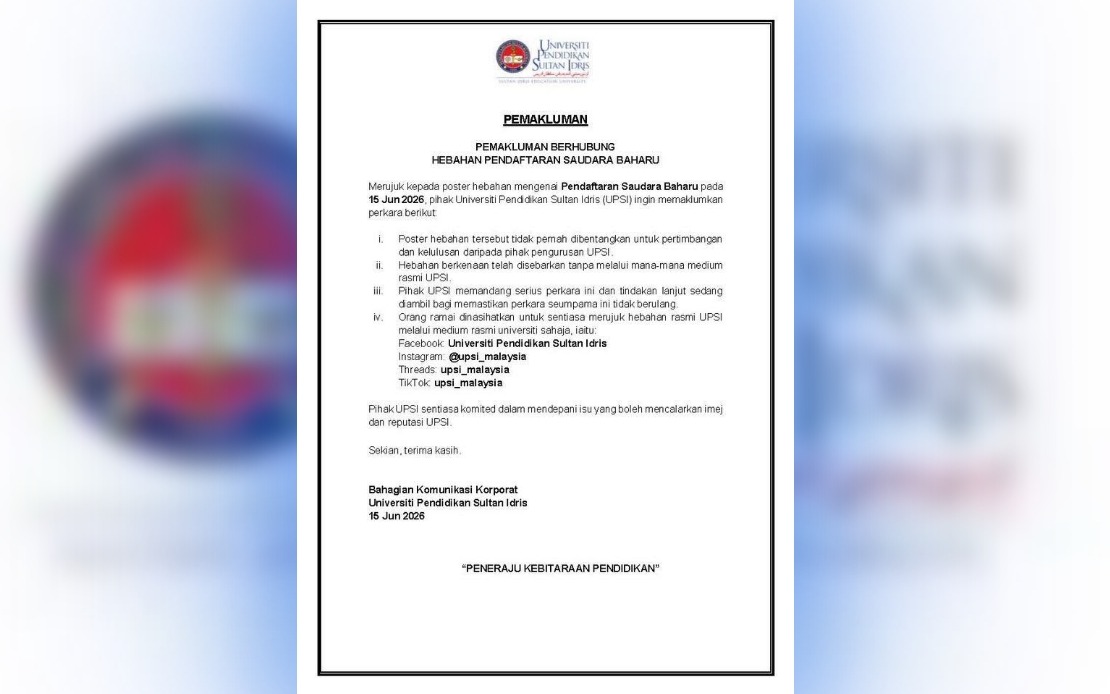
Universiti Pendidikan Sultan Idris (UPSI) has firmly rejected any connection to a poster concerning the registration of 'saudara baharu'—newly converted Muslims—that became the subject of widespread social media discussion in mid-June. The institution released a statement through its official social channels, clarifying that the document, dated June 15, had never been formally presented to university leadership for examination or endorsement.
The university emphasised that the material in question was disseminated entirely outside its official communication frameworks. No authorised UPSI channels were utilised in spreading the content, according to the institution's account. This distinction is crucial for understanding how misinformation or unauthorised messaging can attach itself to established organisations, particularly in the digital age where institutional names carry weight and credibility that bad actors can exploit.
UPSI's response underscores a growing challenge faced by Malaysian universities and government bodies: the rapid spread of content bearing institutional branding or simply attributed to official sources without genuine institutional approval. The poster's circulation without proper channels represents a breach that the university views with considerable gravity, signalling institutional concern about reputational damage and the potential for manufactured content to create false impressions about its positions or activities.
The statement released by UPSI conveyed the administration's determination to address the breach seriously. University authorities indicated that investigative measures would be pursued to identify how the poster originated and circulated, with measures implemented to prevent similar incidents in future. This reactive posture reflects the university's recognition that in an environment where information spreads instantaneously across platforms, rapid institutional response becomes essential to managing perception and truth.
Crucially, UPSI stressed its ongoing commitment to safeguarding its institutional image and reputation. For an educational institution, particularly one focused on teacher training and professional development, maintaining public trust and clarity about its values and activities is paramount. The unauthorised dissemination of material ostensibly connected to the university threatens that foundational trust.
The university also reinforced guidance to the public regarding information verification. It urged Malaysians to rely exclusively on announcements released through UPSI's verified official channels rather than assuming that any content circulating online bearing the institution's name or reference necessarily originates from authoritative sources. This appeal for media literacy and source verification reflects a broader institutional frustration with how digital platforms enable rapid amplification of unvetted material.
The incident exemplifies a pattern observed across Malaysian institutions in recent years: the weaponisation of institutional branding to lend false authority to messages, whether for recruitment purposes, policy announcements, or ideological positioning. The fact that this poster specifically concerned matters of religious conversion and registration adds another dimension, touching on topics where Malaysian society maintains particular sensitivities and where unauthorised messaging can generate rapid community response and concern.
For Malaysian readers and those following institutional developments in Southeast Asia, this episode serves as a practical reminder about digital verification practices. With educational and governmental institutions increasingly finding their names attached to content they did not produce, the responsibility for distinguishing authoritative sources from unauthorised material falls partly on information consumers themselves. UPSI's clarification, while defensive in nature, essentially invites the public to adopt more rigorous approaches to source validation.
The broader implications for UPSI extend to operational security around its digital assets and communication protocols. Universities and large organisations increasingly must implement systems to monitor where their names and logos appear online, respond rapidly to misuse, and implement additional verification mechanisms for stakeholders seeking to distinguish genuine institutional communications from fabricated alternatives. The incident, while resolved through swift institutional denial, highlights systemic vulnerabilities that persist across Malaysian organisations navigating the complex digital information landscape.