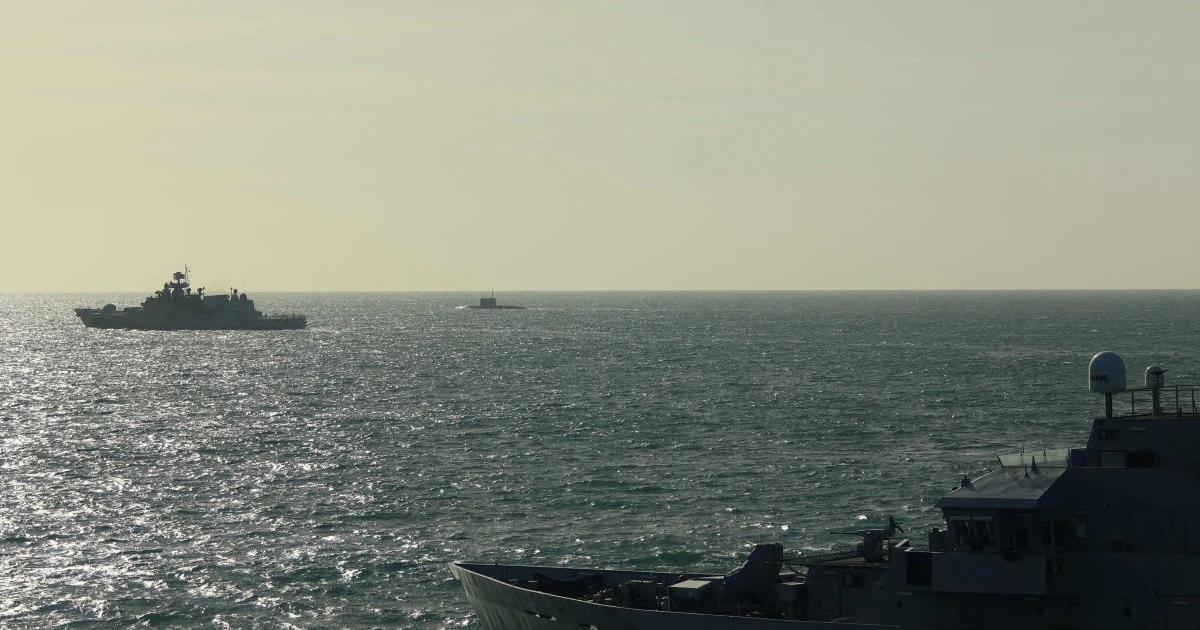
UK Prime Minister Keir Starmer has sought to downplay the severity of an incident involving a Russian naval vessel in the English Channel, classifying the firing of warning shots near a civilian yacht as reckless rather than deliberately provocative. The distinction, made during remarks on Wednesday, reflects London's measured diplomatic approach even as tensions between Britain and Russia continue to simmer across multiple fronts.
The incident represents the latest in a string of maritime confrontations between Russian naval forces and Western vessels operating through strategically vital sea lanes. The English Channel, one of the world's busiest shipping routes, has become an increasingly contested arena as Moscow reasserts its military presence and Western nations respond with heightened vigilance. For Malaysia and other Southeast Asian maritime powers, such incidents carry broader implications for international law and the principle of freedom of navigation, which underpins global commerce and security.
Starmer's characterisation of the event as "reckless" rather than "sinister" suggests an attempt to avoid escalatory language while still registering concern about Russian naval conduct. The terminology carries weight in diplomatic circles—suggesting dangerous incompetence rather than deliberate malice can occasionally provide diplomatic cover for de-escalation, though it risks understating the gravity of armed vessels operating in contested waters. This rhetorical positioning allows the UK government to maintain pressure on Russia whilst avoiding rhetoric that could trigger further military posturing.
The incident occurred against a backdrop of heightened British military activity in and around European waters. The Royal Navy has intensified operations in the North Sea, Baltic approaches, and Channel areas partly in response to Russian military exercises and partly to demonstrate NATO solidarity with allied nations bordering Russian territory. For regional observers in Southeast Asia, the pattern mirrors concerns about military vessels operating in disputed waters closer to home, particularly in the South China Sea where similar tensions between established maritime powers and rising military forces have created uncertainty.
Russia's military doctrine increasingly emphasises assertive presence operations designed to test Western resolve and assert territorial claims. Warning shots, though dramatic and attention-grabbing, represent a calibrated form of military signalling—aggressive enough to demonstrate capability and intent, yet stopping short of direct kinetic engagement. This grey-zone tactic has become common in contemporary maritime disputes globally, challenging traditional international law frameworks that were designed for clearer distinctions between peace and conflict.
The incident also highlights the fragility of civilian-military interactions in heavily trafficked waters. Commercial vessels and private yachts operating through major sea lanes increasingly find themselves in proximity to military activity that extends beyond their control or understanding. Safety protocols for civilian traffic in areas with military activity require constant updating, particularly when multiple nations conduct operations simultaneously. For Malaysian mariners and shipping companies with interests in European waters, such incidents underline the importance of real-time maritime intelligence and communication with naval authorities.
Starmer's response reflects broader British foreign policy challenges in managing relations with Moscow whilst maintaining NATO cohesion and deterrence. The UK has positioned itself as a particularly vocal supporter of Ukrainian resistance and has adopted hardline rhetoric on Russian military actions, yet such measured characterisations suggest recognition that rhetorical restraint may sometimes serve strategic interests better than inflaming already tense situations. This balancing act characterises much Western policy towards Russia in recent years—firmness without needless provocation.
The diplomatic language employed also serves a domestic political audience in Britain. Describing the incident as reckless rather than sinister allows Starmer to demonstrate that his government takes Russian aggression seriously without appearing to overreact or treat minor incidents as major crises. Public confidence in leadership partly depends on calibrated responses to security challenges, and Starmer's framing suggests a prime minister in control of his government's narrative and response mechanisms.
From a Southeast Asian perspective, the broader pattern of Russian assertiveness in distant waters carries implications for how major powers might behave closer to the region. If Russia faces limited consequences for warning shots in the English Channel, could similar tactics become normalised in other strategically important waters? The South China Sea already sees countless incidents involving military vessels from multiple nations, and international responses to them shape expectations about what behaviour constitutes acceptable risk.
The incident also reflects Russia's broader strategy of demonstrating continued military capability and willingness to operate in areas where Western powers traditionally enjoyed dominance. As Russia becomes increasingly isolated economically and diplomatically due to its actions in Ukraine, military posturing offers a means of projecting power and asserting relevance. These operations, from the Russian perspective, serve to complicate Western planning and demonstrate that Moscow remains a force requiring serious consideration.
Moving forward, such incidents will likely recur as long as Russia maintains active naval deployments in the Atlantic and North Sea. The challenge for Britain and NATO partners involves developing protocols that reduce the likelihood of dangerous escalation whilst maintaining freedom of navigation and operational capability. International maritime law provides frameworks for such coexistence, but their effectiveness depends on mutual acceptance and commitment to crisis communication mechanisms.
For UK policymakers, the broader challenge involves sustaining public and allied support for a prolonged period of elevated tension with Russia without either capitulating to pressure or triggering uncontrolled escalation. Starmer's measured language reflects this difficult middle path, acknowledging concern whilst avoiding the rhetoric of existential conflict. As Russia continues testing boundaries through military operations, how Western leaders characterise these incidents will shape international expectations about acceptable conduct in shared maritime spaces.