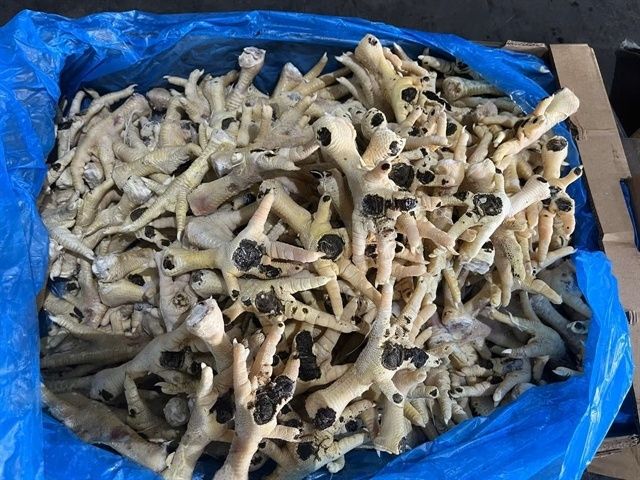
Vietnamese authorities have brought smuggling charges against two business executives following an investigation into a scheme that saw hundreds of containers of frozen chicken feet illegally diverted from re-export requirements to domestic Vietnamese markets over a three-year period. Hanoi police announced the charges on Friday, June 19, concluding a probe that exposed significant gaps in food safety oversight and customs enforcement, with potential implications for regional supply chains and consumer protection frameworks across Southeast Asia.
The two suspects are Nguyen Thi To Loan, 47, who operated ABF Food Import-Export JSC in Ninh Binh Province, and Trang Tuyet Ngoc, 45, who held a senior position at An Binh Group as head of the assistant department. Police stated that both individuals have admitted to all charges leveled against them. The investigation revealed a deliberate scheme in which poultry products originating in countries experiencing active disease outbreaks were knowingly misdirected away from their declared purpose, creating potential biosecurity and public health risks for Vietnamese consumers unaware of the products' origins.
Between 2023 and 2026, the operation imported 339 containers of frozen chicken feet under false pretenses. The shipments were officially declared to customs authorities as goods intended solely for processing and subsequent re-export, a designation that carries specific legal restrictions under Vietnamese law. However, this classification exists precisely because poultry products from countries with active disease problems pose significant health risks and are therefore prohibited from domestic consumption. The fact that authorities permitted such imports with re-export declarations indicates either regulatory vulnerability or deliberate manipulation of inspection procedures that warrants closer examination by regional food safety bodies.
Instead of honoring the re-export requirement, Loan directed Ngoc to systematically distribute the chicken feet throughout Vietnam's domestic market. The distribution network proved remarkably extensive, reaching food service businesses across multiple provinces including Hanoi, Cao Bang, Ninh Binh, and Quang Ninh, as well as other regions. Investigators estimate that more than 10,000 metric tonnes of the smuggled product reached consumers and commercial kitchens, meaning thousands of Vietnamese establishments and their patrons unknowingly consumed poultry products that originated in countries with documented disease issues. This scale demonstrates how effectively the operation penetrated legitimate supply chains without detection for years.
The financial dimensions of the scheme underscore the significant commercial motivation. The total value of imported goods was calculated at more than VNĐ347 billion, equivalent to approximately US$13 million. Notably, no import duty was paid on any of these shipments, representing an additional layer of customs evasion that compounded the original smuggling offense. This dual violation—misclassification of goods combined with duty avoidance—suggests a sophisticated understanding of customs procedures and potential complicity or negligence within regulatory systems.
When authorities conducted raids on cold-storage facilities connected to the operation, they uncovered substantial quantities of the contraband product still in storage, revealing the sheer volume of the enterprise. Investigators located more than 2,000 metric tonnes of frozen chicken feet across multiple warehouse locations. The discovery at An Viet 2 freezer facility in Hanoi's Quang Minh Industrial Zone proved particularly concerning, as officers found over 1,000 metric tonnes stored there, including approximately 260 metric tonnes that had visibly expired, displayed mold growth, and emitted foul odors. Most troubling, authorities noted that these degraded products appeared to be staged and prepared for further distribution to unsuspecting buyers, suggesting the operation continued operating despite obvious quality deterioration.
A second raid at the THL cold-storage warehouse in Lang Son Province in northern Vietnam yielded an additional 1,030 metric tonnes of the frozen chicken feet. The distribution of storage facilities across multiple provinces and jurisdictions suggests deliberate logistical planning to evade concentrated detection. This geographic dispersal also complicates enforcement efforts and indicates the operation functioned as a coordinated network rather than an isolated incident. The scale of inventory discovered in warehouses implies either ongoing supply chain disruptions that accumulated unsold stock, or intentional inventory management designed to buffer against detection.
Hanoi police have formally charged both Loan and Ngoc with smuggling under Article 188 of Vietnam's 2015 Penal Code. The specific charge carries serious criminal penalties, reflecting the severity with which Vietnamese authorities regard such violations. Beyond the smuggling classification itself, the case raises separate concerns about biosecurity, food safety standards, and the integrity of customs procedures. The fact that disease-origin poultry products entered Vietnam through officially declared channels and reached consumers highlights systemic weaknesses in verification and monitoring mechanisms that likely extend beyond this single case.
The investigation remains ongoing as authorities work to identify additional individuals and organizations potentially involved in the broader network. This suggests the operation extended beyond the two charged executives, with questions remaining about warehouse operators, logistics coordinators, distribution middlemen, and potentially downstream retailers who knowingly or unknowingly participated in selling the products. The network-building phase of the investigation may reveal institutional failures or corruption within government agencies responsible for customs enforcement and food safety monitoring, aspects that carry implications extending far beyond Vietnam's borders as Southeast Asian trade networks remain interconnected.
For Malaysia and other regional countries, the case presents a cautionary lesson about the vulnerability of integrated food supply networks to fraud and misdeclaration schemes. Vietnamese poultry products and processed foods enter regional markets, and similarly, Malaysian importers source frozen meats and processed foods from across Southeast Asia. If Vietnamese customs and food safety systems permitted such large-scale smuggling for multiple years, comparable vulnerabilities may exist in other countries' inspection regimes. The incident underscores the need for coordinated regional food safety standards, enhanced verification procedures for animal products originating in disease-affected areas, and stronger information-sharing mechanisms between national food authorities to protect consumers across Southeast Asia.


