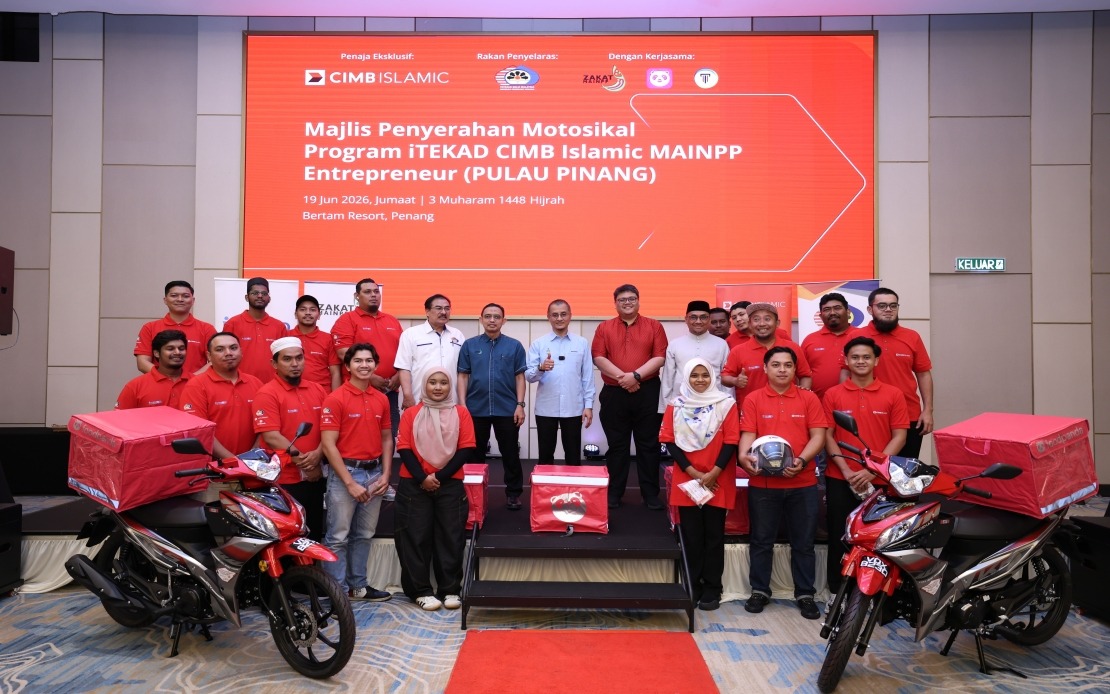
An entrepreneurial initiative in Penang has distributed motorcycles to twenty carefully selected participants as part of a broader effort to improve livelihoods within the asnaf community through structured employment and sustainable income pathways. The handover ceremony took place at Bertam Resort in Kepala Batas, marking a milestone in the iTEKAD CIMB Islamic-MAINPP Entrepreneur programme, which represents a collaborative approach to addressing poverty and economic vulnerability in the state.
The scheme emerged from a strategic partnership involving CIMB Islamic Bank Berhad and Penang Islamic Religious Council (MAINPP), coordinated through Zakat MAINPP. Supporting the initiative are implementation partners including the Malaysian Youth Foundation (YBM), Taylor's Community, and foodpanda Malaysia, each contributing specialised expertise to ensure comprehensive participant support beyond the provision of physical assets. This multi-stakeholder model reflects a recognition that sustainable poverty alleviation requires coordinated effort across financial institutions, religious authorities, development organisations, and private sector entities.
According to Penang Deputy Chief Minister I Datuk Dr Mohamad Abdul Hamid, who also serves as MAINPP president, the programme extends well beyond merely handing over vehicles. Recipients benefit from structured training in fundamental financial management, employment discipline, and entrepreneurial skills designed to enable them to conduct income-generating activities with greater organisation and professionalism. The motorcycles themselves serve as productive assets that facilitate delivery-based work, with foodpanda equipment provided to participants enabling immediate engagement in the gig economy and delivery sector.
The financial architecture supporting this initiative reflects a matching grant model totalling RM400,000. CIMB Islamic Bank Berhad contributed RM200,000 from its Wakalah Zakat fund, while Bank Negara Malaysia provided an equivalent RM200,000 commitment. This dual funding structure demonstrates institutional confidence in the programme's potential impact and represents a meaningful public-private collaboration in deploying zakat funds for economic empowerment rather than purely consumptive assistance.
The selection process itself was rigorous, beginning with 151 initial applications from interested asnaf participants. Candidates progressed through structured screening including formal interviews and a residential Entrepreneurship Camp conducted from May 31 to June 3, 2026, during which applicants underwent intensive training and were evaluated against multiple criteria. The forty-day bootcamp model allowed programme organisers to assess participants' commitment, learning capacity, and genuine entrepreneurial potential before making final selections.
For Malaysian readers and policy observers, the significance of this programme lies in its demonstration of how zakat funds—traditionally conceived as charitable disbursements—can be repositioned as catalytic capital for economic mobility. Rather than functioning as temporary relief, the motorcycles and accompanying training aim to establish sustainable income streams, potentially enabling participants to transition from aid dependency to self-sufficiency. This aligns with evolving thinking about effective poverty reduction in Southeast Asia, where asset transfers combined with skills development have shown stronger long-term outcomes than cash transfers alone.
Datuk Dr Mohamad emphasised that the programme's design reflects an understanding that asnaf development cannot be achieved through isolated interventions. The collaboration demonstrates how expertise must flow across institutional boundaries—from banking and religious authorities to youth development and logistics companies—to address the multifaceted challenges facing vulnerable populations. This integrated approach contrasts with more fragmented charitable efforts and suggests a model that other states and cities in Malaysia might adapt.
The initiative also connects to broader state-level policy objectives, particularly the Penang Islamic Religious Development Agenda 2030 (APAI2030), which positions economic empowerment as integral to holistic community development. Beyond immediate income generation, the programme frames participant success as contributing to educational advancement, family stability, and youth engagement—outcomes that extend across multiple dimensions of human development rather than remaining narrowly economic.
The tangible provision of motorcycles and delivery equipment serves symbolic and practical purposes simultaneously. For participants, these assets represent institutional confidence in their capacity to succeed, communicating that they have been deemed worthy of substantial investment. Practically, the motorcycles immediately enable participation in the growing delivery economy, where demand from e-commerce platforms and food delivery services continues expanding across Malaysia and the region. Participants equipped with vehicles and foodpanda training can begin generating income within days rather than months.
Looking at implications for the broader Malaysian context, this programme suggests how religious authorities can partner with development organisations and financial institutions to operationalise zakat in ways that address root causes of poverty rather than merely symptoms. As Malaysia continues grappling with urban poverty and employment challenges particularly affecting young people, models that combine capital provision with skills training and institutional support may prove increasingly valuable.
The programme also reflects recognition within Malaysia's Islamic finance sector that social responsibility and profit motives need not conflict. CIMB Islamic Bank's commitment of zakat funds to this initiative demonstrates how Islamic banking institutions can direct Shariah-compliant returns toward poverty alleviation while supporting market-based solutions involving foodpanda and delivery services. This hybrid approach—combining charitable zakat with participation in the platform economy—offers a pragmatic pathway for vulnerable populations to access income opportunities.
For the twenty programme participants, the motorcycles represent more than vehicles; they constitute entry points into structured employment and entrepreneurial activity. Combined with ongoing mentorship from implementation partners, the motorcycles enable these individuals to build demonstrable work records, develop business experience, and potentially establish platforms for further economic advancement. If the programme succeeds in its stated objectives, participants may graduate from supported positions to independent entrepreneurship or formal employment.