Deputy Prime Minister Datuk Seri Dr Ahmad Zahid Hamidi has called on Malaysian Muslims to draw inspiration from the achievements of this year's Tokoh Maal Hijrah award recipients, saying their recognition underscores the importance of lifelong learning and community service within the Islamic tradition. Speaking in the wake of the awards ceremony held at Masjid Putra in Putrajaya, Ahmad Zahid stressed that the honours bestowed on the laureates should galvanise the broader Muslim population to embrace similar values of scholarly pursuit and social contribution.
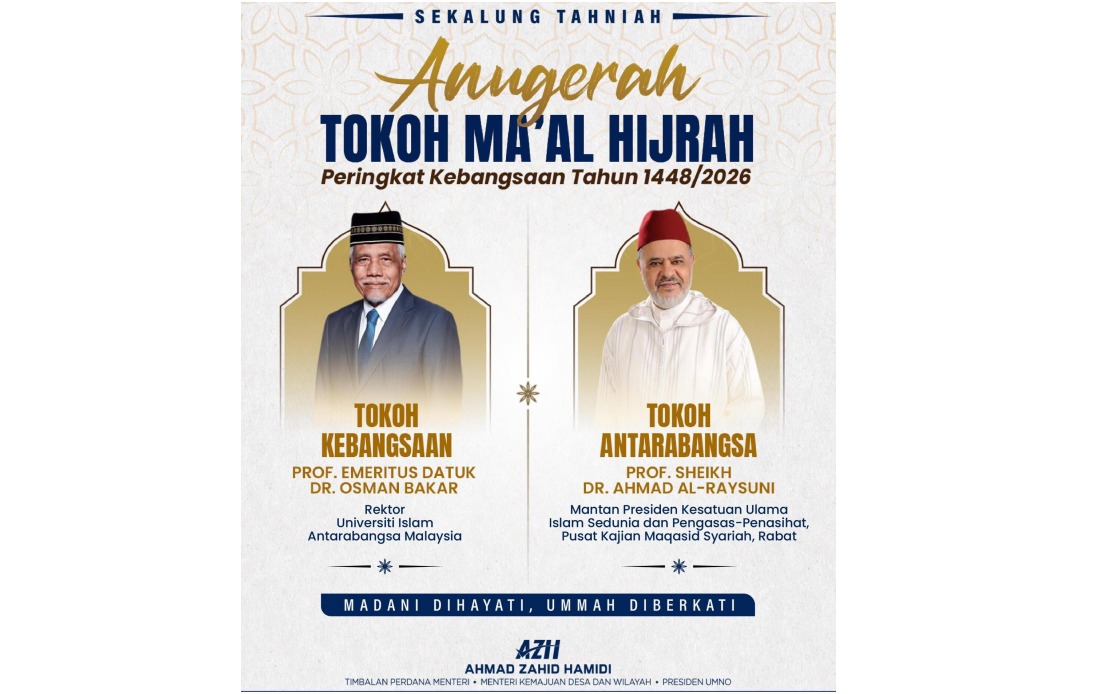
Prof Emeritus Datuk Dr Osman Bakar was named the recipient of the National Tokoh Maal Hijrah Award, while Prof Sheikh Dr Ahmad Al-Raysuni, a prominent Islamic jurisprudence expert from Morocco, claimed the International Tokoh Maal Hijrah Award. The dual recognition highlights Malaysia's commitment to celebrating intellectual achievement and moral leadership both within national borders and on the global stage. Ahmad Zahid emphasised that these recipients exemplify the qualities Muslims should cultivate in themselves—dedication to advancing knowledge, commitment to uplifting their communities, and devotion to strengthening the ummah and Islamic civilisation as a whole.
The selection of winners and presentation of awards took place during Malaysia's national-level Maal Hijrah celebration, an annual commemoration of Prophet Muhammad's migration to Medina, which marked a pivotal moment in Islamic history. The Sultan of Perak, Sultan Nazrin Shah, conferred the honours upon the recipients, presenting them with cash prizes, trophies and certificates of appreciation. This ceremonial recognition reflects the significance placed on individuals who have demonstrated exemplary contributions to Islamic scholarship and community welfare.
Ahmad Zahid's remarks underscore a broader Malaysian perspective on how individual achievement can serve collective advancement. By highlighting the contributions of Osman Bakar and Ahmad Al-Raysuni in empowering the Muslim community and elevating the status of knowledge, he positioned their work as serving wider purposes—spreading Islamic values characterised by mercy, wisdom and societal benefit. The framing suggests that intellectual pursuits within Islamic contexts are not divorced from practical outcomes but are fundamentally linked to improving people's lives and strengthening social cohesion.
Second Deputy Prime Minister Datuk Seri Fadillah Yusof echoed similar sentiments, viewing the awards ceremony as an occasion to motivate all Malaysians—not solely the Muslim majority—to deepen their commitment to national and community development. Fadillah interpreted the Maal Hijrah narrative beyond its historical dimensions, positioning the Prophet's migration as an enduring philosophical framework that encapsulates values such as sacrifice, unity, resilience and unwavering determination to drive constructive change. This reading of Maal Hijrah as a guiding principle rather than merely a commemorative event reflects how Malaysia's political leadership uses Islamic historical narratives to animate contemporary civic ideals.
Fadillah's emphasis on building a progressive, prosperous and values-based society reveals an important tension within Malaysia's governance approach. The administration seeks to demonstrate that Islamic principles and modern development are mutually reinforcing rather than contradictory. By celebrating award recipients who have advanced knowledge and Islamic learning, the government positions itself as championing both spiritual enlightenment and material progress. This messaging carries particular resonance in a Southeast Asian context where some Muslim-majority nations struggle to reconcile religious traditions with rapid modernisation.
The Tokoh Maal Hijrah awards programme itself serves as a vehicle for recognising excellence and leadership within the Islamic intellectual sphere. The establishment of separate national and international categories acknowledges that significant contributions to Islamic thought and community welfare originate both within Malaysia and abroad. Ahmad Al-Raysuni's selection as an international awardee suggests that Malaysia's recognition framework extends beyond its borders, positioning the country as part of a broader Islamic scholarly community and affirming its interest in fostering transnational intellectual connections.
For Malaysian Muslims, the awards carry practical implications beyond symbolic recognition. The call to continue seeking knowledge and serving communities articulated by both Ahmad Zahid and Fadillah provides a normative framework for individual and collective action. In a society where religious identity intersects with multiple dimensions of citizenship, such exhortations from senior political figures carry weight in shaping expectations around Muslim engagement in intellectual, educational and social spheres. The awards thus function as both celebration of past achievement and template for future aspirations.
The timing and venue of the ceremony—a national-level Maal Hijrah celebration at the principal mosque in the federal administrative capital—underscore the state's institutional investment in commemorating and promoting Islamic values. By hosting the event at Masjid Putra and having it presided over by a reigning sultan, Malaysia's leadership ensured that the awards ceremony carried ceremonial weight and institutional gravitas. This approach reflects how Malaysia's constitutional monarchy and Islamic establishments collaborate to shape public discourse around religion and national identity.
In the broader Southeast Asian context, Malaysia's Tokoh Maal Hijrah awards programme exemplifies how Muslim-majority nations attempt to integrate Islamic traditions with contemporary governance frameworks. Unlike some regional neighbours that maintain more formal separation between religious and state affairs, Malaysia's model explicitly positions Islamic achievement as central to national development narratives. This integration carries both advantages—it affirms religious identity within civic life—and complexities, particularly regarding the inclusion of non-Muslim citizens in frameworks primarily articulated through Islamic conceptual language.
The recognition of both Osman Bakar's and Ahmad Al-Raysuni's work demonstrates Malaysia's acknowledgment that Islamic knowledge production extends across disciplinary boundaries. Osman Bakar's scholarship has addressed the intersection of science and Islamic thought, while Ahmad Al-Raysuni's expertise encompasses jurisprudence and Islamic law. By celebrating such diverse contributions, Malaysia's awards programme signals that Islamic excellence is not confined to religious studies narrowly conceived but encompasses intellectual work addressing fundamental questions about knowledge, ethics and society.
Looking forward, the awards scheme will likely continue serving as a platform for identifying and celebrating Muslim leaders whose work aligns with state-articulated values of knowledge advancement and community service. The participation of senior government figures in publicly commending recipients ensures that the awards maintain visibility and perceived importance within Malaysian Muslim circles. Whether the recognition translates into sustained support for awardees' ongoing work or primarily serves ceremonial functions remains an open question, though the cash prizes and institutional prominence suggest some commitment to substantive recognition beyond symbolism.