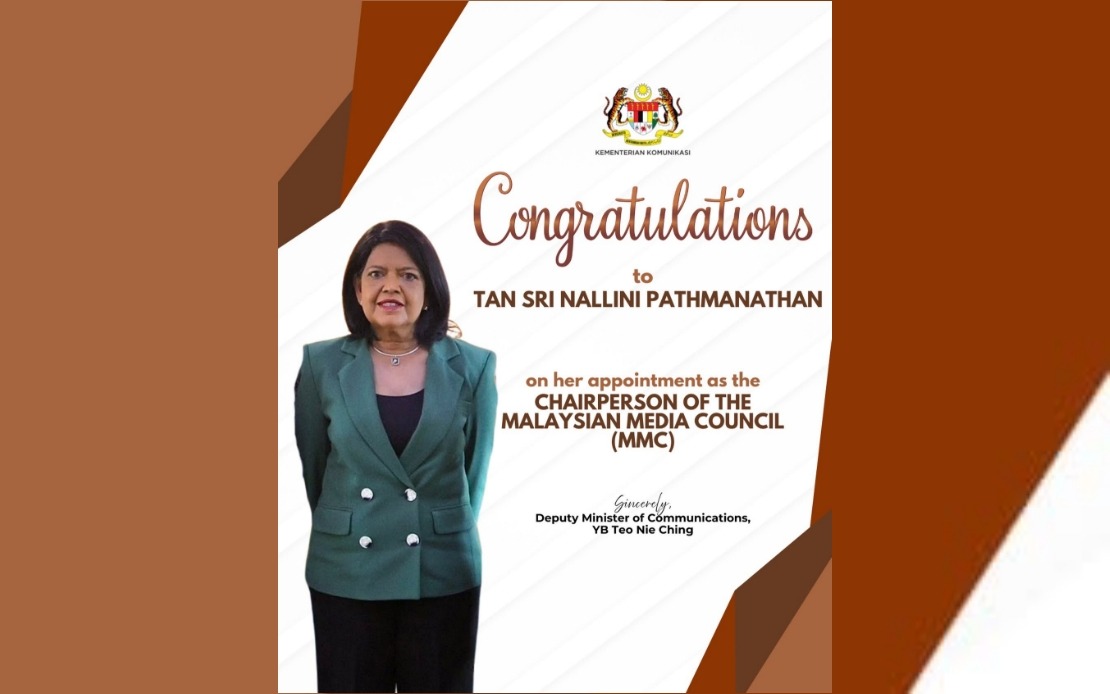
The Malaysian Media Council has appointed former Federal Court judge Tan Sri Nallini Pathmanathan as its chairperson, with Deputy Communications Minister Teo Nie Ching publicly endorsing the decision. Teo released a statement expressing confidence in Nallini's leadership credentials, drawing particular attention to her judicial philosophy and track record on matters relating to media rights and constitutional interpretation during her time on the bench.
Teo's endorsement carries weight in government circles as she highlighted specific judgments that demonstrate Nallini's commitment to nuanced legal reasoning on sensitive matters. In a high-profile citizenship case that divided the Federal Court in a 4-3 split, Nallini authored a dissenting opinion advocating for a purposive and compassionate approach to interpreting constitutional provisions governing Malaysian citizenship for children born to Malaysian fathers and foreign mothers. The judgment showcased her willingness to challenge prevailing interpretations when she believed compassion and constitutional intent warranted it.
Equally significant was Nallini's position in a landmark case concerning online media liability. She ruled that an online news portal should not be held responsible for comments posted by its subscribers, a decision that established important precedent protecting digital publishers from liability for user-generated content. This judgment is particularly relevant to modern media operations across Southeast Asia, where jurisdictions continue grappling with how to regulate online platforms while preserving editorial independence.
The Malaysian Media Council itself represents a watershed moment for the country's media landscape. After fifty years of sustained advocacy, numerous petitions, and policy discussions involving journalism organisations, industry bodies, and civil society groups, the self-regulatory framework finally materialised through the Malaysian Media Council Act 2025. The establishment of this institution reflects broader regional movements towards industry self-governance as an alternative to direct state regulation.
Teo emphasised the philosophical foundation underlying self-regulation in her statement, arguing that journalists occupy a constitutionally significant role as democracy's fourth estate. She contended that government intervention in media operations, regardless of intent, inevitably generates perceptions of suppression and undermines public confidence in press independence. This logic has gained acceptance among policymakers across Southeast Asia who recognise that media credibility depends on demonstrable freedom from state interference.
The self-regulatory model adopted by Malaysia stands in contrast to more interventionist frameworks elsewhere. By placing governance in the hands of industry bodies rather than government agencies, the Malaysian approach attempts to address legitimate concerns about journalism standards and accountability without triggering the credibility damage that typically accompanies state-directed media oversight. For Malaysian newsrooms and publishers, this distinction carries practical implications regarding editorial autonomy and operational flexibility.
Nallini's appointment received unanimous endorsement from the MMC Board at its meeting on May 26, suggesting broad consensus among media industry representatives, publisher organisations, and journalism bodies regarding her suitability for the role. Her judicial background, combined with demonstrated sensitivity to constitutional values and individual rights, positions her to lead an institution required to balance legitimate industry interests against public expectations of responsible reporting.
The timing of the council's establishment reflects evolving attitudes towards media governance across the region. As digital transformation accelerates and new platforms fragment traditional audience patterns, Southeast Asian countries increasingly recognise the inadequacy of legacy regulatory approaches. The Malaysian model of industry self-governance may offer instructive lessons for neighbouring nations wrestling with similar challenges around digital media accountability, subscriber comment moderation, and editorial standards without resorting to government control mechanisms.
For Malaysian newsrooms, the MMC's existence introduces new accountability structures while theoretically providing greater insulation from direct political pressure. Publishers must now operate within a framework established by industry peers rather than ministerial directives. This shift requires journalists and editors to internalise professional standards while understanding that their industry now bears primary responsibility for policing misconduct and maintaining public trust through mechanisms approved by fellow practitioners.
Teo's statement underscores government recognition that media independence serves broader democratic interests. By publicly supporting an appointment based on judicial philosophy rather than political alignment, the deputy communications minister signalled that the administration views the council as genuinely independent. This positioning matters for the council's credibility with international press freedom organisations and regional journalism networks that monitor media environments across Southeast Asia.


