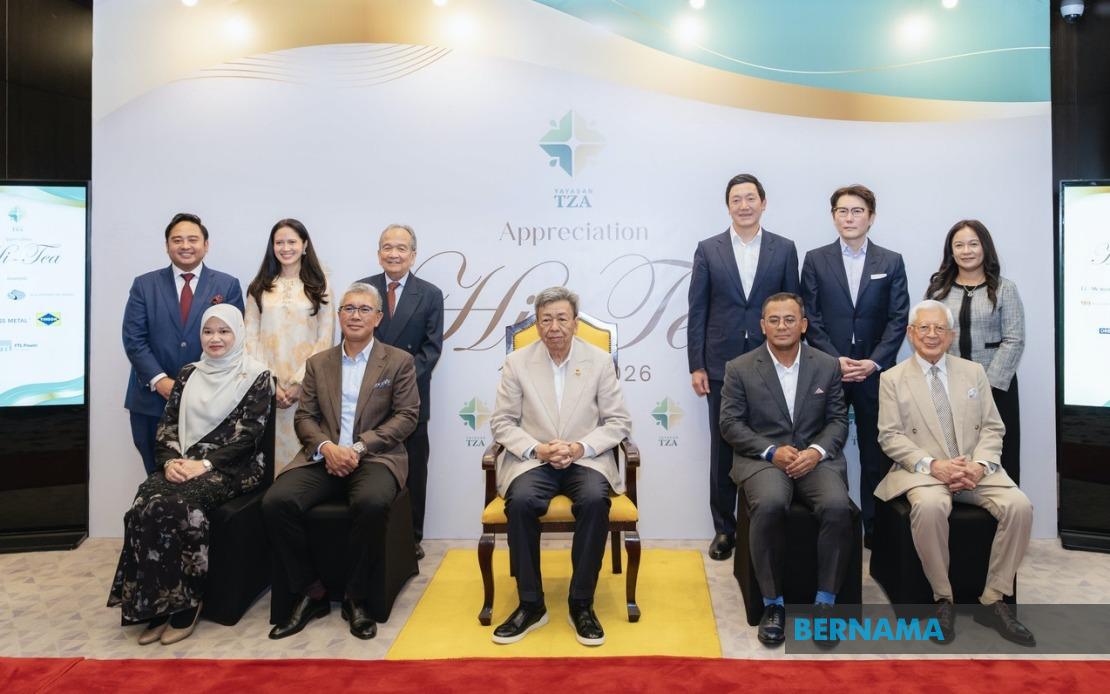
Sultan Sharafuddin Idris Shah, the Sultan of Selangor, attended the Yayasan TZA (YTZA) Appreciation Hi-Tea Ceremony in Kuala Lumpur on June 18, underscoring the royal institution's continued backing for philanthropic work in the state. Arriving at approximately 3.50 pm, His Royal Highness was welcomed by foundation leadership including chairman Tan Sri Arshad Raja Tun Uda and advisor Tengku Datuk Seri Zafrul Abdul Aziz, alongside Selangor Menteri Besar Datuk Seri Amirudin Shari and Education Minister Fadhlina Sidek, highlighting the gathering's significance across government and civil society circles.
Founded to address systemic gaps in Malaysia's social safety net, YTZA has positioned itself as a bridge between corporate resources and vulnerable communities. In his remarks, Tengku Zafrul articulated the foundation's philosophy that effective charitable work must transcend emergency relief to cultivate lasting change. His framing of YTZA's approach—spanning educational enrichment, environmental stewardship, grassroots engagement, and cultural festivities—reflects a holistic understanding of community development that recognises interconnected challenges facing underserved populations. This multifaceted strategy distinguishes YTZA from narrower charitable models and aligns with Malaysia's broader push toward inclusive growth narratives.
The foundation's flagship initiative, ACE SPM, addresses a critical vulnerability in Malaysia's education system: the disparity in examination preparation between affluent and low-income students. By targeting Sijil Pelajaran Malaysia candidates from B40 (bottom 40% income) households, the programme directly tackles educational inequality at a pivotal transition point. During 2025, ACE SPM served 467 pupils across ten Selangor schools, a concentrated but meaningful intervention. Equally significant, YTZA's digital outreach mechanisms extended support to over 4,000 students, suggesting sophisticated use of technology to overcome geographical and economic barriers. This dual-track approach—intensive in-person support combined with scalable digital delivery—represents a contemporary model for philanthropic impact in Malaysia's partially digitised education landscape.
The foundation's plans to substantially expand ACE SPM reflect confidence in the model's efficacy and recognition that demand far exceeds current capacity. Malaysia's education system, whilst free at the primary and secondary levels, contains hidden costs—tuition, coaching centres, and examination materials—that disproportionately burden B40 families. By subsidising or providing these services, YTZA partially compensates for systemic inequalities rooted in household income rather than student ability. The expansion signals that foundation leadership views the programme as addressing a market failure that government subsidy alone has not rectified.
Corporate commitment to YTZA's vision materialised tangibly during the ceremony. Kuok Brothers Sdn Bhd presented a cheque worth RM1 million, whilst YTL Power International Berhad contributed RM300,000, sums that substantially expand the foundation's operational budget. These donations illustrate how Malaysian corporations increasingly view philanthropic engagement as integral to corporate social responsibility and stakeholder relations. The Sultan's formal witnessing of these pledges elevates their symbolic weight, signalling that business contributions to social welfare enjoy royal patronage and, by extension, legitimacy within Malaysia's institutional hierarchy.
YTZA's launch of Larian KITA@Klang—a community fun run scheduled for October 10—anchors the foundation's work within civic celebration and public participation. The fourth iteration of the Larian KITA series, this event merges physical activity, inclusivity messaging, and cultural-culinary tourism around Klang's identity. By tying the run to the Sultan of Selangor's Silver Jubilee commemoration, the foundation strategically links grassroots engagement to marquee state occasions, amplifying visibility and potentially attracting wider participation. For Malaysian communities accustomed to government-organised public events, privately-organised runs framed around social inclusion represent a gradual normalisation of civic activism beyond state channels.
The composition of attendees—spanning the royal household, state executive, federal education ministry, and corporate sector—illustrates how Malaysian social initiatives increasingly function as forums where power networks intersect and legitimacy is mutually conferred. The Sultan's presence validates YTZA's mission; government officials signal alignment with corporate-philanthropic models; and corporations demonstrate commitment to national development narratives. This convergence, whilst generating productive collaboration, also reflects Malaysia's particular political economy wherein substantial social provision remains delegated to civil society rather than expanded state capacity.
YTZA's emphasis on grassroots empowerment rather than dependency-creating handouts mirrors contemporary global best practices in development philanthropy. Tengku Zafrul's articulation of the foundation's commitment to helping communities build futures rather than merely addressing immediate shortfalls suggests an evolution in Malaysian charitable thinking—away from patronage models toward accompaniment and capacity-building frameworks. This reorientation, though rhetorically embedded in traditional language of compassion and resilience, actually represents a substantive shift in how elite institutions conceptualise their relationship to disadvantaged populations.
For Southeast Asian observers, YTZA exemplifies a broader pattern wherein wealthy city-states and regions within large developing nations establish philanthropic mechanisms to manage inequality without fundamentally redistributing wealth or power. Malaysia's rapid urbanisation and economic stratification have created constituencies—particularly B40 families in expanding metropolitan areas—whose aspirations exceed available public services. Foundations like YTZA partly absorb pressure that might otherwise translate into political demands for expanded social spending, effectively privatising solutions to collective challenges. Understanding YTZA's role therefore requires recognising both its genuine impact on individual beneficiaries and its function within Malaysia's particular political settlement.
The foundation's donor base and leadership composition underscore the centralised nature of Malaysian philanthropic capacity. Tengku Zafrul's own profile—scion of Malaysia's industrial elite and Yayasan TZA's namesake—exemplifies how concentrated wealth translates into concentrated influence over social priorities. While individual recipients undoubtedly benefit from ACE SPM and community programmes, the structural limitations of philanthropic approaches become apparent: they can supplement but not supplant systemic reform. For Malaysian policymakers, YTZA's demonstrated capacity to serve thousands of B40 students annually simultaneously illustrates the scale of need that public education budgets alone have not addressed and the inevitability of dependence on private actors for equitable outcomes.


