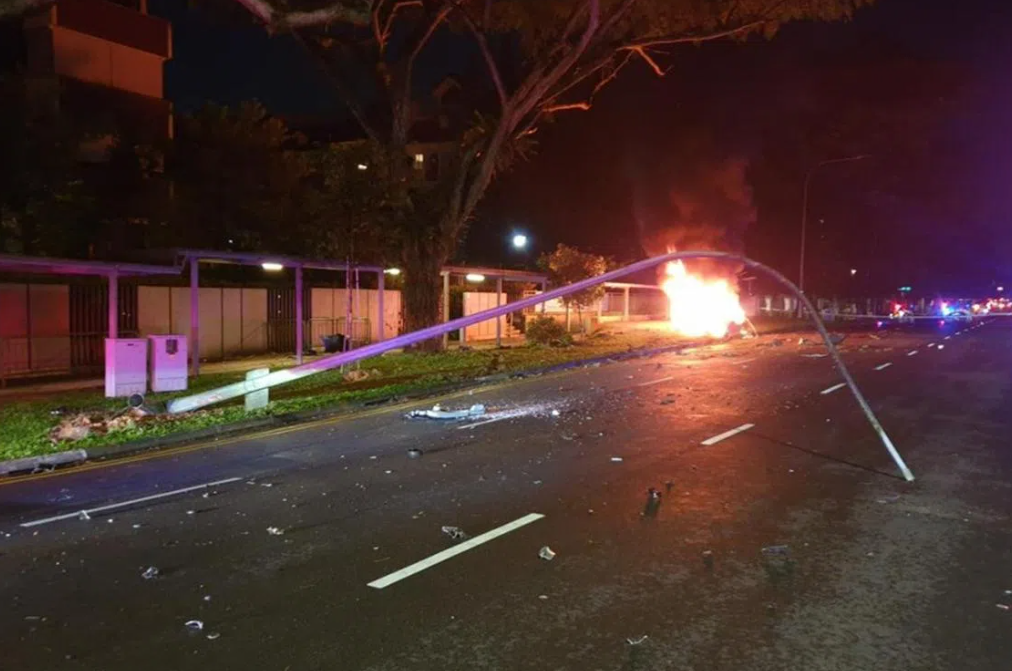
A dangerous early-morning incident on Singapore roads has resulted in serious criminal charges against a 29-year-old driver whose erratic behaviour endangered multiple lives, including two children who were injured in the collision. Aaron Tan Yao Cong appeared in court on Thursday, June 18, to face five separate charges stemming from events that unfolded on March 6, 2024, when his vehicle careened through traffic at speeds exceeding 114 kilometres per hour before slamming into a private bus near Sixth Avenue and igniting in flames.
The sequence of events that morning reveals a troubling pattern of reckless driving compounded by intoxication. At 5:50 a.m., Tan allegedly ignored a traffic sign requiring straight movement along Cavenagh Road toward Bukit Timah Road, instead veering left to drive directly into oncoming traffic. Rather than continuing this dangerous trajectory, he came to a temporary halt on the left side of the two-lane road before suddenly accelerating away, initiating the more catastrophic phase of the incident.
When police officers approached his vehicle at 6 a.m., Tan fled the scene, leading them on a high-speed pursuit that lasted several minutes. Between 6:16 a.m., when he was spotted racing along Bukit Timah Road toward Upper Bukit Timah Road, Tan maintained an average velocity of 114 kilometres per hour whilst weaving dangerously between other vehicles. His reckless manoeuvring continued through congested traffic corridors between Coronation Road and Anamalai Avenue, demonstrating either complete disregard for or impaired awareness of the danger he posed to other road users.
The collision occurred at the junction of Sixth Avenue when Tan allegedly proceeded through a red traffic light and struck a private bus that was executing a U-turn. The impact was severe enough to propel his vehicle into a lamp post, the subsequent damage igniting a fire that engulfed the car. Remarkably, all four occupants of Tan's vehicle—himself and three passengers—managed to escape the burning wreckage without being trapped. However, the bus proved more hazardous for its occupants: the driver and two young passengers, both aged nine and ten, required hospital treatment for injuries sustained in the collision.
Alcohol played a significant role in the incident, with forensic evidence establishing Tan's intoxication at the time of arrest. When detained following the crash, he refused to submit to a breathalyser test at the scene, an act of non-compliance that itself constitutes a criminal offence in Singapore. Subsequent analysis revealed his blood alcohol concentration measured 148 milligrams per 100 millilitres of blood—nearly double the legal limit of 80 milligrams per 100 millilitres. This finding carries particular weight given Tan's prior conviction for drink-driving in 2019, establishing him as a repeat offender in this category.
The comprehensive charge sheet against Tan reflects the multiple dimensions of his culpability. Beyond the foundational charge of drink-driving as a repeat offence, he faces charges of dangerous driving causing hurt, creating a hazardous condition by leaving his vehicle in a dangerous position, failing to cooperate with breathalyser procedures, and driving against the flow of traffic. His refusal to indicate whether he would enter guilty pleas suggests the case will proceed to trial, potentially requiring detailed examination of evidence and witness testimony.
The legal consequences Tan faces are substantial and increase significantly because of his previous conviction. For repeat drink-driving, he could receive up to two years imprisonment and fines reaching $20,000 Singapore dollars. The dangerous driving charge carries potential imprisonment of two years and fines up to $10,000, with repeat offenders facing enhanced penalties of up to two years and $20,000 respectively. Additional charges carry lesser but still serious sanctions: three months imprisonment or $1,000 for the hazardous vehicle positioning offence, and up to six months imprisonment or $5,000 for refusing the breath test, with repeat offenders liable for up to one year imprisonment and $10,000 fines.
Tan's case exemplifies persistent weaknesses in road safety compliance that trouble Singapore authorities and resonate across Southeast Asia. The combination of alcohol impairment, excessive speed, traffic law violations, and failure to cooperate with enforcement represents a cascading series of dangerous decisions that could easily have proven fatal. That young children became victims in this scenario heightens public concern and demonstrates how individual recklessness affects innocent bystanders, particularly vulnerable road users.
For Malaysian readers and drivers across the region, this incident serves as a stark reminder of the cumulative dangers posed by drink-driving. Singapore's legal framework increasingly penalises repeat offenders, yet Tan's prior conviction in 2019 failed to deter similar behaviour. This pattern suggests that legal penalties alone may prove insufficient without complementary strategies addressing underlying compliance attitudes and behaviour change among persistent offenders. The case returns to court on July 16 for further proceedings, with sentencing likely to establish precedent regarding judicial treatment of repeat dangerous driving cases involving child victims.


