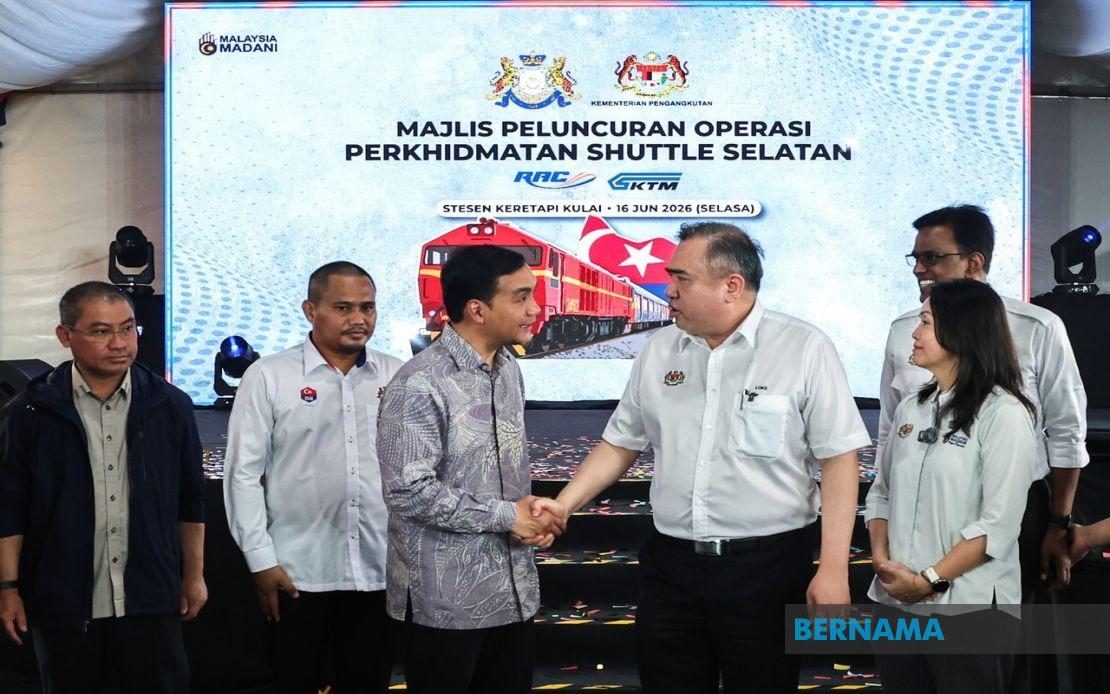
Johor has taken a significant step in addressing its public transport needs with the official launch of the Shuttle Selatan service, a new rail-based shuttle connecting three major areas: Kulai, JB Sentral and Pasir Gudang. The service commenced operations at Kulai KTM station, marking an important development for a state that has experienced rapid economic expansion in recent years. According to Transport Minister Anthony Loke, the initiative is projected to benefit more than two million people across the three zones, reflecting the government's commitment to enhancing regional connectivity.
The inaugural phase of the Shuttle Selatan operates along two primary corridors designed to address commuter demand in the southern Johor corridor. The Kulai-JB Sentral-Kulai route and the Kempas Baru-Pasir Gudang-Kempas Baru route form the foundation of the service, with journey times of approximately 40 to 45 minutes depending on the route. This positioning places the shuttle service as a competitive alternative to private vehicle usage for residents commuting between these three economically significant areas. The relatively quick transit times reflect infrastructure improvements that have prioritised efficiency for daily commuters.
Ambitious expansion plans suggest that the government views this launch as merely the opening chapter of a broader public transport transformation in the region. Anthony Loke outlined intentions to extend the service further, proposing a route that would connect Paloh to Kulai via intermediary stations at Kluang, Renggam and Layang-Layang. This extended corridor would dramatically increase the geographical coverage of the shuttle system, potentially unlocking connectivity for communities currently underserved by efficient public transport options. Such expansion reflects a strategic recognition that Johor's industrial and logistics sectors require seamless movement of workers across a wider geographic footprint.
Beyond the existing and planned routes, the government has committed to establishing three additional stations to broaden accessibility. The proposed stations at Taman Daya, Bandar Baru Sri Alam and Pasir Putih represent targeted investments in residential areas, ensuring that the benefits of rail-based transport reach populations beyond the initial three major hubs. This approach demonstrates a deliberate effort to democratise access to public transport infrastructure, preventing the shuttle service from becoming relevant only to workers in central business districts or major industrial zones.
Recognising that efficient public transport extends beyond the rail network itself, the government has implemented a comprehensive ecosystem of supporting services addressing the crucial first- and last-mile connectivity challenge. Feeder bus services coordinate with the shuttle service to collect and distribute passengers from residential neighbourhoods to station points. Additionally, coordination with Bas.My routes ensures that multiple public transport modalities work in concert rather than competing. Dedicated shuttle services operate from Kempas Baru, while park-and-ride facilities at AEON Bandar Dato' Onn enable drivers to transition from private vehicles to public transport, addressing the practical barriers that often prevent adoption.
To accelerate behavioural change toward public transport usage, authorities have deployed financial incentives through the Commuter MADANI Shuttle Selatan Card. The government distributed 3,000 cards free of charge to eligible Johor residents, with each RM50 card granting unlimited rides on the Shuttle Selatan for a defined period. This direct subsidy approach, backed by a Railway Assets Corporation allocation exceeding RM150,000, acknowledges that price remains a significant determinant in transport choices. By reducing the immediate financial burden on early adopters, the initiative seeks to demonstrate value and build ridership momentum.
For Malaysian readers particularly engaged with economic development, the timing of the Shuttle Selatan launch reflects broader shifts in how rapidly industrialising regions approach urban planning. Johor's emergence as one of Malaysia's fastest-growing states has created demand pressures across industrial, logistics, port, education and trade sectors. These economic drivers require workforces that can move efficiently between residential zones and employment clusters. The shuttle service directly addresses this gap, representing an acknowledgment that infrastructure investments must evolve alongside economic transformation. Without such mobility solutions, rapid growth risks creating congestion and productivity inefficiencies that ultimately constrain further development.
The development also underscores strategic thinking about regional connectivity within Peninsular Malaysia. Johor's geographic position as both a major economic zone in its own right and a gateway to Singapore means that transport efficiency carries implications beyond state boundaries. Enhanced internal connectivity supports Johor's competitiveness in attracting both Malaysian and international investment, while also facilitating cross-border mobility that characterises modern Southeast Asian economic integration. A state with inefficient internal transport systems risks losing competitive advantage to regions offering superior mobility.
The Shuttle Selatan represents collaborative infrastructure development involving multiple government entities. The Ministry of Transport, Keretapi Tanah Melayu Berhad (KTMB), and the Railway Assets Corporation (RAC) combined efforts to deliver the service, with oversight from Johor's state government through Menteri Besar Datuk Onn Hafiz Ghazi and the Public Works, Transport, Infrastructure and Communications Committee. This multi-agency coordination reflects the complexity of modern transport infrastructure, where success requires alignment across operational, financial and policy dimensions.
Looking forward, the success of Shuttle Selatan carries implications for how other Malaysian regions approach public transport development. If the service achieves targets for ridership and operational efficiency, it may establish a replicable model for medium-sized cities and industrial corridors throughout Malaysia. The emphasis on feeder services, last-mile connectivity and user subsidies addresses chronic challenges that have limited public transport adoption in regional areas. Conversely, if execution falters or ridership remains underwhelming, it may prompt reflection on whether current approaches to incentivising modal shift adequately address Malaysian travel patterns and preferences. The coming months will prove instructive for policymakers contemplating similar initiatives elsewhere.


