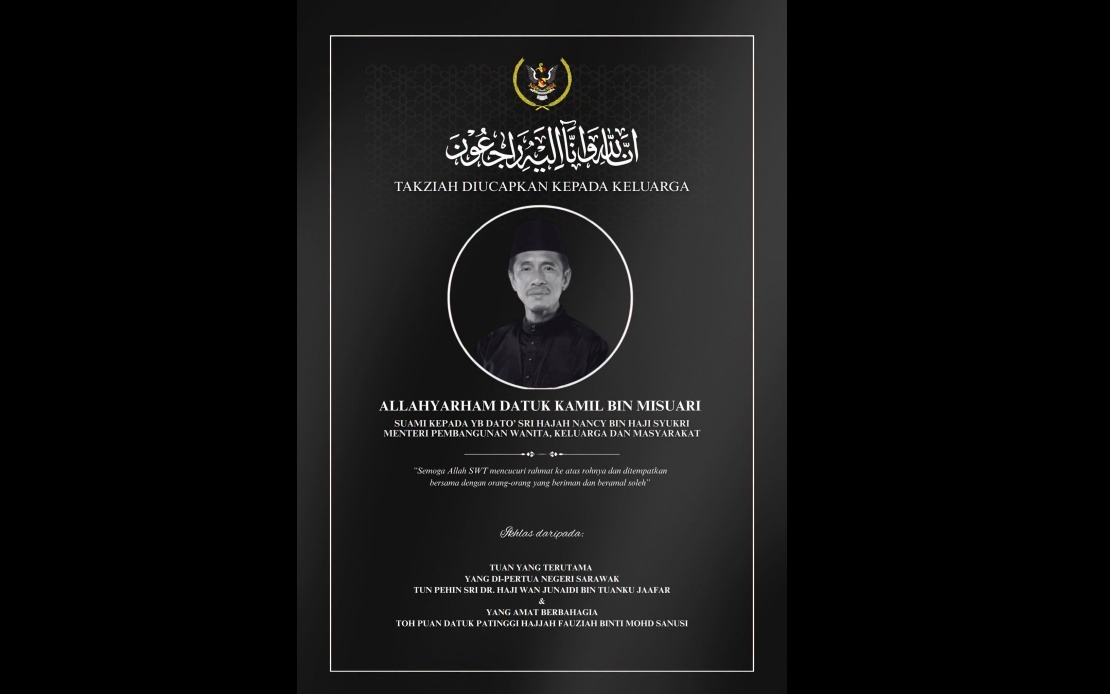
Tun Dr Wan Junaidi Tuanku Jaafar, the Yang Dipertua Negeri Sarawak, has offered his formal condolences to Women, Family and Community Development Minister Datuk Seri Nancy Shukri following the death of her husband, Datuk Kamil Misuari. The prominent figure passed away this evening at a hospital in Kuala Lumpur after what sources indicate was a period of declining health. The passing marks the end of a long marriage that has been central to Nancy's personal life throughout her career in public service.
In an official statement released through Astana Sarawak, the governor and his wife, Toh Puan Fauziah Mohd Sanusi, extended their deepest sympathies and offered prayers for the deceased. The couple invoked blessings upon Kamil's soul, requesting that Allah SWT grant him forgiveness, accept his virtuous deeds throughout his lifetime, and grant him a place among the righteous in the hereafter. Such gestures of spiritual support are customary within Malaysia's high-level political circles and reflect the close bonds maintained between senior government officials across the federation.
The statement further conveyed the governor's wishes that Nancy and her immediate family would find the inner strength and patience necessary to navigate the challenging period of bereavement that lay ahead. The expression of such sentiments by a head of state carries particular weight in Malaysian protocol and demonstrates the respect accorded to Nancy within her own state leadership structures. The governor's intervention also underscores the interconnected nature of Malaysia's political establishment, where news of loss among prominent figures typically generates formal acknowledgements from various quarters of government.
According to an announcement from the Office of the Minister of Women, Family and Community Development, Kamil had been hospitalised in the federal capital before his condition deteriorated. The circumstances surrounding his health situation have not been publicly detailed, though his age of 65 suggests he may have been dealing with age-related medical concerns. His passage after such medical care reflects the unpredictable nature of serious health crises, even when patients receive treatment at major healthcare facilities.
Arrangements have already been made to transport Kamil's remains back to Sarawak, his home state, where final rites will be conducted in accordance with Islamic tradition. His funeral will take place at the Samariang Muslim Cemetery in Kuching, allowing his family, constituents, and professional associates to pay their respects in the setting where he had deep roots. The decision to return him to Sarawak reflects the strong cultural significance of being laid to rest in one's native state and provides an opportunity for the broader Sarawakian community to participate in mourning rituals.
The couple's marriage, which began in 1985, represents nearly four decades of partnership during a period of significant change in Malaysian politics and society. Throughout their union, they were blessed with three children, who now face the reality of losing a parent while their mother manages both personal grief and the demands of holding a ministerial portfolio. Nancy's position as Women, Family and Community Development Minister places her in a particularly visible role within government, making her family circumstances a matter of broader public interest while also testing her personal resilience during this difficult time.
For Nancy specifically, the loss comes at a point in her career where she holds significant responsibility for policy affecting families and community welfare across the nation. Her ministerial work touches on issues ranging from family support systems to women's development programmes, areas where personal experience with familial loss may inform her understanding of the challenges faced by Malaysian families. The irony is not lost that she now joins the many Malaysians who experience bereavement while carrying substantial professional obligations.
Within Sarawak's political landscape, the passing of Kamil represents a notable development given his connection to Nancy, who has been a significant figure in national politics. The state government's formal response through its Yang Dipertua Negeri demonstrates the protocol accorded to families of federal ministers, reflecting the coordination that exists between state and federal leadership regardless of political party affiliation. Such gestures are important elements of Malaysia's Westminster-influenced political culture, where courtesy and acknowledgement of significant life events are considered fundamental to governance.
The broader implications of Nancy's personal loss extend to considerations of how senior female ministers in Malaysia navigate the intersection of family responsibilities and high-level public office. While male politicians have historically managed similar situations, the visibility of Nancy's position means her journey through this grief will likely be subject to greater public scrutiny. The support she receives from various government quarters, including the Sarawak leadership, will serve to reinforce institutional acknowledgement of the human dimensions underlying political office.