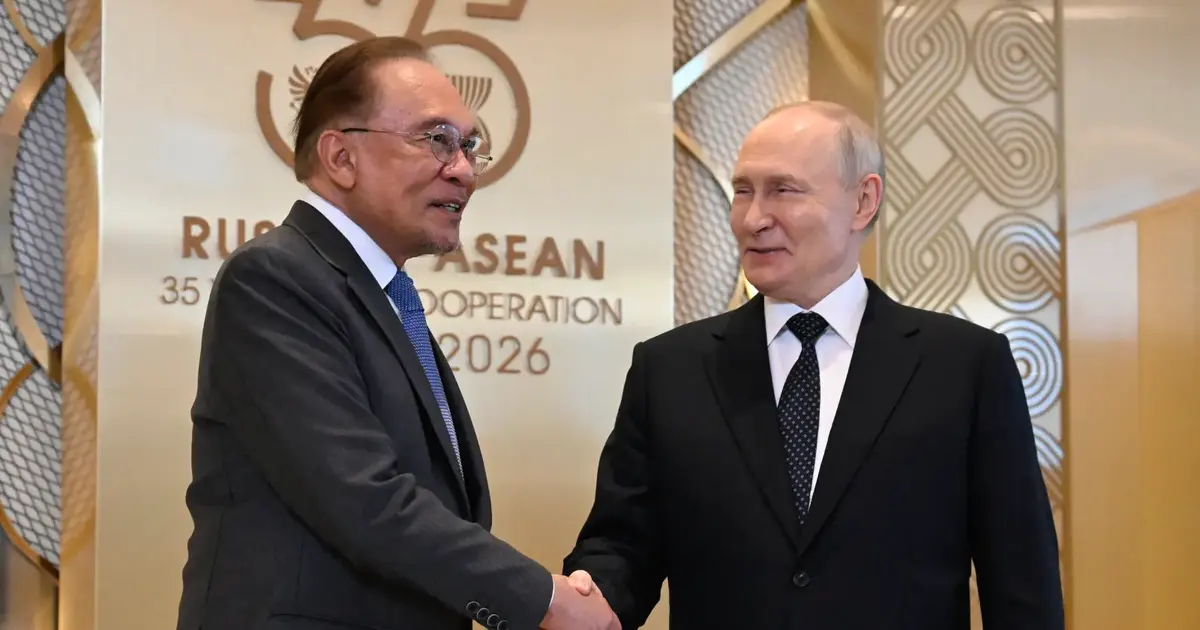
Malaysia has secured a significant energy commitment from Russia, with President Vladimir Putin pledging reliable supplies of oil and gas extending through the next two decades. Prime Minister Anwar Ibrahim disclosed the assurance following high-level discussions between the two nations, marking a strategic reinforcement of Malaysia's energy security amidst evolving global market dynamics and geopolitical shifts affecting resource-dependent economies across Southeast Asia.
The long-term supply agreement represents a substantial backing for Malaysia's energy requirements during a period when the region faces mounting pressure to diversify fuel sources while maintaining economic competitiveness. With energy costs continuing to influence manufacturing competitiveness and inflation trajectories throughout the Southeast Asian bloc, securing predictable supply chains for critical commodities such as hydrocarbons strengthens Malaysia's position in both domestic industrial planning and regional trade negotiations. The 20-year horizon aligns with Malaysia's medium-to-long-term infrastructure and industrial development strategies, providing predictability for power generation facilities, petrochemical complexes, and downstream energy-dependent sectors.
Russia's willingness to extend such guarantees reflects Moscow's broader strategic interests in maintaining influence across the Asia-Pacific region, particularly as traditional Western markets impose sanctions and diplomatic isolation. For Malaysia, the arrangement balances energy security imperatives with the nation's carefully calibrated foreign policy stance of maintaining constructive relationships across competing geopolitical blocs. This pragmatic approach has allowed Malaysia to benefit from multiple international partnerships without becoming overly dependent on any single power or coalition.
Beyond energy commerce, Anwar Ibrahim emphasized that his diplomatic engagements encompass expanded commercial ties with the region's largest economies. Turkmenistan, designated as the specific focus of the Prime Minister's visit, serves as a strategic hub connecting Central Asian resources with Asian markets, making it a logical waypoint for Malaysian trade initiatives. The nation's position along crucial transit routes for energy and manufactured goods makes bilateral cooperation particularly valuable for Malaysian exporters seeking to penetrate markets across the Eurasian landmass.
Malaysia's targeted focus on China, Japan, and South Korea reflects sophisticated calculation regarding where growth opportunities and complementary demand structures exist. China's massive manufacturing base and infrastructure development programmes create sustained demand for Malaysian commodities, intermediate goods, and specialised components. Japan's mature economy presents opportunities in high-value manufacturing, technology transfer, and premium consumer products, while South Korea's dynamic industrial sector offers partnership prospects in semiconductor supply chains and advanced manufacturing.
The timing of these trade initiatives coincides with Malaysia's broader economic repositioning following pandemic-related disruptions and shifting global supply chain patterns. Companies worldwide have accelerated nearshoring and friendshoring initiatives, prompting Malaysia to strengthen its position as a reliable alternative supplier to more traditional sources. Deepening commercial connections with major Asian economies supports this repositioning by establishing frameworks for preferential access and closer integration within regional production networks.
Anwar Ibrahim's multi-dimensional approach to international engagement—simultaneously addressing energy security while pursuing export expansion—demonstrates Malaysia's determination to enhance economic resilience through diversified partnerships. Rather than viewing these initiatives as competing priorities, the government clearly sees them as complementary elements of a coherent development strategy. Securing energy supplies enables sustained economic growth, which in turn creates the productive capacity necessary for meaningful export expansion to sophisticated Asian markets.
The diplomatic initiatives also carry implications for Malaysia's positioning within regional economic blocs and frameworks. Enhanced trade relationships with China, Japan, and South Korea strengthen Malaysia's hand in various ASEAN-led negotiations and free trade discussions. Countries demonstrating strong bilateral connections with major powers gain greater leverage in shaping regional standards, commercial rules, and investment frameworks that benefit their own enterprises.
Furthermore, these developments underscore Malaysia's successful navigation of complex international relationships at a time when many smaller nations face pressure to align explicitly with one geopolitical camp or another. By maintaining constructive engagement across different power centres—securing Russian energy commitments while simultaneously expanding trade with American-aligned Japan and South Korea—Malaysia preserves strategic flexibility and maximises access to resources and markets.
For Malaysian businesses, particularly those in export-oriented sectors, the expanded framework for engagement with major Asian economies opens concrete opportunities for market access and partnership development. Government-to-government agreements typically pave the way for private-sector participation, trade financing arrangements, and regulatory harmonization that facilitate commercial exchanges. Malaysian firms in petrochemicals, electronics, palm-based products, and electrical machinery stand to benefit from improved market access and reduced trade friction resulting from strengthened bilateral relationships.
The energy security dimension carries particular significance given Malaysia's own substantial oil and gas reserves, which remain important for domestic consumption and export revenue. While Malaysia possesses considerable hydrocarbon resources, the nation faces long-term depletion trajectories for certain reserves and benefits from maintaining diverse sourcing options. Access to Russian supplies provides strategic insurance against supply disruptions from other regions and creates additional leverage in international energy markets.
These diplomatic and commercial initiatives reflect the strategic maturity Malaysia has demonstrated in international affairs. Rather than viewing energy security and export expansion as separate challenges, policymakers have integrated them into a cohesive strategy that advances multiple national objectives simultaneously. The results—two-decade supply assurances coupled with expanded market access in key Asian economies—position Malaysia to address both immediate economic requirements and longer-term structural development goals.
%22%2F%3E%3C%2Fpattern%3E%3C%2Fdefs%3E%3Crect%20width%3D%22100%25%22%20height%3D%22100%25%22%20fill%3D%22url(%23ph1cimrg)%22%2F%3E%3Crect%20width%3D%22100%25%22%20height%3D%22100%25%22%20fill%3D%22url(%23ph1cimrp)%22%2F%3E%3Ctext%20x%3D%2250%25%22%20y%3D%2250%25%22%20text-anchor%3D%22middle%22%20dominant-baseline%3D%22central%22%20fill%3D%22rgba(255%2C255%2C255%2C0.95)%22%20font-family%3D%22Georgia%2C%20'Times%20New%20Roman'%2C%20serif%22%20font-weight%3D%22700%22%20font-size%3D%22194%22%20letter-spacing%3D%22-0.02em%22%3ETakaful%3C%2Ftext%3E%3C%2Fsvg%3E)