Thailand's violence-plagued southern border region experienced a sharply escalated security crisis on Friday, June 19, when militants orchestrated two separate bombings targeting police personnel within hours of each other. The dual attacks, which struck communities in Yala and Pattani provinces, underscored the persistent challenges facing Thai authorities in containing insurgent activity in the Muslim-majority deep south, where a two-decade-old separatist conflict continues to claim lives and destabilise civilian communities.
The first bombing occurred at 8.10 am along the Ban Pulo Saniyae–Ban Sakai road in Thanto district, Yala province, where a group of attackers detonated an explosive device targeting a border patrol police unit responsible for protecting teachers in the region. The blast injured six officers, with two suffering wounds severe enough to require intensive medical intervention. Among the critically wounded, Corporal Kittisak Saksang sustained facial lacerations from shrapnel fragmentation, whilst his colleague Corporal Poraphat Wongruaydee experienced traumatic chest compression and temporary loss of mobility, though he remained conscious throughout initial treatment.
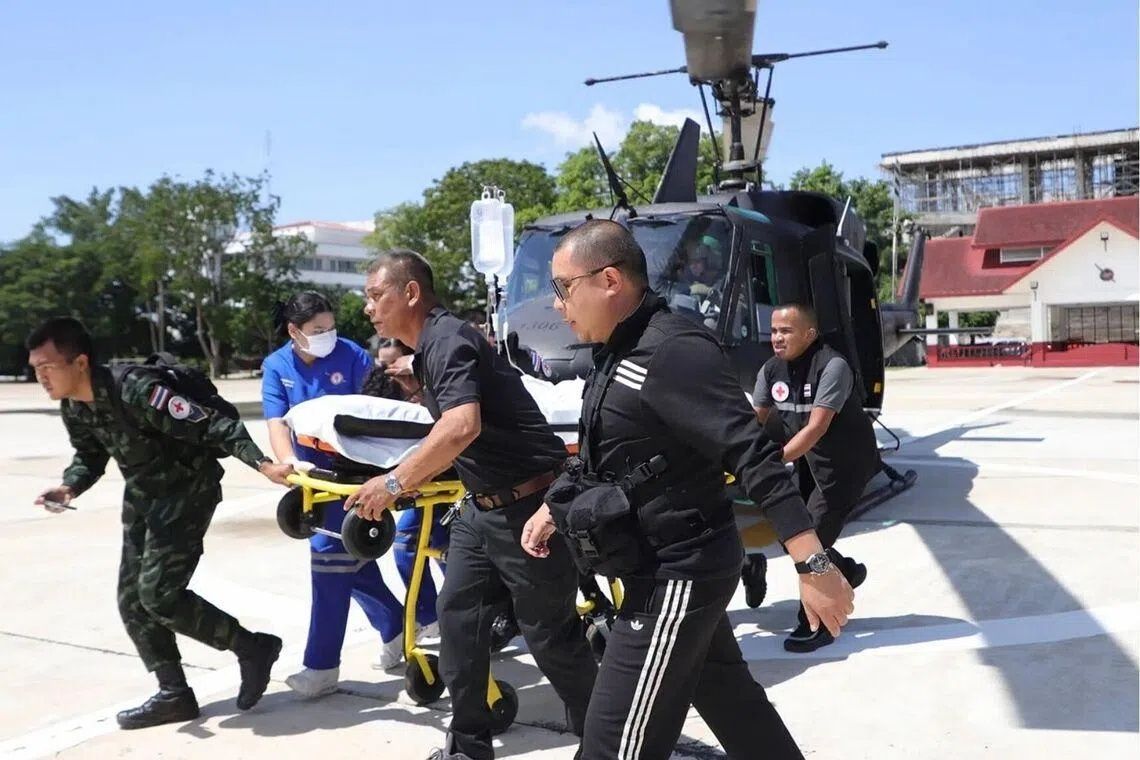
The immediate response saw all six injured officers transported to Thanto Hospital, a facility with limited trauma capabilities. Recognising the severity of Wongruaydee's condition, medical personnel rapidly arranged helicopter evacuation to Yala Regional Hospital, a tertiary centre equipped for complex surgical cases. Hospital officials subsequently disclosed that Wongruaydee required emergency thoracic surgery to drain blood accumulating within his pleural cavity and to repair pulmonary tissue damaged by the blast. The critical nature of his injuries prompted an urgent regional appeal for blood donations of all types, highlighting the severe physiological trauma inflicted by the explosion.
The incident's aftermath triggered standard protocol responses: explosive ordnance disposal specialists conducted comprehensive scene investigation, forensic teams collected evidence, and security personnel established expanded perimeters to prevent further violence. Such measures have become routine in Thailand's restive border zones, where attacks targeting security personnel represent a recurring tactic employed by anti-government militant groups seeking to undermine state authority and create public fear.
Just over three hours later, at 11.30 am on the same day, a second explosion struck the Pattani Police Special Operations unit at Ban Khuan Yi in Mayo district, Pattani province. This attack targeted a tactical unit that had been establishing security checkpoints in the vicinity. The timing appeared carefully coordinated, suggesting possible communication between attack cells or operational planning designed to stretch emergency response capabilities across multiple districts simultaneously. Five officers—Sergeants Anuchit, Bunyawat, Wisitphon, Aphisit and Sumit—sustained injuries from blast-induced chest trauma and were transported to Mayo Hospital for ongoing treatment.
The cumulative toll of the day's violence reached eleven police personnel injured across two provinces, representing a significant operational impact on Thai security forces already stretched across vast geographical terrain. The injuries clustered around blast trauma affecting respiratory systems and fragmentation wounds, injuries consistent with improvised explosive devices commonly employed by southern insurgent groups. Both incidents occurred in districts with documented militant activity histories, suggesting attackers selected targets aligned with established threat profiles.
These bombings reflect persistent challenges confronting Bangkok's counterinsurgency strategy in the south. Despite military operations, intelligence gathering, and community-based security initiatives deployed since the insurgency intensified in 2004, militants maintain operational capacity to conduct coordinated attacks against security infrastructure. The teacher protection angle in the first attack carries particular symbolic weight, as educational personnel have historically represented soft targets in the conflict's narrative of resistance against perceived Thai state encroachment on Malay-Muslim identity and autonomy.
For Malaysia, these developments warrant close monitoring given cross-border dimensions of southern Thailand's instability. Militant networks operating across the Thai-Malaysian frontier have historically moved personnel and matériel between jurisdictions, and escalating violence in Yala and Pattani can create refugee flows or security incidents affecting northern Malaysian states including Kedah and Perlis. Malaysian security agencies maintain cooperative arrangements with Thai counterparts, but porous borders and sympathetic populations in northern Malaysia occasionally complicate bilateral enforcement efforts.
Regional observers note that such attacks often precede or follow particular political developments or negotiation cycles in Thailand's long-running peace process. Understanding the tactical messaging behind coordinated bombings requires consideration of broader political contexts, including government transition periods, military reorganisations, or fluctuations in separatist group cohesion. The June 19 attacks' apparent sophistication—simultaneous targeting of multiple units—suggests organisational capacity rather than spontaneous or opportunistic violence, potentially indicating either renewed militant coordination or factionalism within insurgent movements.
Authorities have cordoned affected areas and initiated investigative procedures aimed at identifying perpetrators and constructing legal cases. However, the southern conflict's complex character—involving multiple armed groups, political grievances, economic marginalisation, and ethno-religious dimensions—means that conventional law enforcement responses often prove insufficient for addressing underlying drivers of violence. Long-term stability in Yala and Pattani provinces will likely require complementary approaches combining security operations with sustained developmental investment and political dialogue addressing separatist groups' articulated concerns regarding autonomy and cultural recognition within Thailand's national framework.
%22%2F%3E%3C%2Fpattern%3E%3C%2Fdefs%3E%3Crect%20width%3D%22100%25%22%20height%3D%22100%25%22%20fill%3D%22url(%23ph29wsrg)%22%2F%3E%3Crect%20width%3D%22100%25%22%20height%3D%22100%25%22%20fill%3D%22url(%23ph29wsrp)%22%2F%3E%3Ctext%20x%3D%2250%25%22%20y%3D%2250%25%22%20text-anchor%3D%22middle%22%20dominant-baseline%3D%22central%22%20fill%3D%22rgba(255%2C255%2C255%2C0.95)%22%20font-family%3D%22Georgia%2C%20'Times%20New%20Roman'%2C%20serif%22%20font-weight%3D%22700%22%20font-size%3D%22272%22%20letter-spacing%3D%22-0.02em%22%3EAnwar%3C%2Ftext%3E%3C%2Fsvg%3E)