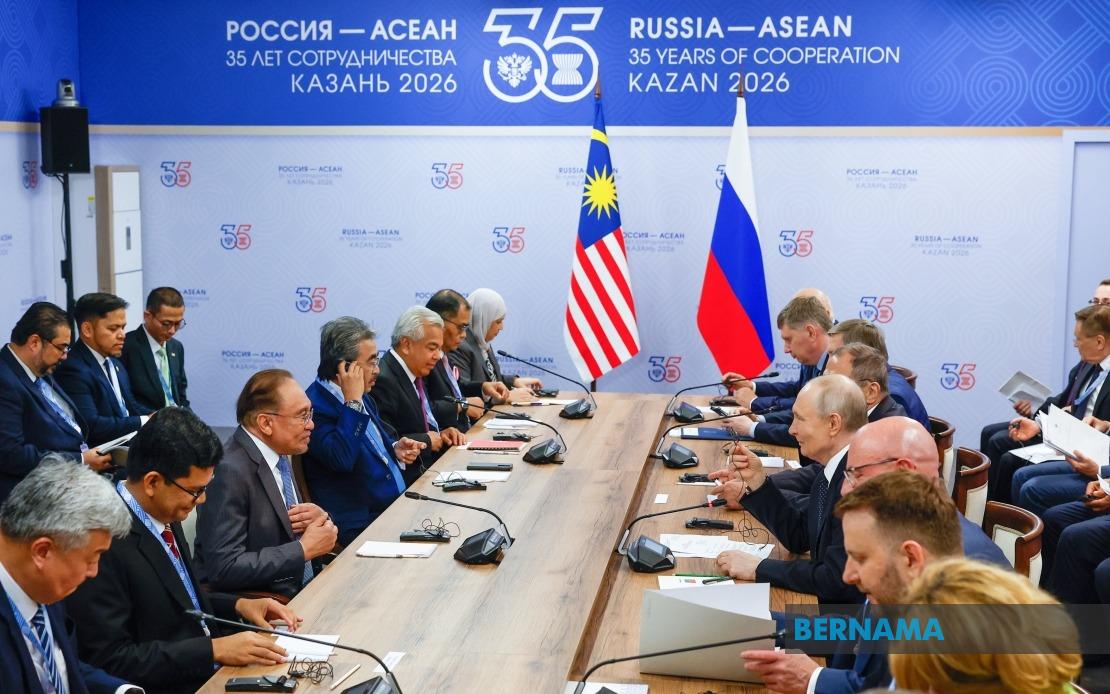
Russian President Vladimir Putin has signalled Russia's readiness to deepen its strategic partnership with Malaysia, emphasising the solid groundwork both nations have laid for expanded bilateral engagement. Speaking during talks with Malaysian Prime Minister Datuk Seri Anwar Ibrahim at the ASEAN-Russia Commemorative Summit in Kazan on June 18, Putin highlighted that the relationship has matured substantially and is positioned for meaningful growth in the coming years.
The timing of Putin's remarks carries symbolic weight, as 2025 marks the 60th anniversary of formal diplomatic relations between Moscow and Kuala Lumpur. Putin characterised their approach to this milestone as grounded in "substantive positive experience," suggesting that decades of accumulated trust and working relationships provide a foundation for moving beyond ceremonial engagement toward concrete practical cooperation. This framing indicates that both governments view the anniversary not merely as a historical marker but as an inflection point for accelerating joint initiatives.
The infrastructure underpinning the bilateral relationship extends across multiple channels. Regular high-level ministerial contacts, parliamentary exchanges, and the work of an intergovernmental commission dedicated to economic, scientific, technical and cultural projects ensure that cooperation remains structured and goal-oriented. This institutional apparatus has proven effective in translating political will into tangible outcomes, allowing both nations to pursue shared interests without the friction that sometimes characterises less formalised partnerships.
Economic data underscores the growing commercial dimension of the relationship. Bilateral trade expanded by 12.9 per cent during 2025, a performance Putin cited as evidence of the partnership's vitality. For Malaysia, which maintains carefully calibrated relationships across the major powers, this growth trajectory presents opportunities to diversify trading partners and deepen economic interdependence with Russia at a time when global supply chains are being reshaped by geopolitical realignments. Russian interest in Malaysian commodities and services, coupled with Malaysian demand for Russian energy and industrial goods, creates natural complementarities that transcend political considerations.
Beyond commerce, Putin stressed Russia's commitment to collaboration in education, science, technology, and tourism. These softer dimensions of bilateral engagement serve multiple purposes: they facilitate knowledge transfer, build people-to-people connections that transcend governmental shifts, and create constituencies in both nations invested in maintaining good relations. For Malaysia's scientific and educational institutions, partnerships with Russian counterparts offer access to research capabilities and academic traditions that broaden intellectual horizons. Reciprocally, Russian institutions benefit from engagement with Southeast Asia's dynamic and increasingly sophisticated knowledge sectors.
Malaysia's role within ASEAN adds diplomatic leverage to its relationship with Russia. Putin explicitly acknowledged Malaysia's contributions to strengthening the Russia-ASEAN strategic partnership, particularly referencing Malaysia's stewardship of the inaugural 2005 Russia-ASEAN summit meeting. This recognition underscores that Malaysia functions not only as a bilateral partner to Russia but as a crucial bridgehead to the broader Southeast Asian region. As ASEAN members navigate the complex task of maintaining equidistance among competing great powers, Malaysia's willingness to facilitate closer Russia engagement signals that Moscow retains strategic importance in regional calculations.
Putin's personal dimension to the engagement—recalling previous meetings with Anwar in Malaysia and extending best wishes to His Majesty Sultan Ibrahim, King of Malaysia—reflects diplomatic courtesy but also signals continuity in leadership and stability in relations. Such gestures, while ceremonial in appearance, reinforce the notion that Russia-Malaysia relations transcend any single administration and rest on institutional foundations capable of weathering leadership transitions.
For Malaysia, cultivating this partnership requires careful navigation. The Southeast Asian nation has long sought to maintain balanced relations with major powers, avoiding exclusive alignments while extracting maximum benefit from each relationship. Russian engagement offers potential advantages in energy security, agricultural cooperation, and defence ties without the geopolitical complications that sometimes accompany partnerships with Western powers or neighbouring China. Moreover, Malaysia's Muslim-majority population and significant historical ties to Middle Eastern and Islamic-world politics provide it with perspectives and interests that resonate with Russian foreign policy objectives in an increasingly multipolar international system.
The emphasis on "mutual respect and consideration of interests"—language Putin employed to characterise the partnership's foundational principles—suggests both nations recognise the importance of acknowledging legitimate security concerns and strategic priorities rather than seeking to subordinate one party's interests to another. This approach proves particularly valuable when nations possess divergent geopolitical orientations or face pressure from competing great power blocs to choose exclusive allegiances.
Looking ahead toward 2025's 60th anniversary celebrations, both Russia and Malaysia appear intent on marking the occasion with substantive achievements rather than ceremonial gestures alone. The growth in bilateral trade, expansion of educational and scientific exchanges, and deepening of defence relations could collectively demonstrate that the partnership has matured into a relationship of genuine strategic significance rather than peripheral importance. For Malaysian policymakers, such developments reinforce the credibility of Malaysia's non-aligned positioning and its capacity to extract concrete benefits from relationships with distant great powers.
The broader context of Russia-Southeast Asia relations suggests that Putin's remarks about Malaysia reflect a wider Russian strategy to maintain and strengthen partnerships across the region during a period of intense great power competition. As the United States, China, and India compete for influence in Southeast Asia, Russia's patient cultivation of relationships with ASEAN members—facilitated through trusted interlocutors like Malaysia—positions Moscow to participate meaningfully in regional affairs and maintain strategic relevance beyond its immediate geographic sphere. Malaysia's reciprocal openness to deepening this partnership indicates that Russian overtures find receptive audiences among Southeast Asian elites who value strategic autonomy and resist pressure toward exclusive alignment.