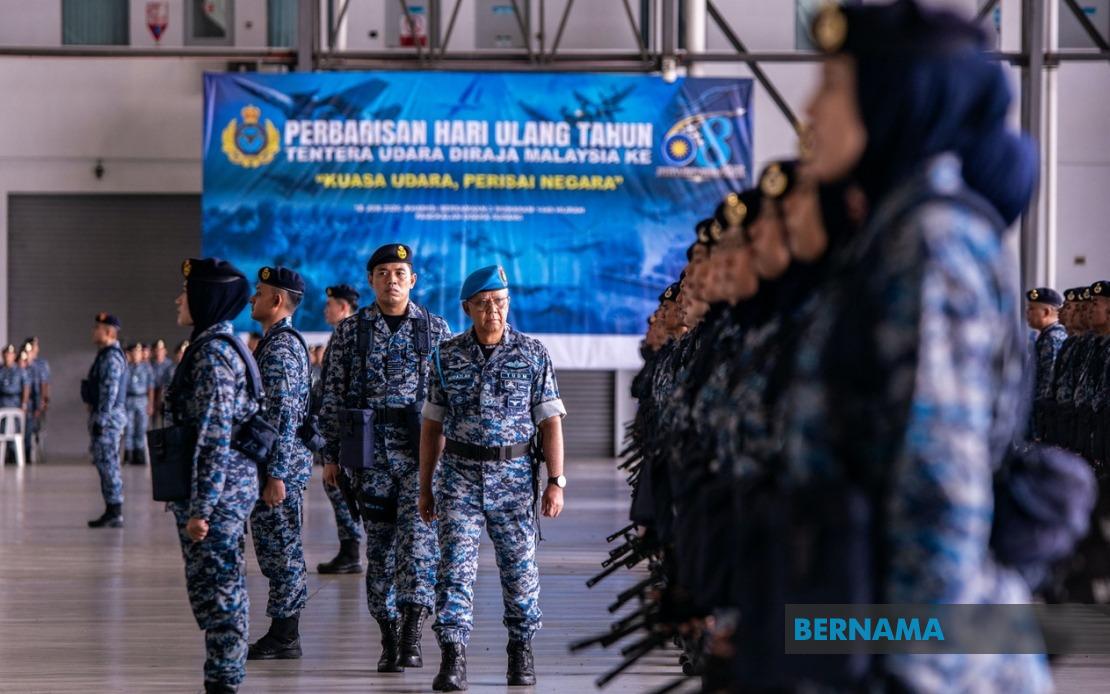
Malaysia's air defence posture is undergoing a significant upgrade as the Royal Malaysian Air Force rolls out a comprehensive radar deployment programme spanning multiple regions. The initiative, unveiled during the RMAF's 68th Anniversary Parade in Subang, reflects a broader strategic effort to modernise the nation's surveillance infrastructure and strengthen its capacity to detect and respond to emerging threats across its vast airspace and maritime domains.
Chief of Air Force General Tan Sri Muhamad Norazlan Aris outlined the deployment of air defence radar systems at three terrestrial locations: Bintulu in Sarawak, Bukit Puteri in Terengganu, and Bukit Lunchu in Johor. Complementing these ground-based installations, the air force is simultaneously establishing an air surveillance radar capability on Pulau Layang-Layang in the South China Sea, creating a layered detection network that extends Malaysia's situational awareness across contested and strategically vital waters.
These infrastructure investments form the cornerstone of Phase One under the RMAF Capability Development Plan 2055, an ambitious long-term modernisation roadmap designed to position the air force as a technologically competitive force capable of addressing future security challenges. By anchoring current procurement decisions within a 2055 framework, the RMAF is signalling its commitment to sustained capability development rather than ad hoc acquisitions, a discipline that has historically eluded Malaysian defence planning.
The strategic rationale behind the radar network extends beyond conventional air defence. General Muhamad Norazlan emphasised that the new systems will close critical gaps in Malaysia's airspace surveillance, particularly in regions deemed strategically significant to national interests. The emphasis on "early warning detection" underscores the air force's recognition that compressed reaction times are essential in modern aerial operations, where threats can materialise and evolve with minimal notice.
Regional geopolitical turbulence has sharpened Malaysia's focus on defensive capabilities. The ongoing conflict in West Asia, particularly disruptions to shipping through the Strait of Hormuz, has illustrated how distant conflicts can cascade through global supply chains and energy markets with immediate consequences for Malaysia's economy. These developments serve as a cautionary lesson for Malaysian policymakers about the interconnectedness of international security and national prosperity.
Malaysia's dependence on unimpeded maritime passage makes the security of critical sea lanes an existential concern. The Strait of Malacca, which channels roughly a third of global maritime trade and connects the Indian Ocean to the Pacific, remains one of the world's most strategically consequential waterways. Concurrently, the South China Sea continues to witness competing claims and military modernisation by multiple powers, creating an environment where Malaysia must balance national defence requirements against the imperative to maintain peaceful regional relations and freedom of navigation.
The radar installations represent a tangible manifestation of Malaysia's determination to maintain sovereign control over its declared airspace and maritime zones. By establishing monitoring capabilities at strategic points, the RMAF enhances its ability to identify and track aircraft and maritime activities within national jurisdiction, a fundamental prerequisite for effective air defence. The Pulau Layang-Layang installation carries particular significance given its location in the South China Sea, where Malaysia maintains territorial claims and where surveillance gaps have historically complicated efforts to monitor airspace.
Beyond the technical dimensions, the modernisation programme reflects evolving doctrine within the RMAF regarding integrated air and maritime defence. Rather than operating as isolated systems, the distributed radar network will eventually feed into a centralised command and control architecture capable of generating a unified air picture across the nation's operating environment. This integration remains critical for coordinating responses to airspace incursions or maritime security incidents.
The ceremony itself, attracting former air force chiefs and involving 288 military personnel across multiple specialised units, underscored the institutional weight accorded to the capability development agenda. The parade's thematic emphasis, "Kuasa Udara, Perisai Negara" (Air Power, Shield of the Nation), crystallised the RMAF's messaging that air superiority and surveillance capabilities represent essential pillars of national defence. The presentation of service medals to 17 recipients acknowledged the personnel whose operational and developmental contributions support such modernisation initiatives.
From a regional perspective, Malaysia's radar modernisation programme reflects a broader Southeast Asian trend toward enhanced military capabilities and technological sophistication. As tensions mount across multiple flashpoints—from the South China Sea to the Strait of Malacca—countries throughout the region are investing in surveillance, early warning, and air defence systems to protect shipping corridors, monitor territorial claims, and deter potential incursions. Malaysia's programme thus sits within a competitive upgrading dynamic that characterises contemporary Southeast Asian security dynamics.
The phased approach embedded within CAP55 suggests that additional capability enhancements will follow beyond the initial radar deployments. Aircraft acquisitions, air defence weapon systems, and personnel training initiatives are likely forthcoming as the RMAF works toward its 2055 vision. The long-term timeline affords flexibility to adjust modernisation priorities as threat assessments evolve and technological innovations emerge.
For Malaysian civilians and businesses dependent on stable airspace and maritime security, the radar expansion carries practical implications. Enhanced surveillance capabilities should theoretically reduce vulnerability to undetected incursions, transnational organised crime exploiting airspace gaps, or security incidents affecting shipping. However, translating technical capability into operational effectiveness requires sustained investment in personnel training, maintenance protocols, and integrated command structures—dimensions that extend well beyond hardware procurement.


