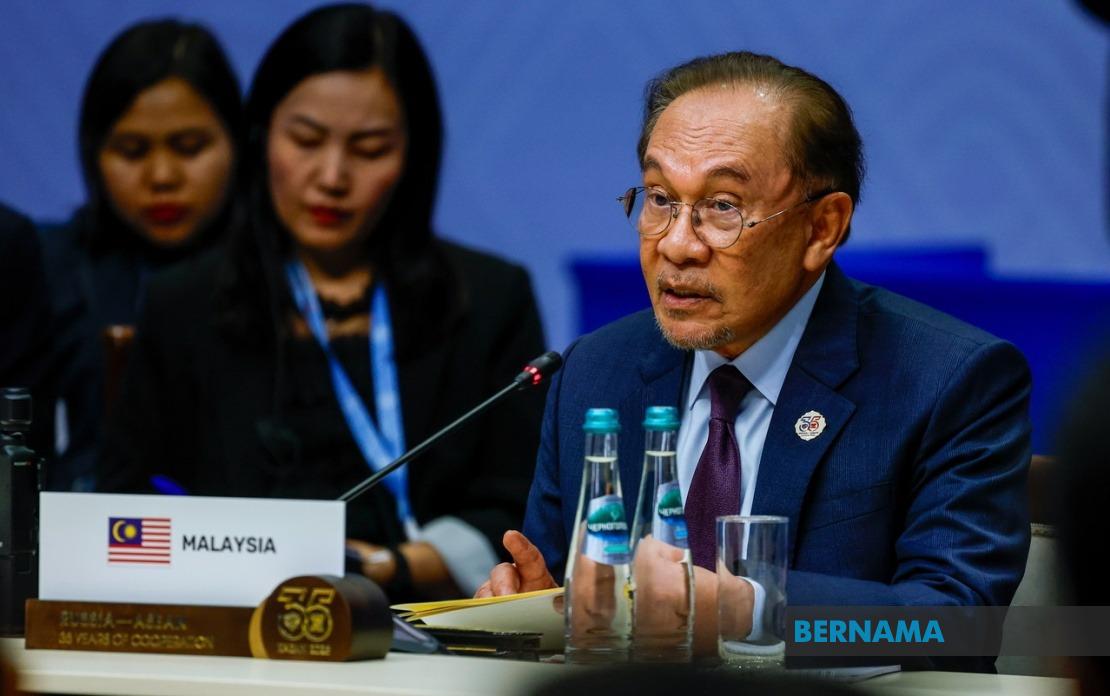
Prime Minister Datuk Seri Anwar Ibrahim has called on ASEAN and Russia to substantially deepen their strategic cooperation across numerous sectors, while reaffirming Malaysia's commitment to resolving international disputes through dialogue and adherence to international law rather than military escalation. Speaking during the plenary session of the ASEAN-Russia Commemorative Summit in Kazan on June 18, Anwar positioned the gathering as a vital platform for fostering collaboration in an increasingly fractious and unpredictable global landscape.
The summit, which brings together leaders and senior representatives from across Southeast Asia and Moscow, represents the highest-level forum for both sides to chart their strategic priorities and address issues of mutual concern. Anwar underscored that the two-day meeting provides an invaluable opportunity for the ten-member bloc and Russia to demonstrate their commitment to regional stability and prosperity, particularly as the international order faces mounting pressures from competing geopolitical interests.
At the heart of Anwar's message was an emphatic assertion that sustainable peace can only emerge through sustained dialogue, mutual understanding, and respect for the framework of international law. This stance reflects Malaysia's broader foreign policy orientation, which has consistently advocated for multilateral engagement over confrontation. In the context of rising great power competition and regional flashpoints, Malaysia's positioning as a voice for principled diplomacy carries particular weight within ASEAN's broader consensus-building approach to international relations.
The Prime Minister identified several key cooperation areas worthy of intensified focus. Trade and investment linkages form the foundation of any enduring partnership, yet Anwar expanded the agenda beyond traditional commercial ties to encompass emerging domains such as artificial intelligence, digital infrastructure, and advanced scientific research. These sectors represent the frontiers of twenty-first century economic competition, and stronger ASEAN-Russia collaboration could help both sides avoid technological silos and foster innovation that benefits their populations. Energy cooperation remains strategically significant given Russia's vast hydrocarbon reserves and ASEAN's growing energy demands, while food security concerns—increasingly pressing for developing nations in Southeast Asia—present another avenue for substantive partnership.
Among the more distinctive cooperation proposals Anwar raised was the halal industry, a sector where ASEAN possesses considerable expertise and market leadership while Russia harbours significant untapped potential. People-to-people exchanges represent the softer dimension of bilateral relations, fostering mutual comprehension and cultural appreciation that can anchor official diplomacy in broader societal support. By weaving together economic pragmatism with cultural understanding, Anwar articulated a vision of partnership that extends beyond transactional arrangements to embrace deeper civilisational connections.
The summit's timing coincided with the thirty-fifth anniversary of ASEAN-Russia relations, which formally commenced in 1991 in Kuala Lumpur during the final era of the Cold War. This three-and-a-half-decade trajectory reflects a relationship that has evolved from tentative post-Cold War engagement into a more structured strategic partnership. The milestone anniversary provided symbolic weight to efforts to consolidate and institutionalise cooperation frameworks for the coming years.
Additionally, Anwar reiterated Malaysia's unequivocal stance on contemporary Middle Eastern conflicts. The Prime Minister demanded an immediate cessation of violence in Gaza, unimpeded delivery of humanitarian assistance to civilian populations, and protection of Palestinian self-determination rights. Malaysia's condemnation extended to Israel's expansion of military operations into Lebanese territory and any attacks on the United Nations Interim Force in Lebanon, reflecting long-standing Malaysian positions on Palestinian rights and regional stability. These declarations underscore how ASEAN's engagement with Russia occurs within a framework where Southeast Asian nations maintain distinct perspectives on global conflicts, particularly those affecting Muslim-majority regions.
The summit is expected to produce four significant outcome documents that will shape cooperation trajectories for years ahead. The Kazan Declaration commemorating thirty-five years of relations serves as a political statement affirming both parties' commitment to the partnership. Dedicated joint statements on energy and cultural cooperation signal serious intent to operationalise collaboration in these domains. Most significantly, the comprehensive plan of action for implementing the ASEAN-Russia Strategic Partnership from 2026 to 2030 will provide concrete mechanisms, timelines, and benchmarks for deepening ties across previously identified sectors.
For Malaysia specifically, enhanced ASEAN-Russia cooperation carries multifaceted implications. As a major trading nation and technology hub aspiring to developed-country status, Malaysia stands to benefit from expanded scientific and technology partnerships with Russia, particularly in areas where Russian expertise complements Malaysia's industrial capabilities. The energy sector presents opportunities for Malaysian companies to develop expertise in unconventional energy sources and transition technologies. Within ASEAN's collective framework, Malaysia's diplomatic voice advocating for rules-based cooperation reinforces the bloc's positioning as a rational, principled actor in international affairs—an image Malaysia has cultivated assiduously since the Cold War's conclusion.
Philippines President Ferdinand Marcos Jr, serving as this year's ASEAN chair, attended alongside other member states' delegations, ensuring broad representation across the region's diverse economies and political systems. This inclusive participation reflects ASEAN's consensus-based decision-making processes and its commitment to presenting a unified voice in major international engagements. The attendance of leaders and senior officials from all ten member states demonstrates the summit's significance within ASEAN's diplomatic calendar and Russia's perceived importance to Southeast Asian strategic calculations.
Foreign Ministry statements preceding the summit framed it explicitly as an opportunity to assess three-and-a-half decades of bilateral progress while establishing fresh directions for the coming five-year strategic cycle. This stocktaking function proves essential in any long-term partnership, enabling both sides to identify successes worth accelerating and areas requiring renewed focus. The outcome documents will effectively codify the shared vision that emerged from deliberations, transforming political commitments into actionable cooperation initiatives.
The timing of heightened ASEAN-Russia engagement occurs amid broader shifts in global geopolitics, where Southeast Asian nations increasingly seek to maintain balanced relationships with major powers rather than align exclusively with any single bloc. For Malaysia and its ASEAN partners, closer engagement with Russia serves multiple strategic interests: it reinforces the principle that developing nations can cultivate partnerships across competing power centres, it opens economic and technological opportunities beyond traditional Western partnerships, and it amplifies ASEAN's influence as a bloc capable of engaging meaningfully with all major global actors. As Malaysia continues navigating complex regional dynamics and competing international pressures, its advocacy for dialogue-based cooperation frameworks positions the nation as a responsible steward of regional peace and stability.


