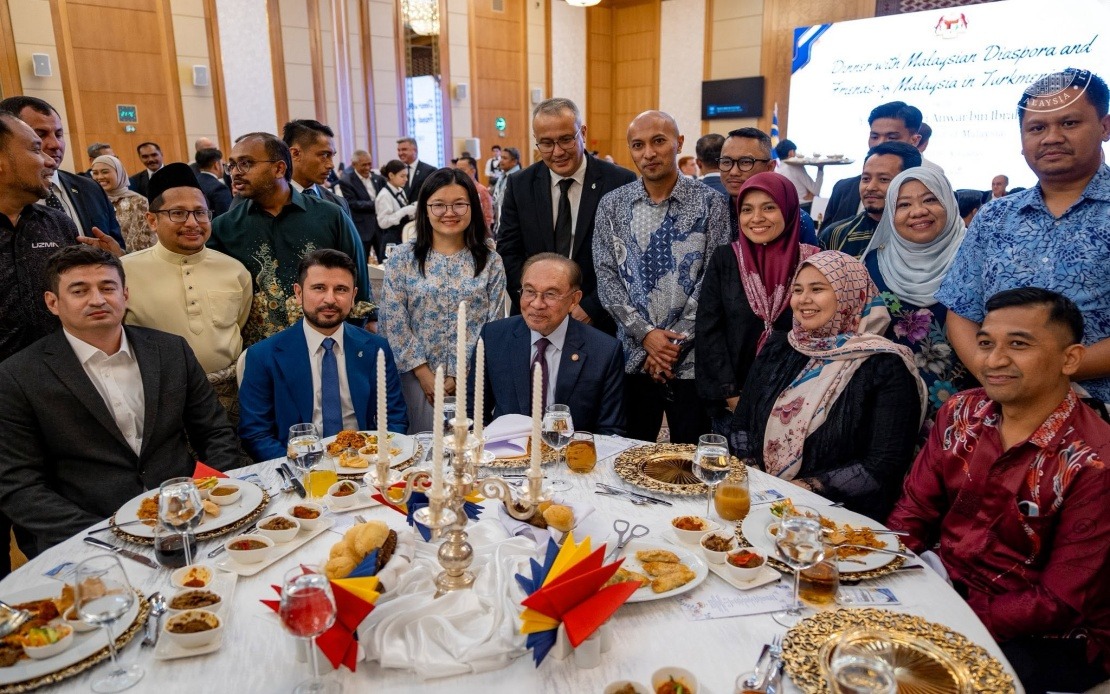
Prime Minister Datuk Seri Anwar Ibrahim has made a point of connecting with Malaysians living abroad during his ongoing official visit to Ashgabat, Turkmenistan, reflecting the MADANI Government's broader commitment to maintaining meaningful relationships with citizens scattered across the globe. The engagement with the diaspora community underscores how contemporary Malaysian foreign policy extends beyond traditional diplomatic and commercial channels to include the personal bonds that nationals maintain with their homeland, even when residing in distant corners of Central Asia.
The Premier seized the occasion to reinforce the government's vision of an integrated Malaysian community that transcends geographical boundaries. In remarks shared on Facebook, Anwar emphasised that despite the considerable distance separating Ashgabat from Kuala Lumpur, the gathering carried the warmth and intimacy of a hometown reunion. This framing carries significance for Malaysian expatriates who often navigate the psychological complexities of extended overseas residence—the validation that their connection to Malaysia remains valued by the highest levels of government provides both reassurance and encouragement.
Central to Anwar's message was the characterisation of overseas Malaysians as informal ambassadors advancing the nation's interests and reputation internationally. This conceptualisation has practical implications, as diaspora communities often serve as cultural bridges, investment facilitators, and sources of valuable networks that strengthen bilateral relationships between Malaysia and their countries of residence. By publicly recognising this role, the Prime Minister elevates the status of Malaysians abroad from mere expatriates to stakeholders in national development and soft power projection.
Anwar encouraged the diaspora to maintain active engagement with domestic affairs, urging them to follow Malaysia's ongoing development trajectory and remain informed about the country's progress. This appeal reflects a recognition that diaspora communities, when properly connected to the homeland, become multipliers of Malaysia's global standing. Their informed perspectives on domestic developments allow them to articulate Malaysia's policies and achievements to their local networks more effectively than official channels sometimes can achieve.
The visit to Turkmenistan marks Anwar's first official engagement with the Central Asian nation at the presidential level, arriving at the invitation of Turkmenistan President Serdar Berdimuhamedov. This diplomatic visit follows Berdimuhamedov's December 2024 visit to Malaysia, establishing a reciprocal pattern that signals the emergence of bilateral relationship institutionalisation. For Malaysia, deepening ties with Central Asian nations represents a strategic diversification of its international partnerships, moving beyond traditional Southeast Asian and developed-economy alignments.
Beyond the ceremonial aspects of state visits, Anwar articulated that Malaysia's engagement with Turkmenistan encompasses dimensions transcending the conventional trade and investment frameworks that typically dominate bilateral discussions. The Prime Minister positioned the visit as an opportunity to forge genuine friendship, enhance mutual comprehension between the nations, and identify emerging cooperation areas that serve both countries' strategic interests. This broader conceptualisation of diplomatic engagement reflects Malaysia's evolving approach to international relations under the MADANI administration.
The timing and nature of this diaspora engagement during an official state visit reveals sophisticated diplomatic practice. Rather than relegating engagement with overseas nationals to cultural attaché-level functions, the Prime Minister's personal involvement signals that Malaysia's government views diaspora relations as a central foreign policy concern worthy of executive attention. This approach proves particularly important for Malaysian communities in less-populated regions like Central Asia, where consular resources may be limited and direct government contact becomes especially meaningful.
For Malaysian business professionals and investors operating in Turkmenistan and neighbouring Central Asian markets, the Prime Minister's visit carries tangible significance. Increased high-level diplomatic engagement typically facilitates the resolution of bilateral impediments to commerce, clarifies investment protections, and creates momentum for formal trade agreements. The presence of these diaspora networks often translates into enhanced opportunities for Malaysian enterprises seeking to establish or expand operations in the region.
The diaspora meeting also contextualises Malaysia's broader engagement strategy with Central Asia, a region increasingly important to Asian geopolitics and economic development. By strengthening connections with Malaysian communities throughout the region, the government simultaneously expands its intelligence-gathering capacity and cultural influence. Diaspora members serve as conduits through which Malaysian perspectives penetrate local business, academic, and policy circles, generating soft power effects that complement formal diplomatic initiatives.
Anwar's emphasis on the MADANI Government's commitment to diaspora relations reflects a policy priority that extends across multiple government agencies and diplomatic missions worldwide. This thematic consistency across different settings—whether in Ashgabat or elsewhere—demonstrates that diaspora engagement constitutes a deliberate strategic pillar rather than ad-hoc diplomatic courtesy. The approach acknowledges that nearly two million Malaysians reside abroad, representing considerable economic and human capital invested in various host countries.
The two-day Turkmenistan visit represents Malaysia's effort to position itself as an active regional participant in Central Asian affairs, an area where Southeast Asian nations have historically maintained limited engagement. Strengthening bilateral relationships at the highest levels, combined with cultivation of diaspora networks, creates a multi-layered approach to building Malaysia's presence and influence in strategically important but geographically distant regions.
Looking forward, the diaspora engagement during this visit establishes a template for how Malaysia can leverage its scattered citizen communities to amplify diplomatic effectiveness and international standing. As the MADANI Government continues executing its foreign policy agenda, the recognition and activation of diaspora potential represents an underutilised asset that connects Malaysia's global community to domestic development goals and international aspirations.