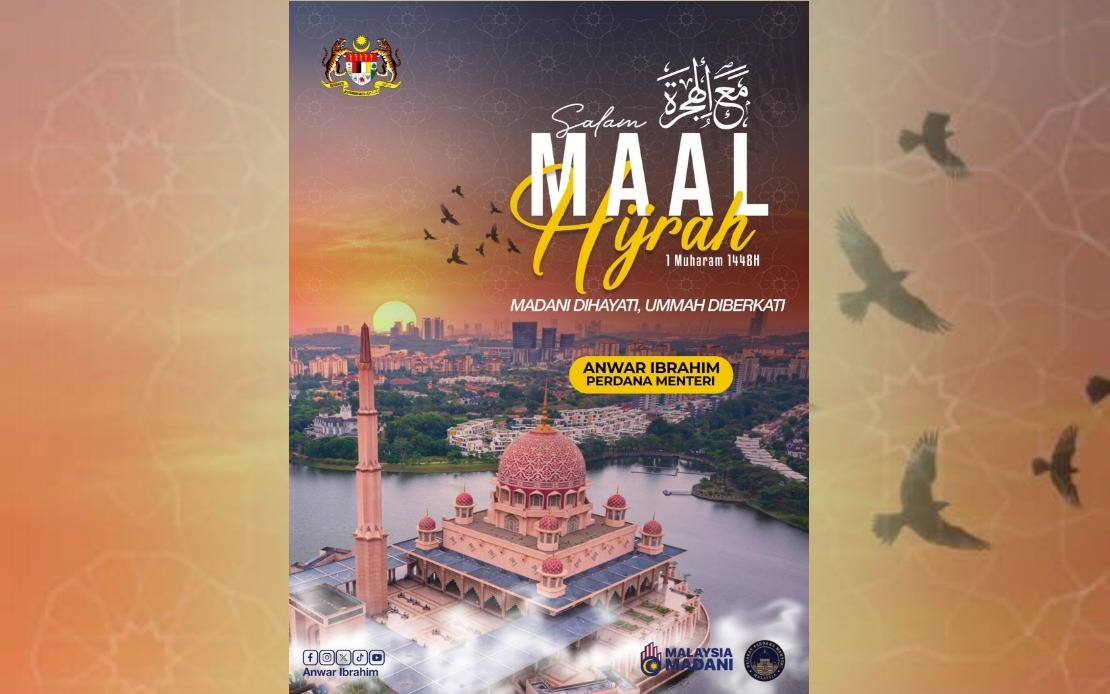
Prime Minister Datuk Seri Anwar Ibrahim has stressed that channelling the spirit of Hijrah requires more than inspirational messaging—it demands genuine consensus and collaborative effort across Malaysia's diverse communities to drive substantive reforms rooted in justice, truth, prosperity and security. Speaking on the occasion of Maal Hijrah 1448H, Anwar drew parallels between the Prophet Muhammad SAW's migration to Madinah and the collective action necessary for contemporary nation-building, positioning the Islamic historical event as a template for mobilising national consensus rather than pursuing partisan agendas.
The Prime Minister's invocation of Hijrah carries particular weight in Malaysia's current political climate. Rather than presenting reform as the domain of government alone, Anwar's framing emphasises that sustainable change emerges from coordinated action among diverse stakeholders—a message that resonates across Malaysia's multicultural landscape and implicitly acknowledges the limitations of top-down policy implementation. His emphasis on the historical precedent of Prophet Muhammad SAW's migration suggests that successful transformation requires patience, sacrifice and the willingness of different groups to work toward shared objectives, themes that extend beyond religious contexts to encompass the broader challenge of national cohesion.
Central to Anwar's message is his rejection of what he characterised as hollow activism—the reliance on slogans, rhetoric and individual initiative without substantive coordination. This distinction proves significant for Malaysia, where previous reform efforts have sometimes faltered when enthusiasm outpaced organisational capacity or when different groups pursued competing visions. By anchoring reform in the concept of Hijrah, which encompasses both spiritual migration and practical relocation, Anwar signals that transformation requires concrete restructuring of systems and institutions, not merely aspirational language or symbolic gestures.
The Prime Minister drew specific historical examples from the Hijrah narrative to illustrate inclusive leadership. He highlighted the contributions of youth such as Saidina Ali Abi Talib, women including Asma Abu Bakar, and numerous companions who participated in organising and executing the migration. This deliberate acknowledgment of diverse participants—cutting across age, gender and social status—carries implicit messaging about the composition of Malaysia's reform coalition. By invoking historical precedent showing that transformative movements require participation across demographic lines, Anwar positions inclusive engagement not as a modern afterthought but as foundational to success.
The challenge Anwar identifies—translating Hijrah's spirit into current reality—reflects recognition that historical analogies, however spiritually resonant, do not automatically produce policy outcomes. Malaysia faces distinct complications absent from seventh-century Arabia: competing economic interests, entrenched bureaucratic practices, and the need to balance reform momentum with institutional stability. Anwar's emphasis on patience toward victory suggests he understands that reform cycles extend beyond electoral terms and require sustained commitment from constituencies with differing immediate priorities.
The Department of Islamic Development Malaysia's selection of "MADANI Dihayati, Ummah Diberkati" (MADANI Embraced, The Ummah Blessed) as the national theme for this year's Maal Hijrah celebration explicitly connects the historical Hijrah to the government's MADANI framework—the acronym representing Memperkasakan Rakyat (Empowering People), Asah (Cultivating), Daya Tahan (Resilience), Amanah (Integrity) and Negara (Nation). This thematic alignment attempts to translate Islamic historical narrative into contemporary governance language, suggesting that the development of Madinah's Islamic civilisation offers lessons for modern state-building. The framing positions Hijrah not as purely commemorative but as a lens through which to evaluate whether current policies genuinely embody the qualities of justice, unity and collective benefit.
For Malaysian policymakers and civil society observers, Anwar's emphasis on cooperation rather than unilateral action contains practical implications. It suggests a governing approach that seeks broader buy-in for reforms rather than attempting to impose changes through executive fiat. Whether addressing economic restructuring, institutional reform or social policy, this framework requires building consensus among stakeholders with competing interests—a slower process than top-down implementation but potentially more durable when changes require sustained compliance and cultural adaptation.
The theological dimension Anwar introduced—referencing verse 100 of Surah An-Nisa regarding rewards for migration in Allah's path—adds spiritual weight to his secular political argument. By invoking Quranic authority, he frames reform commitment as a religious obligation rather than merely a policy preference, potentially mobilising religious constituencies and framing opposition to reform as religiously problematic. This rhetorical move attempts to shift reform discourse from instrumental political calculation to spiritual imperative, though its effectiveness depends on whether diverse Malaysian audiences accept this framing.
The invocation of Hijrah during a period of significant Malaysian reform efforts signals that the Prime Minister understands transformation requires mobilising multiple sources of legitimacy simultaneously. Religious, historical, institutional and pragmatic arguments must reinforce each other if substantial change is to take hold. Anwar's insistence that reform cannot succeed through individual effort or single-party action reflects both political calculation and genuine recognition that Malaysia's complexity—its diversity, its established power structures, its competing visions of national identity—demands inclusive coalitions.
As Malaysia continues implementing MADANI-framework initiatives across governance, economic policy and social programmes, the sustainability of these efforts will partly depend on whether the consensus and unity Anwar advocates can be institutionalised beyond rhetorical commitment. The gap between invoking Hijrah's cooperative spirit and actually achieving sustained collaboration across competing interests remains substantial, particularly in areas where reform creates winners and losers. Whether Anwar's framework can bridge this gap will significantly influence Malaysia's reform trajectory.