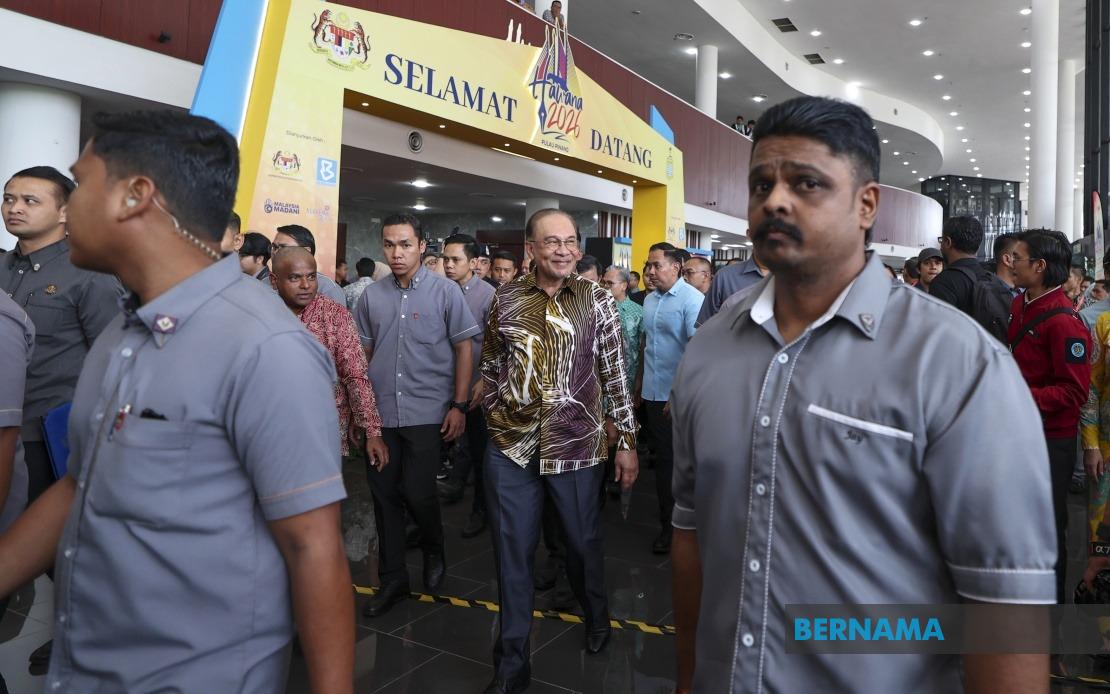
Prime Minister Datuk Seri Anwar Ibrahim has officially opened the HAWANA 2026 National Journalists' Day celebration, a significant gathering that underscores the government's commitment to recognising the critical role of media professionals in sustaining democratic discourse and public information. The event took place at the PICCA Convention Centre @ Butterworth Arena on June 20, with the Prime Minister arriving at 2.40 pm to preside over the day's proceedings. His attendance signals the administration's continued emphasis on media integrity and the essential contributions journalism makes to national development.
The Prime Minister was warmly received by senior government officials reflecting the cross-sector importance of the occasion. Penang Chief Minister Chow Kon Yeow, Communications Minister Datuk Fahmi Fadzil, and Communications Ministry secretary-general Datuk Abdul Halim Hamzah were among those greeting Anwar upon his arrival. The delegation's composition highlights how HAWANA 2026 extends beyond a single ministry initiative to encompass broader government and state-level engagement with the journalism community. Before proceeding to the main ceremonies, the Prime Minister took time to tour exhibition booths and browse the HAWANA 2026 Photo Gallery positioned at the venue's foyer, a gesture that demonstrates personal engagement with the event's content and recognition of participating media organisations.
The celebration attracted a substantial contingent of regional and international guests, elevating its standing as an ASEAN-level platform for media dialogue. Delegates from neighbouring Timor-Leste, Cambodia, and Laos attended, including Timor-Leste's Secretary of State for Social Communication Expedito Loro Dias Ximenes and Cambodia's Undersecretary of State at the Ministry of Information Prak Thaveak Amida. The participation of Phuangpasert Keosouvanh, Permanent Secretary of the Cabinet Office of Laos' Ministry of Technology and Communications, underscores the regional dimension of contemporary media challenges and the value of cross-border professional exchange. Representatives from regional news agencies including Timor-Leste's Agencia Noticiosa de Timor-Leste, Indonesia's Antara News Agency, and the Vietnam News Agency rounded out the international representation.
Bernama, Malaysia's national news agency, played a central organisational role in orchestrating the event, with leadership including chairman Datuk Seri Wong Chun Wai and chief executive officer Datin Paduka Nur-ul Afida Kamaludin in attendance. The agency's prominent position reflects its status as the implementing body for HAWANA 2026 under the Ministry of Communications. The working committee structure, headed by Nur-ul Afida with deputy chairman Arul Rajoo Durar Raj and project director Mohd Shukri Ishak contributing to operational execution, demonstrates the professional infrastructure supporting such a large-scale gathering.
International media organisations and professional associations amplified the event's stature. Beyond ASEAN representatives, the gathering included delegates from Indonesia's Antara News Agency and Vietnam News Agency, as well as participation from Xinhua News Agency and the Indonesian Journalists Association. This international footprint positions HAWANA 2026 as more than a domestic recognition event; it functions as a substantive dialogue space where professional standards, ethical challenges, and future directions for journalism across the region can be discussed with peers facing similar operating environments.
The ceremonial centrepiece involved the Prime Minister presenting the HAWANA Award and Special HAWANA Award to individuals recognised for outstanding contributions to journalism and public thought advancement. This recognition framework honours journalistic excellence while simultaneously highlighting the government's appreciation for the profession's role in shaping informed public discourse. Beyond individual awards, Anwar also distributed contributions from the Kasih@HAWANA Fund to deserving media veterans, a welfare-oriented initiative that acknowledges the personal sacrifices made by journalists throughout their careers.
The event operated under the thematic framework of 'Media Integrity Strengthens Credibility', a carefully chosen emphasis that reflects contemporary global concerns about information quality and public trust in news institutions. This thematic selection proves particularly relevant for Malaysia and Southeast Asia, where rapid digitalisation, social media proliferation, and the challenge of misinformation have intensified scrutiny on journalistic standards. By anchoring HAWANA 2026 to this theme, organisers positioned the gathering as responsive to pressing professional concerns rather than merely ceremonial.
The scale of participation—approximately 1,000 media practitioners from Malaysia and abroad—demonstrates substantial industry engagement with HAWANA as a professional platform. This attendance level reflects the event's perceived value as a forum for generating contemporary ideas, networking across national and regional boundaries, and collectively reflecting on journalism's trajectory. For Malaysian journalists, such gatherings provide opportunities to benchmark practices against international peers and participate in discussions about evolving professional standards.
The Ministry of Communications, working through Bernama, has established HAWANA as a recurring institutional mechanism for acknowledging journalism's contributions to democracy and development. The platform serves multiple functions simultaneously: it honours individual achievement, facilitates international professional dialogue, provides welfare support to journalism veterans, and creates public space for discussing media's role in society. For a region navigating complex information environments and competing pressures on editorial independence, such structured recognition and dialogue spaces carry particular significance.
The gathering's ASEAN composition reflects how media professionalism and ethical standards increasingly require regional dialogue and coordination. Journalists across Southeast Asia encounter similar challenges ranging from digital disruption to political pressures and economic sustainability concerns. HAWANA's success in convening these communities suggests appetite for continued regional engagement on professional standards and best practices. The presence of state officials alongside media practitioners also indicates governments' recognition that media integrity ultimately serves broader public interests in informed governance and democratic participation.
For Malaysian media practitioners, HAWANA 2026 provides official recognition of their profession's essential democratic functions at the highest governmental level. The Prime Minister's personal inauguration of the ceremony sends signals beyond the journalism community about the administration's commitment to media freedom and professionalism. Such high-level engagement, while ceremonial in form, carries substantive implications for how governments relate to and support independent journalism within their borders.


