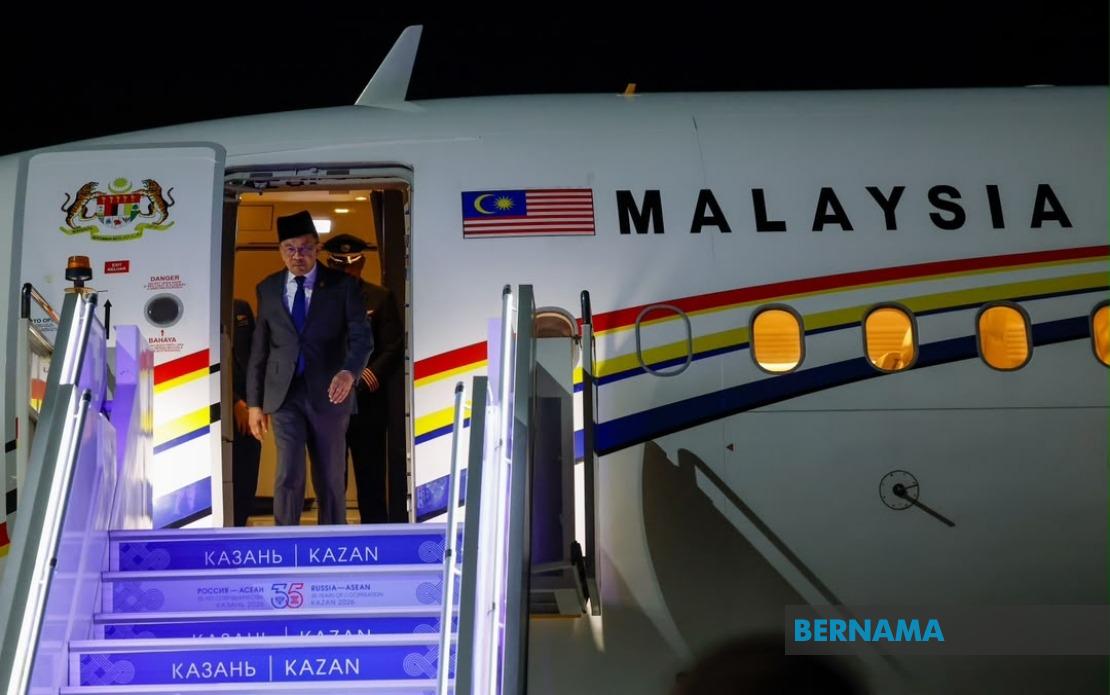
Prime Minister Datuk Seri Anwar Ibrahim touched down in Kazan on Sunday evening to participate in a significant diplomatic gathering that celebrates three decades of formal engagement between Southeast Asia's premier regional bloc and the Russian Federation. His arrival at Kazan International Airport at 10.20 pm local time signals Malaysia's active role in advancing ASEAN's strategic partnerships amid a rapidly shifting geopolitical landscape. The two-day working visit positions Malaysia at the centre of discussions aimed at deepening institutional ties between the ten-member ASEAN grouping and Moscow, at a time when regional powers are recalibrating their international partnerships.
The delegation accompanying the Prime Minister underscores the economic dimension of this engagement. Minister of Investment, Trade and Industry Datuk Seri Johari Abdul Ghani and Minister of Economy Akmal Nasrullah Mohd Nasir travelled alongside senior officials from the Prime Minister's Office and the Foreign Ministry, reflecting the cross-portfolio importance Malaysia attributes to Russia relations. This configuration suggests that discussions will extend beyond ceremonial diplomatic niceties to encompass concrete commercial opportunities and sectoral collaboration. The Malaysian Ambassador to Russia, Datuk Cheong Loon Lai, coordinated the airport reception, while the Russian side deployed officials including Ilya Nachvin, Minister of Digital Development of Tatarstan, Kazan Mayor Ilsur Metshin, and State Protocol Department representatives—a protocol arrangement that signals Moscow's commitment to substantive engagement with the Southeast Asian delegation.
The summit itself serves as a milestone moment in ASEAN-Russia relations, marking thirty-five years since the two parties formalized diplomatic engagement in Kuala Lumpur in 1991. For Malaysian observers, this anniversary carries particular significance given the nation's traditional balancing act between regional and great-power interests. The diplomatic framework established over these three-and-a-half decades has evolved from modest foundational arrangements to what both sides now characterize as a Strategic Partnership, testament to the gradual but steady expansion of bilateral and multilateral engagement between Southeast Asia and Russia. The Kazan venue itself—situated in the Volga region and capital of the Republic of Tatarstan—carries symbolic weight as a centre of Russian industrial and technological development, reinforcing Moscow's desire to showcase its non-European dimensions during this gathering.
According to statements from Wisma Putra, the Malaysian Foreign Ministry, the summit agenda encompasses a remarkably broad spectrum of cooperative domains. Beyond traditional diplomatic pleasantries, planned discussions are expected to address trade and investment frameworks, energy cooperation, food security mechanisms, digital economy initiatives, scientific and technological partnerships, cultural exchanges, educational programmes, and people-to-people connections. This expansive agenda reflects ASEAN's determination to construct a multifaceted relationship with Russia that transcends any single sectoral interest. For Malaysia specifically, these discussions hold particular resonance given the nation's dependence on food imports and its strategic positioning as both an energy consumer and emerging renewable technology exporter, making energy and food security discussions directly relevant to domestic policy objectives.
The summit is anticipated to produce four formal outcome documents that will institutionalize cooperation frameworks extending through 2030. The Kazan Declaration commemorating the thirty-five-year relationship will serve as the overarching political statement, while separately negotiated instruments on energy cooperation and cultural cooperation will provide sectoral specificity. Most substantially, the Comprehensive Plan of Action for 2026-2030 will establish detailed operational guidelines for implementing the ASEAN-Russia Strategic Partnership across the decade ahead. These documents carry weight beyond ceremonial value, as they commit participating nations to specific cooperative mechanisms and provide benchmark standards against which future progress can be measured. For Malaysian policymakers, such formalized commitments offer institutional anchors for managing the relationship predictably amid broader geopolitical uncertainties.
Anwar's participation in this summit constitutes part of a deliberate Malaysian strategy to position ASEAN as the indispensable framework for Asia-Pacific diplomacy while maintaining equidistant engagement with multiple great powers. The Foreign Ministry's statement explicitly framed this visit as reflecting Malaysia's commitment to strengthening ASEAN's external relations and promoting ASEAN Centrality—diplomatic terminology signifying the bloc's determination to remain the primary platform for regional decision-making rather than becoming subordinate to bilateral great-power arrangements. This positioning carries particular importance given recent strategic competition between established and rising powers seeking influence across Southeast Asia. By hosting ASEAN-Russia diplomatic mechanisms, Malaysia contributes to regional efforts to prevent any single external actor from dominating the strategic calculus.
Beyond the formal summit proceedings, Anwar's itinerary includes bilateral engagement with Russian President Vladimir Putin and Tatarstan's leadership, alongside separate meetings with ASEAN counterparts attending the gathering. These private discussions will likely address bilateral Malaysia-Russia relations across trade, investment, and strategic sectors, while collective ASEAN conversations will focus on shared regional concerns. Issues anticipated for discussion include advocacy for dialogue and peace mechanisms addressing ongoing international conflicts, support for economic resilience amid global inflationary pressures and supply chain disruptions, advancement of energy and food security given both regions' vulnerabilities to external shocks, and deepening of people-to-people connections through educational and cultural programming. Each of these topics resonates acutely with Malaysian interests and Southeast Asian regional stability considerations.
This Kazan visit constitutes Anwar's third substantive engagement with Russia since assuming the Prime Minister's office in November 2022, illustrating the consistency Malaysia has maintained in cultivating the relationship despite competing international demands. His September 2024 attendance at the Eastern Economic Forum in Vladivostok provided opportunity for informal networking and economic sector exposure, while his May 2025 official Moscow visit facilitated high-level bilateral discussions with President Putin encompassing trade, investment, agricultural cooperation, educational partnerships, aerospace initiatives, and energy collaboration. The progression from economic forum participation through official bilateral visit to multilateral ASEAN summit participation demonstrates Malaysia's methodical approach to deepening Russian engagement across multiple diplomatic channels and sectoral platforms. This pattern suggests that rather than viewing Russia as a peripheral actor in Asian affairs, Malaysian strategic thinking incorporates Moscow as a significant participant in regional and global governance structures worthy of sustained diplomatic investment.
The timing of this summit carries implications extending beyond bilateral Malaysia-Russia relations to broader Southeast Asian positioning in an era of strategic realignment. As established democracies and authoritarian systems worldwide reassess international partnerships, ASEAN's maintenance of inclusive diplomatic frameworks that accommodate multiple power centres offers a distinctive model. By convening Russia alongside ASEAN members with diverse geopolitical orientations, the bloc demonstrates its capacity to manage relationships that many Western-aligned countries find increasingly complicated. For Malaysia, participation in such frameworks reinforces the nation's long-standing foreign policy principle of non-alignment and strategic autonomy, allowing pursuit of beneficial relationships across ideological divides. This approach has historically served Malaysian interests well, enabling the nation to access resources, investment, and partnerships while preserving decision-making independence.
Looking forward, the outcomes emerging from the Kazan summit will likely shape Malaysia-Russia engagement patterns through the remainder of this decade. The adoption of a comprehensive implementation plan extending to 2030 signals both parties' intention to move beyond episodic high-level visits toward sustained institutional cooperation. For Malaysian businesses, the frameworks established could facilitate access to Russian markets and investment capital, particularly in sectors where complementarities exist. For Malaysian policymakers, formalized energy and food security cooperation mechanisms offer potential hedging strategies against future supply disruptions. The people-to-people and educational components may gradually expand the constituency within both nations who view the bilateral relationship as beneficial, creating political constituencies supportive of sustained engagement. Through these multiple channels, what began as modest diplomatic normalization in 1991 has evolved into a consequential partnership requiring active management and continuous reinvestment of political capital by both sides.


