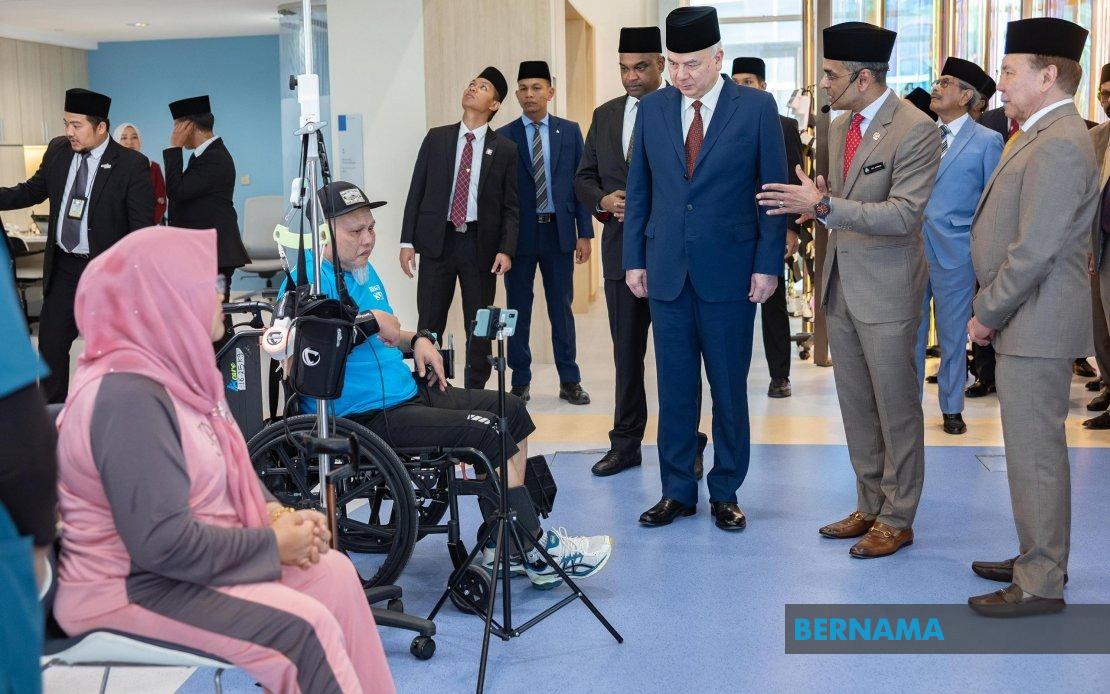
Perak's Sultan Nazrin Shah has inaugurated the Social Security Organisation's (PERKESO) newest rehabilitation facility in Meru Raya, a centre that combines cutting-edge neurotechnology with traditional values of human compassion. The opening of the Neuro-Robotics and Cybernetics Rehabilitation Centre marks a significant moment in Malaysia's modernisation of social healthcare infrastructure, reflecting the nation's commitment to supporting workers facing physical and neurological challenges. The facility, which has been formally named Pusat Rehabilitasi Perkeso Sultan Nazrin Shah, was attended by senior state officials including Raja Muda Perak Raja Jaafar Raja Muda Musa, Raja Di Hilir Perak Raja Iskandar Dzulkarnain Sultan Idris Shah, Menteri Besar Datuk Saarani Mohamad, and Minister of Human Resources Datuk Seri R. Ramanan.
During the opening ceremony, Sultan Nazrin articulated a vision of rehabilitation that extends far beyond its physical infrastructure or technological capabilities. The sovereign emphasized that the centre's true foundation rests upon the knowledge, skill and empathy of healthcare professionals who work within its walls, a reminder that even the most sophisticated equipment requires human judgment and compassion to deliver meaningful outcomes. The facility brings together an interdisciplinary team spanning neurological medicine, assistive technology specialists, physiotherapists, occupational and vocational therapists, social workers and psychologists—a comprehensive approach designed to address both the physical and emotional dimensions of recovery.
Crucially, Sultan Nazrin framed the centre as representing a fundamental philosophical shift in how Malaysia approaches rehabilitation and social welfare. Rather than viewing recovery as primarily a medical or technological matter, the centre embodies a holistic understanding that recognises injured workers as whole persons with families, aspirations and inherent dignity. This positioning signals an important cultural reorientation: that disability or injury need not define a person's future trajectory, and that with appropriate support systems, structured rehabilitation and genuine opportunities, individuals can rebuild their lives with independence restored. For Malaysia's workforce, this represents a substantial statement about the nation's values and priorities.
The practical implications of this facility are considerable for workers facing various neurological challenges. Stroke survivors may regain lost mobility through advanced rehabilitation protocols, while workers recovering from occupational neurological injuries can access specialised programmes designed to restore both physical capability and cognitive function. Individuals affected by traumatic brain injury—a serious occupational hazard in construction, manufacturing and transportation sectors—gain access to comprehensive support addressing memory, speech, cognitive processing and psychological well-being. For families bearing the emotional and financial burden of a loved one's recovery, the centre offers tangible hope that rehabilitation outcomes need not be predetermined by initial injury severity.
The centre's architectural design, inspired by the traditional craft of gold-thread embossing, carries symbolic weight beyond mere aesthetics. This incorporation of Malaysian cultural heritage into modern healthcare infrastructure demonstrates that contemporary rehabilitation need not abandon traditional values or identity. The design choice acknowledges that recovery journeys, like the intricate patterns of traditional embroidery, require patience, precision and attention to detail—a metaphor that resonates within Malaysian cultural understanding.
An important catalyst for the centre's realisation was M. Kulasegaran, who initiated the project during his tenure as Minister of Human Resources from 2018 to 2020. The project's gestation period reflects the substantial planning and coordination required to establish such a sophisticated facility, highlighting how rehabilitation infrastructure development in Malaysia occurs through sustained commitment across political administrations. The continuity of support for this initiative, regardless of changing political circumstances, underscores broad consensus regarding the need for enhanced rehabilitation services.
A particularly noteworthy development is PERKESO's partnership with 7-Eleven for post-rehabilitation workplace training and potential employment pathways. This collaborative model addresses a critical gap in rehabilitation services: many individuals complete therapeutic programmes successfully but struggle to transition back into meaningful employment. By partnering with a major private sector employer, PERKESO creates a bridge between clinical recovery and economic self-sufficiency. Such partnerships acknowledge that rehabilitation's ultimate measure of success is not merely functional improvement, but the individual's ability to resume self-reliant participation in economic and social life.
Sultan Nazrin's appeal to private sector organisations carries significant implications for corporate Malaysia. The invitation to develop further corporate social responsibility initiatives, vocational training programmes and employment opportunities for rehabilitation graduates presents both ethical and business case justifications. Companies engaging with PERKESO gain access to motivated workers seeking to prove their capabilities following recovery, while simultaneously contributing to national social welfare objectives. The model suggests that inclusive employment practices need not be viewed as charitable burden, but rather as mutually beneficial arrangements where recovered workers bring valuable experience, determination and gratitude to their roles.
The centre's existence also carries an important message regarding societal attitudes toward persons with disabilities. Sultan Nazrin explicitly called for elimination of prejudice and stigma, reflecting a growing recognition that discriminatory attitudes often constitute greater barriers to participation than disabilities themselves. Malaysian society, increasingly diverse and multicultural, benefits from shifting these attitudes—particularly within workplaces where inclusive practices enhance team dynamics and organisational culture. The centre's visibility serves as a public affirmation that persons with disabilities belong fully within Malaysian economic and social life.
In his address, Sultan Nazrin challenged conventional measures of national progress, arguing that true development encompasses not merely economic growth or infrastructure expansion, but the nation's demonstrated commitment to preserving human dignity and supporting vulnerable populations. This reframing is particularly significant for Malaysia's trajectory as an upper-middle-income nation increasingly focused on high-value economic activities. Nations competing in knowledge-intensive sectors depend upon their human capital—and the capacity to rehabilitate and restore workers who experience health setbacks directly impacts productivity and innovation capacity.
The facility also positions Malaysia within evolving regional standards for rehabilitation services. As Southeast Asian nations develop their social security and welfare systems, Malaysia's investment in neurotechnology-enabled rehabilitation may influence approaches across the region. The centre demonstrates that advanced technology need not be incompatible with values-based, compassionate service delivery—an important model for developing economies seeking to modernise without abandoning humanistic principles.
Beyond the symbolic and philosophical dimensions, the centre addresses concrete occupational health needs within Malaysia's economy. Manufacturing sectors, construction industries, transportation services and other hazard-prone occupations generate numerous workers requiring specialised neurological rehabilitation. The facility's existence means such workers no longer require overseas referrals for advanced rehabilitation, reducing costs while ensuring culturally appropriate, locally-based care. This has obvious implications for worker welfare, employer costs and national healthcare efficiency.
Moving forward, the centre's success will likely depend upon sustained funding, recruitment of qualified specialists and—critically—the extent to which private sector organisations genuinely embrace the employment partnership model. Sultan Nazrin's opening address has created clear expectations for corporate participation, establishing a benchmark against which the private sector's social responsibility commitments can be measured. The coming years will reveal whether Malaysian businesses view rehabilitation partnerships as genuine commitments or merely reputational exercises.