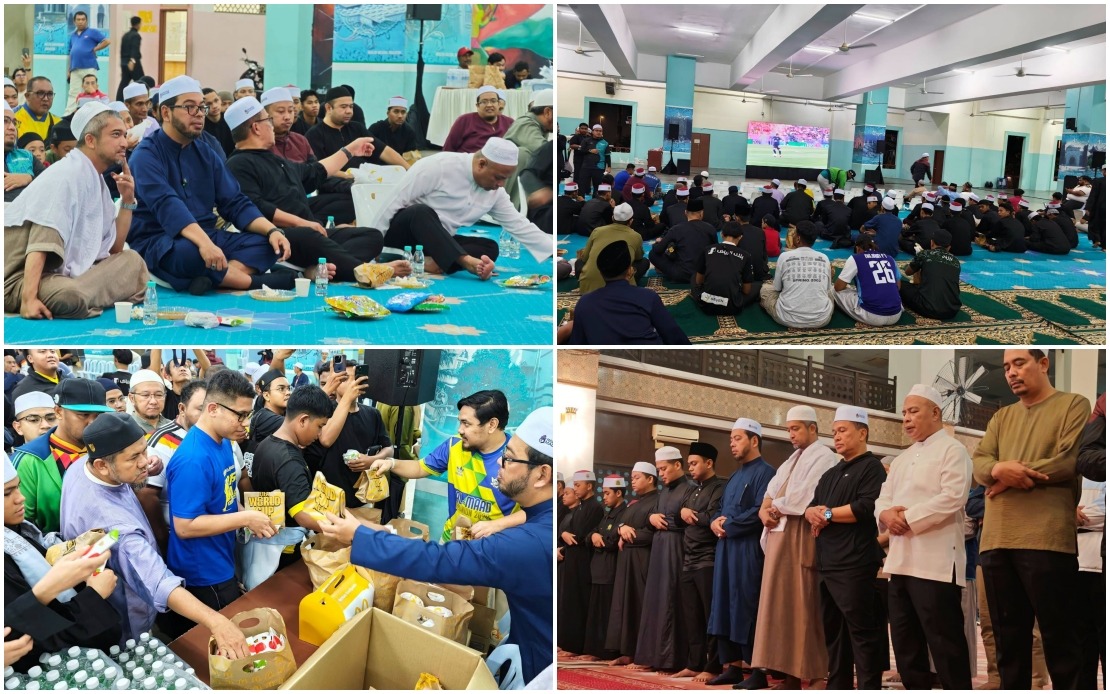
A mosque in the Wangsa Maju district of Kuala Lumpur hosted an unconventional early morning gathering on June 21, drawing more than 300 predominantly young worshippers who arrived before dawn to participate in Qiyamullail prayers before settling in to watch a 2026 World Cup match. The event at Masjid Usamah bin Zaid represented a deliberate effort to weave together spiritual observance with contemporary interests, presenting what organisers described as a wisdom-centred approach to Islamic outreach that acknowledges rather than dismisses the passions of younger generations.
Dr Zulkifli Hassan, who holds the ministerial portfolio overseeing religious affairs within the Prime Minister's Department, attended the event and underscored its significance as a demonstration of how young people's enthusiasm for football could be channelled into enriching spiritual experiences. His presence at the gathering signalled official recognition of the initiative's approach, which stands in contrast to traditional models that often maintain strict separation between entertainment and religious practice. The minister's endorsement reflects a broader shift in Malaysian Islamic institutions towards understanding youth engagement as a legitimate avenue for promoting religious commitment.
Following the pre-dawn prayers, the assembled crowd watched Germany's Group E clash against Ivory Coast unfold in the qualifying stage of the 2026 World Cup tournament, with the Germans emerging victorious by a scoreline of 2-1. The match selection itself provided a vehicle for connecting international sport to the mosque community, transforming what could have been an ordinary screening into a collaborative spiritual and social occasion that catered to the demographics most likely to follow professional football.
The entertainment component extended beyond passive viewing, as the programme incorporated expert analysis delivered by Shahril Arsat, a celebrated figure in Malaysia's football heritage, alongside Khushairi Aizad, a former player who had represented Selangor FA in the President's Cup competition. During the match interval, these football personalities offered tactical breakdowns and assessments of both teams' strategic approaches, lending authenticity and depth to the viewing experience that would have resonated particularly with the younger attendees who comprise the core football-following demographic.
The scale and coordination of the event became apparent through the breadth of institutional involvement in its execution. Datuk Nizam Yahya, serving as the chief executive officer of the Federal Territories Islamic Religious Council, and Datuk Ajib Ismail, holding the position of deputy director-general at the Malaysian Islamic Development Department, participated not as distant observers but as active contributors to the hospitality function. Alongside Dr Zulkifli and the Federal Territories Mufti, these senior officials personally engaged in preparing roti canai breakfast for the assembled worshippers, a gesture that conveyed solidarity with the grassroots community engagement.
The partnership structure underpinning the initiative illustrated the complexity required to execute such a programme successfully. Multiple government and quasi-governmental bodies coordinated their efforts, including the Federal Territories Mufti Department, the Malaysian Islamic Development Department, the Federal Territories Islamic Religious Department, and the Malaysian Islamic Dakwah Foundation. Youth-focused organisations such as Angkatan Belia Islam Malaysia supplemented these official bodies, while specialised groups including the Malaysian Islamic Economic Development Foundation contributed institutional capacity. The mosque's own management team provided the venue and logistical foundation, while private sponsors supported the catering requirements.
For Malaysian and regional observers, this event encapsulates an important contemporary challenge facing Islamic institutions throughout Southeast Asia: how to maintain religious relevance and engagement among populations increasingly immersed in global popular culture and digital entertainment. Rather than positioning religiosity in opposition to modern leisure activities, the Kuala Lumpur mosque's approach suggests that careful, intentional integration can create hybrid spaces where spiritual practice and contemporary interests reinforce rather than undermine one another.
The dawn-time coordination of Qiyamullail with a World Cup screening also demonstrates strategic thinking about temporal rhythms in religious life. By anchoring the event to the pre-dawn prayer period, organisers ensured that spiritual devotion remained the primary purpose, with the football match serving as a secondary engagement that extended the community's time together. This sequencing prevents the accusation that sport has usurped religion's role, while simultaneously acknowledging that young people's commitment to spiritual practice might benefit from being coupled with activities they genuinely enjoy.
The demographic composition—predominantly young worshippers—signals recognition that youth religious engagement requires different approaches than those developed for older, more traditionally observant populations. Malaysian Islamic institutions, like their counterparts across the Muslim world, have grappled with declining youth participation in formal religious settings. Initiatives that meet young people within their actual interests rather than insisting they abandon those interests in favour of traditional forms create pathways towards integration rather than alienation, potentially nurturing longer-term religious commitment built on authentic engagement rather than obligation.
For regional policymakers and religious leaders observing Malaysian developments, the Wangsa Maju event offers a practical case study in contextualised dakwah—Islamic outreach—that treats contemporary culture as a medium for religious teaching rather than an obstacle to it. The involvement of government officials, religious organisations, and community groups suggests institutional buy-in for this philosophy, potentially positioning it as an emerging model for youth-targeted religious programming across Malaysia and beyond.
Looking forward, the success of this particular gathering may inspire similar initiatives coupling religious observance with other contemporary interests—music, technology, sports beyond football, or other domains where young Malaysians invest significant emotional and temporal energy. The challenge for organisers will lie in maintaining the balance between genuine spiritual enrichment and superficial entertainment-seeking, ensuring that integration enhances rather than dilutes the religious dimensions of such events. Should this model continue gaining traction, it could reshape how Malaysian Islamic institutions approach the perennial challenge of connecting with generations who experience religiosity differently than their predecessors.
%22%2F%3E%3C%2Fpattern%3E%3C%2Fdefs%3E%3Crect%20width%3D%22100%25%22%20height%3D%22100%25%22%20fill%3D%22url(%23ph32hyvg)%22%2F%3E%3Crect%20width%3D%22100%25%22%20height%3D%22100%25%22%20fill%3D%22url(%23ph32hyvp)%22%2F%3E%3Ctext%20x%3D%2250%25%22%20y%3D%2250%25%22%20text-anchor%3D%22middle%22%20dominant-baseline%3D%22central%22%20fill%3D%22rgba(255%2C255%2C255%2C0.95)%22%20font-family%3D%22Georgia%2C%20'Times%20New%20Roman'%2C%20serif%22%20font-weight%3D%22700%22%20font-size%3D%22151%22%20letter-spacing%3D%22-0.02em%22%3EPerikatan%3C%2Ftext%3E%3C%2Fsvg%3E)