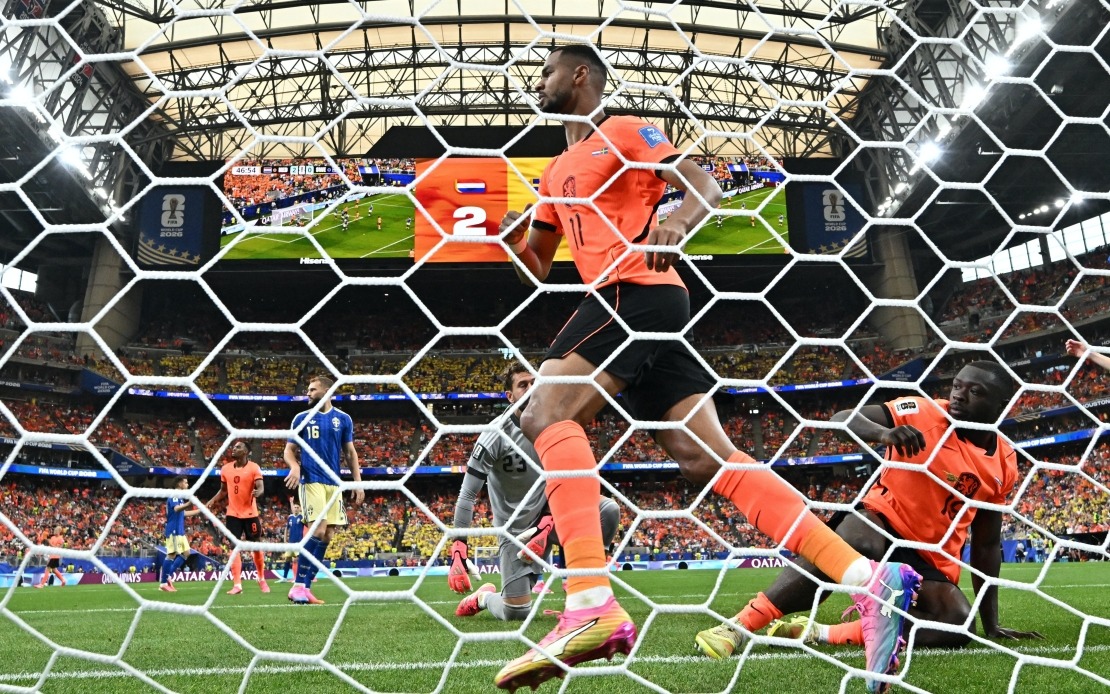
The 2022 World Cup has entered the history books for its extraordinary goal-scoring pace. When Cody Gakpo converted in the Netherlands' emphatic 5-1 victory over Sweden on Saturday, the tournament crossed its 100-goal threshold in just 33 matches—the fastest rate since the 1954 tournament in Switzerland. The Dutch winger's strike, which marked his country's third goal of the afternoon, underscores a dramatic shift in how this World Cup is unfolding compared to recent tournaments.
The mathematics are striking. At 3.03 goals per match through 33 games, the current tournament is significantly outpacing historical precedent. The last time a World Cup saw scoring at this velocity was nearly seven decades ago when Switzerland hosted the competition and reached the century mark after merely 20 matches. More recent editions tell a different story: Brazil 2014 required 36 matches to accumulate 100 goals, Spain 1982 needed the same, while Argentina 1978 and the United States 1994 both required 38 matches. The gap between this tournament and its immediate predecessors reveals a fundamental shift in how the sport is being played at football's highest stage.
Observers and analysts have identified multiple factors contributing to this unprecedented scoring tempo. The official match ball, the Trionda, has attracted particular scrutiny from goalkeeping experts who suggest its aerodynamic properties create difficulties for shot-stoppers attempting to read long-range efforts. Evidence of this phenomenon can be found in the tournament statistics, which show an unusual concentration of goals originating from outside the penalty box, accounting for roughly one-tenth of all goals scored so far.
Environmental conditions have also played a measurable role in the elevated scoring rates. The tournament's scheduling has exposed players to intense heat throughout matches, with fatigue becoming an increasingly significant factor as fixtures progress. Rather than allowing players to suffer diminishing performance levels, match officials have implemented mandatory three-minute cooling breaks, which simultaneously serve as strategic opportunities for coaches to reorganise their tactical systems, refresh their players, and implement in-game adjustments that sometimes lead to more open, attacking football.
The structural expansion of the tournament from 32 to 48 teams represents perhaps the most profound change in competition design. This modification has fundamentally altered the composition of the participant pool, introducing several nations that traditionally would not qualify for the World Cup proper. Some observers initially predicted that broadening the field would inevitably produce an abundance of lopsided scorelines as stronger teams overwhelmed significantly weaker opponents. The early evidence seemed to validate this concern, with Germany's devastating 7-1 demolition of Curaçao and Canada's 6-0 thrashing of Qatar dominating headlines. Tunisia's comprehensive defeats to Sweden and Japan, both by substantial margins, further appeared to support this narrative.
However, a closer examination of the tournament's broader results reveals a more nuanced picture that defies straightforward assumptions about competitive imbalance. While heavy defeats have certainly occurred, numerous matches have produced outcomes that underscore genuine competitive balance across the expanded field. Curaçao, despite Germany's demonstration of continental superiority, subsequently held Ecuador to a goalless draw—a result that speaks to tactical discipline and organised defending among teams considered underdogs. Similarly, Cabo Verde frustrated Spain in a carefully contested stalemate, a result that would have seemed inconceivable to many pre-tournament analysts.
Qatar's performance against Canada further illustrates how context transforms match narratives. While Canada secured a 6-0 victory, Qatar played the majority of the contest with only nine players following disciplinary dismissals, meaning the scoreline partially reflects the consequences of reduced numbers rather than pure footballing superiority. Elsewhere on the tournament landscape, perceived minnows including Jordan and Uzbekistan have demonstrated surprising resilience. Despite sustaining 3-1 defeats to Austria and Colombia respectively, both teams competed with intensity and organisation that suggests the expanded format may not have created merely a series of one-sided encounters.
These counterbalancing results point toward a more encouraging interpretation of the 48-team expansion: rather than simply producing statistical anomalies and blowout victories, the broader participant pool has, paradoxically, generated more entertaining and unpredictable competition. The inclusion of additional football nations has created space for surprise results, unexpected narrative arcs, and genuine drama that often characterises memorable tournaments. For Malaysian and Southeast Asian football enthusiasts observing these developments, the expanded format demonstrates that investment in football development across a wider range of nations can produce tangible competitive improvements and more compelling viewing experiences. The combination of improved ball technology, environmental management, expanded participation, and the tactical sophistication now available across a broader range of teams has collectively transformed this World Cup into one defined not merely by goal-scoring abundance, but by competitive depth that transcends traditional hierarchies.
%22%2F%3E%3C%2Fpattern%3E%3C%2Fdefs%3E%3Crect%20width%3D%22100%25%22%20height%3D%22100%25%22%20fill%3D%22url(%23ph2vu8jg)%22%2F%3E%3Crect%20width%3D%22100%25%22%20height%3D%22100%25%22%20fill%3D%22url(%23ph2vu8jp)%22%2F%3E%3Ctext%20x%3D%2250%25%22%20y%3D%2250%25%22%20text-anchor%3D%22middle%22%20dominant-baseline%3D%22central%22%20fill%3D%22rgba(255%2C255%2C255%2C0.95)%22%20font-family%3D%22Georgia%2C%20'Times%20New%20Roman'%2C%20serif%22%20font-weight%3D%22700%22%20font-size%3D%22194%22%20letter-spacing%3D%22-0.02em%22%3ESpeaker%3C%2Ftext%3E%3C%2Fsvg%3E)
%22%2F%3E%3C%2Fpattern%3E%3C%2Fdefs%3E%3Crect%20width%3D%22100%25%22%20height%3D%22100%25%22%20fill%3D%22url(%23ph21h54g)%22%2F%3E%3Crect%20width%3D%22100%25%22%20height%3D%22100%25%22%20fill%3D%22url(%23ph21h54p)%22%2F%3E%3Ctext%20x%3D%2250%25%22%20y%3D%2250%25%22%20text-anchor%3D%22middle%22%20dominant-baseline%3D%22central%22%20fill%3D%22rgba(255%2C255%2C255%2C0.95)%22%20font-family%3D%22Georgia%2C%20'Times%20New%20Roman'%2C%20serif%22%20font-weight%3D%22700%22%20font-size%3D%22170%22%20letter-spacing%3D%22-0.02em%22%3ETambirat%3C%2Ftext%3E%3C%2Fsvg%3E)
%22%2F%3E%3C%2Fpattern%3E%3C%2Fdefs%3E%3Crect%20width%3D%22100%25%22%20height%3D%22100%25%22%20fill%3D%22url(%23ph3xqbzg)%22%2F%3E%3Crect%20width%3D%22100%25%22%20height%3D%22100%25%22%20fill%3D%22url(%23ph3xqbzp)%22%2F%3E%3Ctext%20x%3D%2250%25%22%20y%3D%2250%25%22%20text-anchor%3D%22middle%22%20dominant-baseline%3D%22central%22%20fill%3D%22rgba(255%2C255%2C255%2C0.95)%22%20font-family%3D%22Georgia%2C%20'Times%20New%20Roman'%2C%20serif%22%20font-weight%3D%22700%22%20font-size%3D%22194%22%20letter-spacing%3D%22-0.02em%22%3EBintulu%3C%2Ftext%3E%3C%2Fsvg%3E)