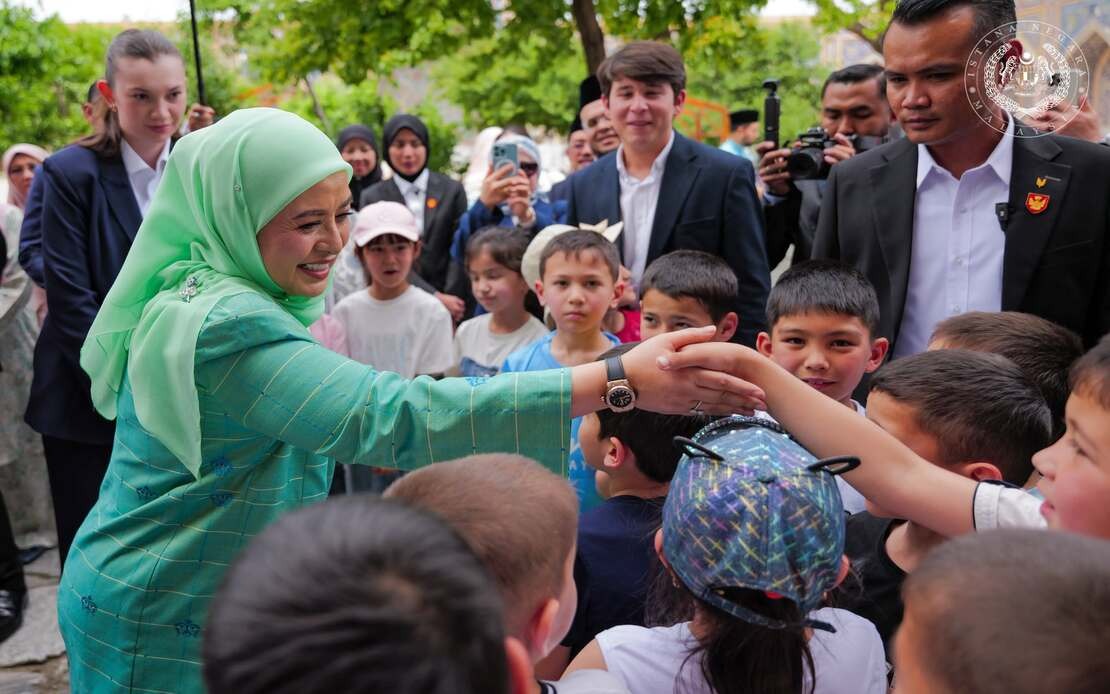
Malaysia's commitment to mutual respect as a cornerstone of social cohesion was recently reaffirmed by Her Majesty Raja Zarith Sofiah, Queen of Malaysia, in remarks shared through official channels. The Queen identified this principle as among the most vital foundations that have historically enabled Malaysians to maintain harmony across their culturally and religiously diverse society, while simultaneously strengthening the bonds of national unity and collective well-being.
In emphasizing the need for courtesy and mutual regard within communities, both domestically and internationally, Her Majesty drew upon Islamic teachings to illustrate the universal relevance of these values. The Queen highlighted a hadith narrated by Abu Hurairah and recorded in the authentic collection of Al-Bukhari, in which Prophet Muhammad outlined three essential principles for believers: avoiding harm to one's neighbours, showing honour to guests, and speaking either kindly or remaining silent. This classical teaching serves as an ethical framework that transcends individual faith backgrounds, emphasizing compassionate conduct and respect for human dignity as shared societal expectations.
The significance of the Queen's intervention lies in her positioning of these values not as aspirational ideals but as practices already deeply embedded within the Malaysian national character. By framing mutual respect as something Malaysians "have always upheld," Her Majesty provides institutional validation for behaviours and attitudes that form the social glue holding together a nation with one of the world's most complex religious and ethnic compositions. This framing is particularly important in a regional context where questions about pluralism and coexistence remain contested in some quarters across Southeast Asia.
Her Majesty's emphasis carries heightened relevance given the current global environment, where polarization and social fragmentation threaten many societies. Malaysia's ability to function as a multilingual, multireligious nation where Malays, Chinese, Indians, and numerous indigenous groups coexist reflects precisely the kind of mutual respect infrastructure that the Queen identified. The monarchy's articulation of these values at the national level reinforces institutional endorsement of behaviour patterns that have empirically contributed to preventing the kind of sectarian violence that has afflicted neighbouring regions.
The Queen's message was particularly directed toward the Muslim community within Malaysia, a strategic choice that reflects the monarchy's role as constitutional guardian of Islam in the federation. By grounding her appeal in Islamic sources rather than secular philosophy, Her Majesty addresses believers in language they recognize as authentic and authoritative. The hadith she cited emphasizes ethical conduct rooted in faith commitment, suggesting that respect for others flows naturally from proper belief and piety rather than constituting a separate, secular principle imposed upon religious identity.
Context for these remarks emerged from a February encounter at Istana Negara, when the Queen engaged warmly with over 100 international tourists at the palace's main entrance. This public demonstration of courtesy extended toward visitors from multiple countries exemplified the very principles she articulated in her subsequent message. Such interactions serve dual purposes: they model the desired behaviours for Malaysian citizens while simultaneously projecting an image of Malaysian hospitality and openness to the international community, a consideration increasingly important for a nation seeking to maintain its standing as a regional economic and diplomatic hub.
The monarchy's intervention in articulating these social values reflects Malaysia's constitutional arrangement, wherein the institution of the Yang di-Pertuan Agong occupies a unique position as both head of state and guardian of Islam. This dual role permits the monarchy to address national unity questions through language that speaks simultaneously to constitutional patriotism and religious identity, a capacity few other institutions within the Malaysian system possess as effectively. The Queen's voice carries particular weight precisely because of her position's symbolic significance across the federation's diverse populations.
Malaysia's experience offers instructive lessons for other plural societies grappling with questions of social cohesion. The explicit affirmation of mutual respect as a national foundational value, articulated through both secular governance channels and religious authorities, creates redundant pathways through which these principles reach citizens. When religious leaders and constitutional authorities convey consistent messages about the importance of treating others with dignity regardless of background, the cumulative effect reinforces behavioural norms more effectively than either institution could achieve alone.
For Malaysian readers, the Queen's remarks deserve attention as more than ceremonial statement-making. They represent a deliberate choice by the highest constitutional authority to place questions of civility, respect, and neighbourly conduct at the forefront of national discourse during a period when social tensions around various issues occasionally surface in Malaysian public conversation. By connecting these values to Islamic tradition, constitutional responsibility, and demonstrable historical practice, Her Majesty provides multiple reinforcing frameworks through which Malaysians can understand mutual respect not as external imposition but as organic expression of their collective identity.
The broader implications extend beyond Malaysia's borders throughout Southeast Asia, where several nations navigate their own plural compositions. The clarity with which Malaysia's monarchy articulates the compatibility between faith-based identity and interethnic respect offers a model that other countries in the region might consider, particularly those seeking to maintain stability while accommodating growing religious and cultural consciousness. The Queen's message implicitly argues that religious commitment and social pluralism need not conflict when grounded in principles of mutual consideration.
Looking forward, the Queen's emphasis on these foundational values suggests the monarchy's continued commitment to positioning itself as guardian of national unity above partisan or sectional interests. In an era of social media fragmentation and increasing polarization globally, such institutional articulation of shared values carries genuine importance. The explicit connection between mutual respect, national harmony, and religious principle provides Malaysians—particularly younger generations for whom these associations may be less intuitive—with authoritative grounding for commitments to pluralistic coexistence that increasingly require conscious cultivation rather than automatic inheritance.


