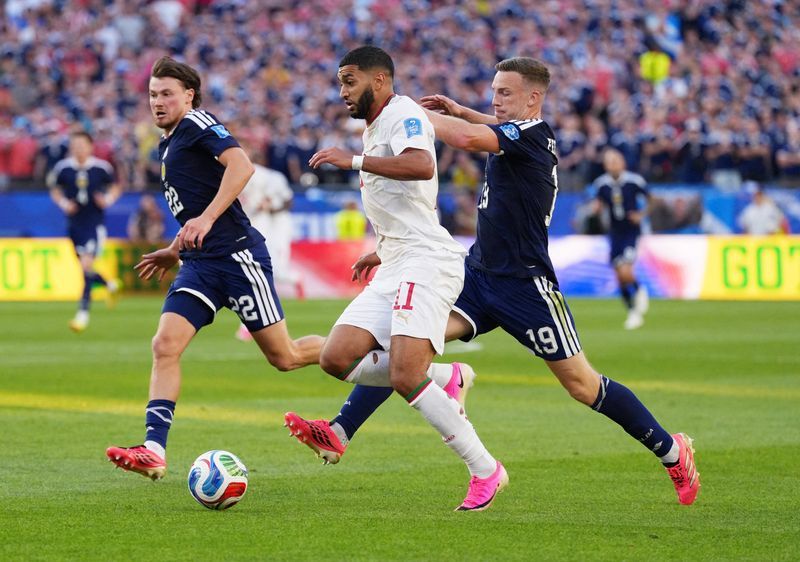
Morocco's superior intensity proved decisive in their 1-0 victory over Scotland in Foxborough, Massachusetts, as the North Africans seized control of Group C with an emphatic performance that extended far beyond the scoreline's apparent closeness. Playing with a pressing intensity that Scotland struggled to match throughout the encounter, Morocco registered their second victory in two matches to occupy the group's summit with four points, leaving the Scots in a precarious position heading into the final round of fixtures.
The match decided itself within the opening moments when Ismael Saibari capitalised on a lapse in Scotland's defensive positioning to record the tournament's fastest goal at just 71 seconds. Receiving a precise cross from Brahim Diaz, Saibari found himself with space behind the Scottish defence after central defender Grant Hanley advanced too eagerly. The Moroccan forward needed no second invitation, striking cleanly past goalkeeper Angus Gunn to set the tone for the remainder of the encounter. This early breakthrough would prove psychologically significant, as Scotland never recovered their equilibrium.
Saibari's clinical finishing added another dimension to his impressive tournament so far. The midfielder, who netted in Morocco's previous 1-1 draw with Brazil and has reportedly undergone medical examinations ahead of a proposed transfer to German champions Bayern Munich, becomes only the second African player to score in his opening two World Cup appearances, joining Egypt's Mohamed Salah in that select category. His emergence as a consistent threat underscores Morocco's depth and attacking ambition at this tournament.
Scotland's preparation and recent history offered little to suggest the dominance they would endure. The Scots had arrived brimming with confidence following their opening 1-0 victory over Haiti, which represented their first World Cup triumph in 36 years and provided genuine momentum. However, the Moroccans dismantled this positive energy with systematic, aggressive football that never allowed Scotland time to establish rhythm or build possession. The visitors created virtually nothing of substance in the opening half, managing no shots on target until deep into stoppage time, a statistic that graphically illustrates their inability to mount meaningful attacking pressure.
Morocco's control extended to several instances where they came agonisingly close to extending their advantage. Azzedine Ounahi orchestrated a dangerous move down the left flank midway through the second half, cutting the ball back into a crowded penalty area only to see two Moroccan attackers fail to make meaningful contact. Later, Bilal El Khannouss fired over the crossbar from a promising position during the first-half exchanges, whilst Saibari himself struck the post with a deflected effort after the interval. These near-misses illustrated a team operating at considerable confidence and tactical coherence.
The Moroccan approach demonstrated calculated aggression without recklessness. Their midfield repeatedly won possession through intelligent pressing, whilst their defensive shape remained compact and organised. El Khannouss forced an important save from Gunn with a glancing header shortly after the restart, evidence of Morocco's capacity to generate multiple scoring opportunities. In contrast, Scotland's attacking contributions proved sporadic and largely ineffectual, with their late-game attempts to create an equaliser ultimately yielding nothing concrete against a defensively resolute opponent.
Morocco's ambition extends beyond mere group survival. Midfielder Ounahi had raised eyebrows during pre-match discussions by publicly stating his team's objective of reaching the final, a comment that might have appeared presumptuous but now carries greater weight given this commanding display. The North Africans reached the semi-finals during Qatar's 2022 World Cup, establishing themselves as serious competitors at the tournament's highest level. Their performance here suggests they possess both the tactical discipline and individual quality to mount another deep run.
The fixture highlighted a contrasting trajectory for both nations. Morocco's victory builds upon their draw with Brazil and positions them ideally ahead of their final group match against Haiti on Wednesday. Scotland's challenge has dramatically intensified following this defeat. The Scots face a daunting final fixture against five-time champions Brazil with only three points from two matches, a situation that demands either a victory or reliance on permutations involving other results. Haiti's confrontation with Brazil later on Friday will prove equally consequential to these calculations, potentially reshaping the mathematical possibilities for all four teams competing within Group C.
The broader context for Southeast Asian and regional football observers reflects Morocco's increasing relevance as a competitive force. Their recent advancement to the semi-finals and continued development of talented players like Saibari suggests the North African nation has moved beyond the category of periodic tournament participant into a more consistent contender. Their systematic approach against Scotland—combining early pressure with controlled possession retention—demonstrates sophistication in tournament football that resonates across Asian competitions, where similar pressing systems have become increasingly prevalent. Morocco's tournament serves as instructive viewing for regional sides studying effective tactical frameworks at the global stage.
For Scotland, this experience delivers a sobering reminder of the margins at elite international level. Despite recent domestic success and genuine quality within their squad, the difference between victory and elimination at this tournament remains measured in single moments and collective intensity. The Scots must regroup psychologically ahead of their Brazil confrontation, knowing that while their path has narrowed considerably, tournament football occasionally produces unexpected outcomes. Their recovery from this disappointment will determine whether they can salvage their participation through an unlikely result against one of football's traditional powerhouses, or whether they depart the competition reflecting on what might have been against a resurgent Morocco.


