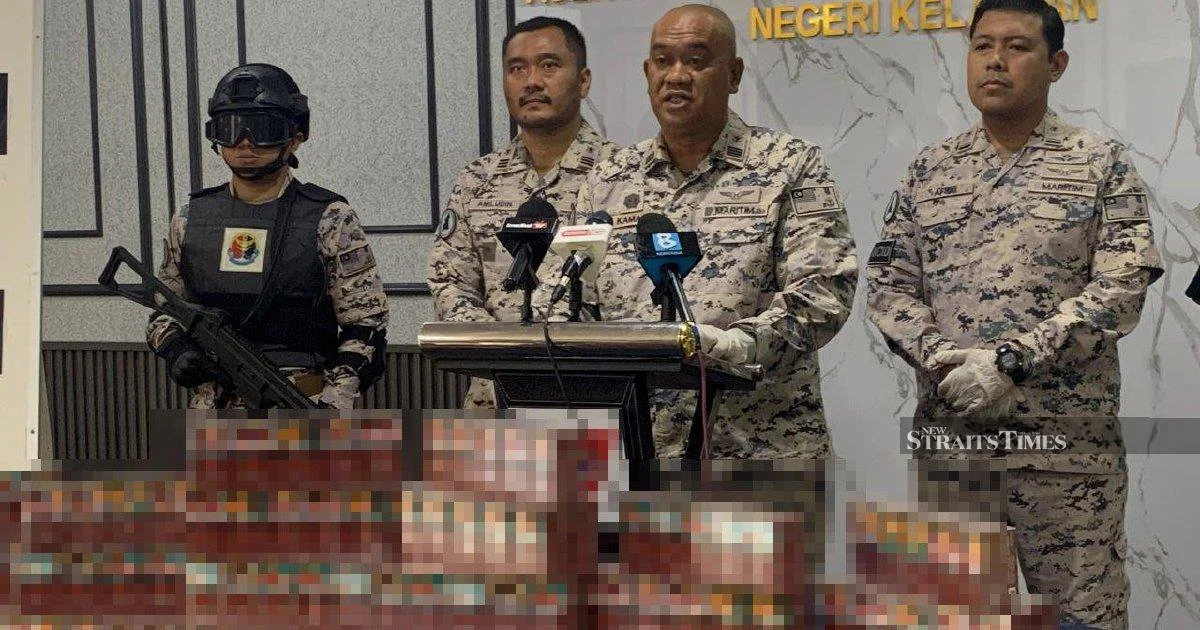
The Malaysian Maritime Enforcement Agency (MMEA) has intensified its grip on contraband trafficking in the Kelantan coastline following a substantial seizure of smuggled cigarettes in recent days. Operating out of Pasir Puteh, enforcement officers apprehended 24 boxes of illegal cigarettes near Kampung Penambang, with the illicit cargo valued at approximately RM212,000. The interception represents a continued crackdown on maritime smuggling networks that have long operated along the strategic Kelantan waterways, a known transshipment point for contraband destined for regional markets.
The seizure underscores the persistent challenge posed by cigarette smuggling across Malaysia's maritime boundaries. Contraband tobacco products remain among the most profitable illicit commodities trafficked through Southeast Asian waters, driven by substantial price differentials between jurisdiction and high consumer demand in the region. These smuggling operations typically exploit remote river systems and coastal access points where enforcement presence is traditionally limited, making waterway operations like those conducted by MMEA increasingly vital to disrupting supply chains.
Kampung Penambang's prominence in this enforcement action highlights how rural river communities inadvertently become transit hubs for organised smuggling syndicates. Traffickers deliberately select locations with limited government infrastructure and sparse civilian populations to minimise detection risks. The MMEA's capacity to monitor and patrol these waterways has become a critical deterrent, though the agency continues to operate with resource constraints across Malaysia's expansive maritime jurisdiction.
The RM212,000 valuation of the seized shipment reflects both the scale of individual operations and the substantial financial incentives driving smuggling networks. Each box likely contained hundreds of cartons of cigarettes, representing inventory that would have generated significant profits once distributed through informal retail channels. The black market for contraband cigarettes typically offers substantial markups over legitimate pricing, creating powerful economic motivations for traffickers to persist despite enforcement risks.
This operation contextualises broader anti-smuggling efforts across the east coast, where maritime proximity to major production and transshipment hubs in the southern Philippines and Brunei creates persistent vulnerability. Kelantan's geographic positioning makes it an attractive entry point for regional contraband flows destined for Malaysian consumption and onward distribution to other states. Law enforcement agencies face constant pressure to adapt tactics as smugglers employ increasingly sophisticated evasion strategies, including the use of smaller vessels and night-time operations to evade detection systems.
The MMEA's enforcement capabilities have expanded substantially in recent years through upgraded surveillance technology and enhanced inter-agency coordination. However, the continuous nature of seizure operations suggests that interdiction efforts, while operationally successful, face systemic challenges in eliminating smuggling at its source. Each major seizure typically represents only a fraction of total contraband traffic moving through Malaysian waters, implying that significant volumes continue to reach domestic markets despite enforcement presence.
Cigarette smuggling carries profound implications for Malaysia's public revenue and fiscal planning. Illicit tobacco products undermine legitimate tax collection, depriving the government of excise revenues crucial for funding public health initiatives and infrastructure development. Additionally, contraband cigarettes often contain unregulated substances and lack proper quality controls, posing health risks to consumers who believe they are purchasing genuine products. The proliferation of black-market cigarettes has become a serious public health concern, particularly affecting younger demographics more vulnerable to marketing and pricing manipulation.
The investigation surrounding this Kelantan seizure presumably continues as authorities seek to identify individuals involved in the trafficking network and upstream sources of the contraband. MMEA cooperation with other enforcement agencies, including the Royal Malaysian Police and Malaysian Customs Department, remains essential for dismantling the broader organisational structures that facilitate these operations. Intelligence gathered from each seizure helps authorities develop targeting profiles for future enforcement activities, enabling more proactive rather than reactive operations.
Looking forward, the MMEA's sustained focus on maritime contraband enforcement reflects official recognition that waterway security directly impacts national economic interests. The agency's ability to execute operations like the Kampung Penambang seizure demonstrates operational effectiveness, yet the persistence of smuggling suggests that enforcement alone cannot eliminate the phenomenon without complementary strategies addressing demand-side factors and international coordination with regional partners. Enhanced information sharing between maritime authorities across Southeast Asia remains essential for identifying trafficking networks and disrupting transnational smuggling infrastructure before illicit goods reach Malaysian shores.