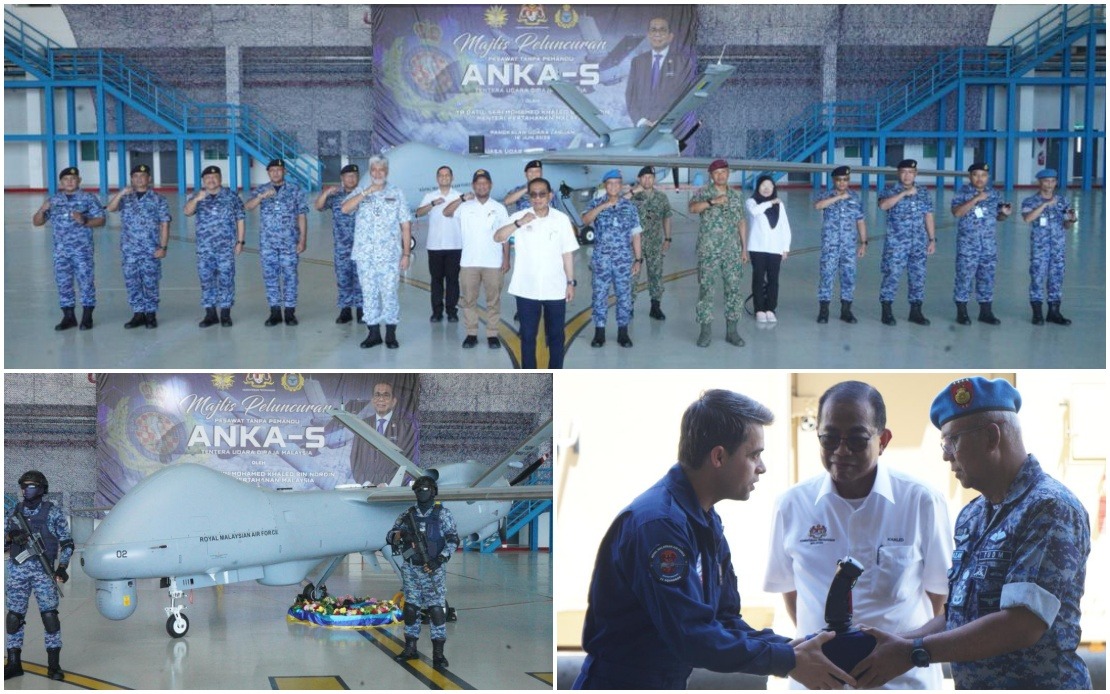
Malaysia has taken a significant step forward in modernizing its defence infrastructure with the operational deployment of the ANKA-S Unmanned Aircraft System by the Royal Malaysian Air Force, a development that carries profound implications for the country's ability to monitor and protect its maritime interests in one of the world's most strategically sensitive regions. Defence Minister Datuk Seri Mohamed Khaled Nordin described the launch of the system at RMAF Labuan Air Base as a transformative moment for national security, providing unprecedented surveillance capabilities that extend Malaysia's operational reach across contested waters and previously difficult-to-monitor areas of strategic importance.
The acquisition of three ANKA-S aircraft, representing an investment of RM423.8 million inclusive of ground control infrastructure and a two-year personnel training programme, reflects Kuala Lumpur's determination to address longstanding gaps in its maritime domain awareness. These medium-altitude, long-endurance platforms represent a departure from Malaysia's traditional reliance on crewed aircraft and surface vessels for surveillance missions, enabling the country to maintain continuous observation over expansive ocean territories without the logistical burden or operational expense of conventional patrol assets. The deployment at Labuan, strategically positioned within the contested South China Sea region, signals Malaysia's intent to strengthen its presence and capability in an area where multiple claimants assert overlapping maritime rights.
The ANKA-S platform brings formidable technical specifications to Malaysia's defence arsenal. Capable of sustained flight exceeding 24 hours at operational altitudes reaching 30,000 feet, the system provides a persistence that traditional manned aircraft cannot match without requiring multiple platforms and rotations. This endurance translates into genuine operational advantage, allowing Malaysian forces to maintain continuous watch over vast maritime zones, conduct detailed vessel identification and tracking, and generate the intelligence necessary to respond swiftly and proportionally to maritime intrusions or suspicious activities. The system's all-weather operational capability further extends its utility, ensuring that surveillance operations continue regardless of meteorological conditions that might ground conventional aircraft.
From an operational efficiency perspective, the introduction of unmanned surveillance systems addresses a persistent challenge facing Southeast Asian navies and air forces: the need to cover extensive maritime areas with limited resources. Where traditional approaches might require multiple sorties by expensive fighter aircraft or the deployment of large patrol vessels for surveillance-only missions, ANKA-S operations enable focused, targeted responses to detected anomalies, reducing fuel consumption, maintenance costs, and crew fatigue while simultaneously increasing response effectiveness. The system's ability to accurately identify and profile vessels allows commanders to make informed decisions about asset deployment, directing resources toward genuine security concerns rather than conducting unfocused patrols across open water.
The conscious decision by Malaysia's leadership not to equip the ANKA-S platforms with offensive weapons, despite the aircraft's technical capability to carry armaments, carries symbolic and strategic weight. By maintaining an explicitly defensive posture, Malaysia communicates to regional and international observers that its capability enhancements serve protective rather than aggressive purposes. This approach reflects the diplomatic sensitivity surrounding military modernization in Southeast Asia, where rapid capability development can trigger security dilemmas and escalatory dynamics among neighbours. Malaysia's restraint in this regard may serve to prevent misinterpretation of its intentions while simultaneously preserving the option for future weaponization should regional circumstances change dramatically.
The positioning of this capability within the South China Sea context cannot be overlooked. The deployment responds to Malaysia's ongoing concerns about protecting its maritime claims, ensuring freedom of navigation, and defending against unauthorized activities in areas where the country exercises sovereign rights or maritime jurisdiction. With multiple powerful nations maintaining substantial military presences in these waters and several smaller states pursuing competing territorial claims, Malaysia's enhanced surveillance capacity provides valuable intelligence for domestic decision-making and potentially strengthens its negotiating position in regional forums addressing maritime security and dispute resolution.
The broader regional implications of Malaysia's ANKA-S deployment extend beyond bilateral defence considerations. As Southeast Asian nations grapple with capacity-building challenges and budget constraints, successful adoption of unmanned systems by the RMAF may influence procurement decisions and strategic planning across the region. Neighbouring countries monitoring Malaysia's investment may view the system's deployment and performance as a reference point for evaluating their own surveillance and defence modernization requirements, potentially sparking a wave of similar acquisitions that collectively reshape the region's defence architecture.
The government's indication that a second phase acquisition of three additional ANKA-S platforms is under consideration demonstrates confidence in the current system and acknowledgement that comprehensive maritime coverage requires expanding this capability. Such expansion would effectively double Malaysia's unmanned surveillance capacity, enabling more persistent coverage of critical maritime zones and providing redundancy that enhances operational resilience. The inclusion of this proposal within Malaysia's national development planning framework indicates a serious commitment to advancing these capabilities as part of broader defence modernization rather than treating it as a peripheral initiative.
The establishment of a dedicated Data Exploitation Centre to process and analyze intelligence generated by the ANKA-S platforms reflects mature understanding that sensor systems alone provide incomplete value; the infrastructure, expertise, and analytical frameworks required to convert raw surveillance data into actionable intelligence prove equally crucial. Malaysia's investment in this supporting infrastructure demonstrates that the government approaches unmanned surveillance not as a standalone technological acquisition but as part of an integrated system requiring comprehensive organizational development and personnel training.
From a cost-benefit perspective, the ANKA-S deployment aligns with rational defence economics, particularly for a middle-power nation navigating substantial security challenges across extensive maritime territory. The operational expense of continuous surveillance using manned aircraft or dedicated patrol vessels far exceeds the marginal cost of operating unmanned platforms once initial acquisition investments are amortized. This economic efficiency permits Malaysia to maintain higher surveillance optempo, increasing the likelihood of detecting unauthorized activities while maintaining budgetary discipline across other defence priorities.
The technical specifications and operational characteristics of the ANKA-S system position Malaysia to address contemporary maritime security challenges more effectively than previously possible. Threats ranging from unauthorized fishing and resource exploitation to human trafficking and transnational smuggling all require sustained observation capabilities that traditional approaches struggle to provide. The unmanned platform's ability to loiter over suspect areas for extended periods, coupled with sophisticated sensor packages capable of accurate vessel identification, provides Malaysian authorities with intelligence supporting law enforcement and regulatory actions across multiple maritime security domains.
Looking forward, Malaysia's ANKA-S deployment establishes a foundation for further defence technology integration and capability advancement. Success with these platforms may facilitate acquisition of additional unmanned systems optimized for different operational requirements, creation of operational doctrine governing unmanned platform employment, and development of personnel expertise that permits maximum exploitation of the technology's potential. The experience gained through operational deployment provides valuable feedback informing future procurement decisions and strategic planning within the RMAF.
Ultimately, the ANKA-S introduction represents Malaysia's pragmatic response to contemporary security challenges in a strategically complex region where enhanced awareness and rapid response capabilities provide competitive advantage. By deploying proven technology in a defensive posture that respects regional sensitivities while clearly signaling determination to protect national interests, Malaysia demonstrates strategic sophistication in balancing security imperatives against diplomatic considerations. The success of this initiative may establish a template for how Southeast Asian nations approach defence modernization in an era of constrained budgets, technological proliferation, and competing regional claims.


