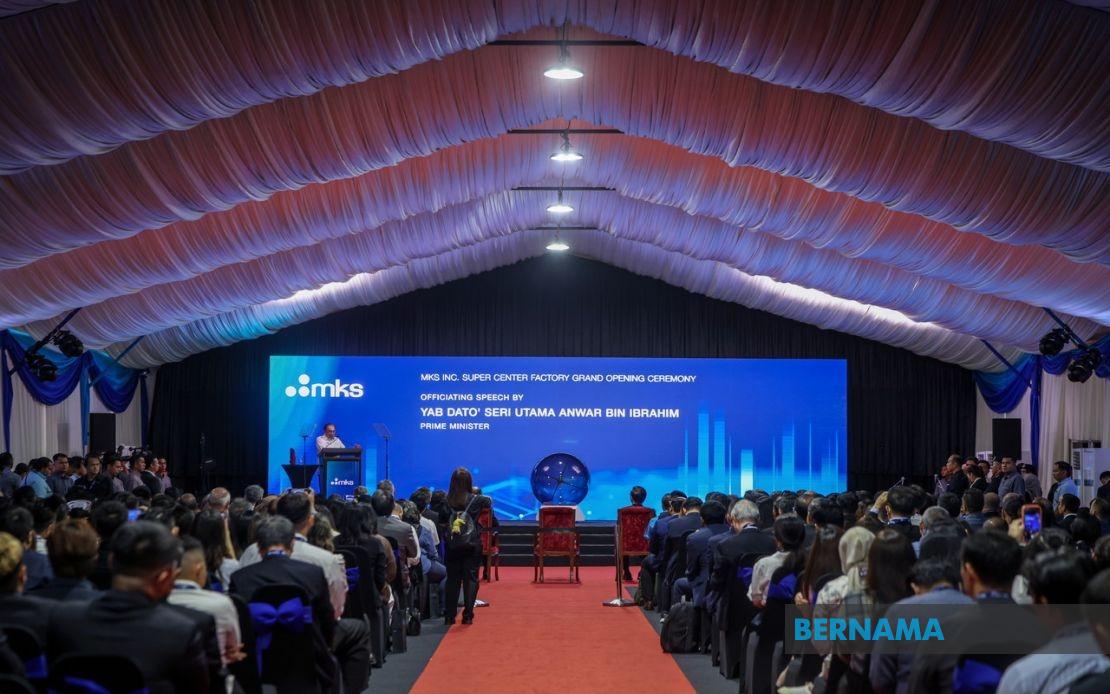
Prime Minister Datuk Seri Anwar Ibrahim has underscored the strategic advantages flowing from Malaysia's deliberate positioning as an independent actor willing to engage with all major powers, a diplomatic posture that he argues has translated into tangible economic gains for the nation. Speaking at the opening of the MKS Super Centre facility in Bandar Cassia Technology Park, Penang, on June 20, Anwar framed Malaysia's refusal to align exclusively with any geopolitical bloc as a source of competitive strength in attracting investment and forging partnerships across diverse regions and political systems.
The Prime Minister's remarks reflect a broader messaging strategy emphasizing Malaysia's capacity to maintain cordial relations simultaneously with the United States, China, India, Russia, and other significant economies without sacrificing national autonomy. He cited recent high-level engagements, including an earlier visit from US President Donald Trump, as evidence of the government's success in cultivating relationships across the ideological and strategic divides that increasingly characterize global affairs. This multipronged diplomatic approach, Anwar suggested, positions Malaysia as a reliable and neutral partner—a reputation that has become commercially valuable in a world fragmented by competing power centers and trade blocs.
A concrete manifestation of this strategy emerged through Petroliam Nasional Bhd, Malaysia's national oil and gas corporation, which recently concluded a significant agreement in Turkmenistan. The deal exemplifies how political goodwill and diplomatic standing can translate into commercial opportunities in energy sectors controlled by strategically important nations. By maintaining working relationships with hydrocarbon-rich states across Central Asia and the broader region, Malaysia has positioned Petronas to compete for contracts and partnerships that might otherwise gravitate toward companies backed by countries perceived as aligned with rival superpowers.
Anwar's framing of neutrality as an economic asset addresses a persistent challenge for Southeast Asian nations: how to benefit from multiple sources of capital, technology, and market access without becoming trapped in zero-sum competitions between major powers. Malaysia, as a middle-income economy with substantial energy resources, manufacturing capabilities, and financial services, occupies precisely the kind of position where such strategic flexibility holds particular value. Companies seeking to diversify supply chains, access new markets, or establish regional hubs increasingly view Southeast Asia as attractive precisely because nations here maintain economic ties across geopolitical divides.
The Prime Minister's comments also implicitly acknowledge the costs of perceived alignment. Countries that are seen as firmly within one bloc's orbit often find themselves excluded from opportunities in competing blocs, particularly in sensitive sectors such as energy, defense, and advanced technology. Malaysia's track record of maintaining substantive relationships with both Western nations and China, despite the obvious tensions in such relationships, reflects a calculation that the economic benefits of flexibility outweigh the potential security or political risks that exclusive alignment might mitigate.
The event itself, attended by Penang Chief Minister Chow Kon Yeow and Deputy Minister of Investment, Trade and Industry Sim Tze Tzin, underscored the domestic dimension of this foreign policy approach. The MKS facility expansion represents investment in manufacturing and technology sectors that increasingly depend on global supply chains and export markets. Companies operating in Penang's industrial parks benefit directly from Malaysia's reputation as a stable, neutral jurisdiction where business can proceed without being caught in geopolitical crossfires that disrupt operations or impose sanctions.
However, sustaining this balancing act requires consistent vigilance and diplomatic skill. Global pressure to choose sides has intensified since 2022, particularly regarding stances toward Ukraine, Taiwan, and the Western-led sanctions regime against Russia. That Anwar felt compelled to highlight recent engagement with Russia suggests the government views maintaining this relationship as important enough to publicly defend, even as Western allies might privately pressure Malaysia to distance itself. The Prime Minister's assertion that Malaysia "expresses our position in some of the more contentious issues" while welcoming "participation of all" attempts to square this circle: maintaining relationships while reserving judgment on divisive matters.
For Malaysia's business community, this diplomatic positioning creates practical advantages. The country's attractiveness as a destination for regional headquarters, manufacturing operations, and financial services stems partly from its relative stability and the perception that Malaysia will not suddenly become unavailable to international partners due to geopolitical ruptures. Multinational corporations hedging against future uncertainty in global trade relationships find Malaysian locations particularly valuable for their flexibility and access to multiple markets.
The broader context for Anwar's remarks involves Southeast Asia's increasing centrality to global economic and strategic competition. As the United States, China, Japan, India, and European powers all vie for influence in the region, nations like Malaysia that can credibly claim independence and neutrality gain leverage in negotiations. They become sought-after partners rather than reluctant auxiliaries in someone else's strategic competition. This inversion of power dynamics—where smaller nations punch above their weight by refusing subordination—represents a significant shift from earlier eras when geopolitical alignment was largely binary and non-alignment was viewed with suspicion.
Moving forward, maintaining this equilibrium will depend on Malaysia's ability to manage expectations and deliver tangible benefits from its diplomatic flexibility. The Petronas deal in Turkmenistan illustrates the potential; similar successes across multiple sectors will reinforce the argument that neutrality and independence generate concrete returns. Conversely, any perception that Malaysia is tilting decisively toward any bloc, or that its neutrality is merely performative, could erode the diplomatic capital Anwar is describing. The Prime Minister's emphasis on Malaysia's "centrality" suggests confidence in this strategy, but the real test will be sustaining it through future crises and pressures.


