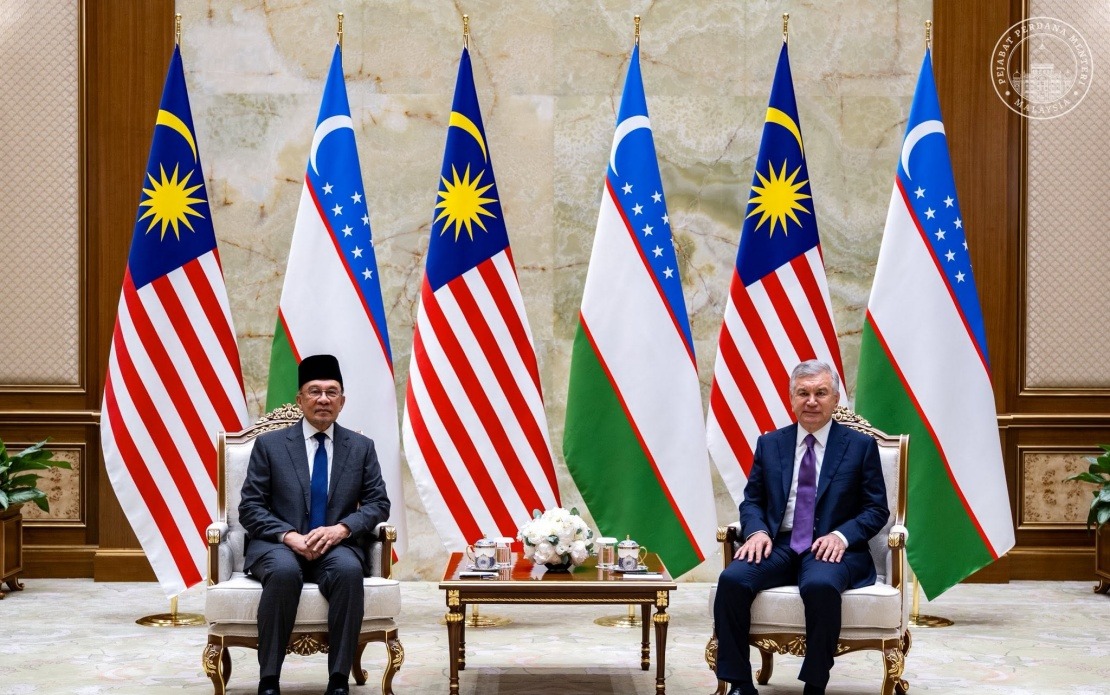
Prime Minister Datuk Seri Anwar Ibrahim has identified substantial opportunities for Malaysia to deepen its partnership with Uzbekistan across multiple strategic domains, ranging from hydrocarbon industries to cultural and educational exchanges. The Malaysian leader articulated this vision following a transit meeting with Uzbekistan President Shavkat Mirziyoyev in Tashkent on June 17, before proceeding to Kazan for the ASEAN-Russia Commemorative Summit scheduled for June 17-18. Though the encounter was relatively brief, Anwar characterised it as productive, allowing both nations to chart a more comprehensive bilateral roadmap centred on mutual economic advancement and shared civilisational values.
Energy cooperation emerged as a cornerstone of the proposed partnership framework discussed during the talks. Anwar emphasised that the gas and petroleum sectors hold particular promise for joint ventures and knowledge transfer. For Malaysia, this represents a strategic opportunity to secure alternative supply chains and deepen ties with a Central Asian energy hub, while Uzbekistan gains access to Malaysian expertise in energy trading and downstream operations. Beyond immediate commercial gains, both nations recognised that expanded energy collaboration could meaningfully contribute to regional energy security during a period of geopolitical uncertainty and fluctuating commodity prices. The emphasis on sustainable development within this energy discourse reflects contemporary global pressures for cleaner transition strategies.
The bilateral agenda extends considerably into traditional trade and investment channels. Malaysia's established expertise in financial services, manufacturing and technology transfer positions it as an attractive partner for Uzbekistan's development aspirations, while Uzbek cotton, minerals and agricultural exports could find growing receptivity within Malaysian supply chains and re-export networks. Investment flows in both directions could be stimulated through targeted policies and institutional frameworks, potentially including special economic zones or joint industrial ventures that leverage comparative advantages.
Educational cooperation stands as another pillar, with particular significance for Malaysia's positioning as a regional knowledge centre. Malaysian universities have long attracted Central Asian students, and expanded scholarships and academic partnerships with Uzbek institutions could strengthen people-to-people bonds whilst addressing skills shortages in both economies. This educational dimension transcends mere technical training, fostering long-term networks of influence and soft power for Kuala Lumpur across a strategically important region.
Anwar placed considerable emphasis on the halal industry as a domain where Malaysia's established global leadership could be leveraged advantageously. Uzbekistan's significant Muslim population and emerging food production capabilities present an untapped market for Malaysian halal certification expertise, product standards and logistical infrastructure. As global halal markets expand at double-digit annual rates, collaborations between Malaysia and Uzbekistan could position both nations more competitively within this burgeoning sector whilst generating employment and value-added processing opportunities.
Tourism cooperation was articulated as a mutual growth driver, with Malaysia seeking to tap Uzbekistan's underexploited tourist market whilst promoting Malaysian destinations to Central Asian travellers. The historic Silk Road heritage of Uzbekistan and Malaysia's positioning as a regional tourism hub create natural complementarities. Enhanced air connectivity, visa facilitation and cultural marketing initiatives could unlock significant visitor flows and hospitality sector revenues for both nations.
Beyond commercial considerations, Anwar brought a civilisational dimension to the bilateral relationship, underscoring the shared Islamic heritage and scholarly traditions that both nations inherited. He referenced the importance of preserving and advancing Islamic civilisation's intellectual legacy, gesturing towards collaborative initiatives in heritage conservation, Islamic finance, Islamic jurisprudence and knowledge production. This framing elevates the partnership above transactional dealings, positioning Malaysia-Uzbekistan relations as part of a broader Muslim world solidarity that carries soft power and cultural resonance.
Anwar's remarks reflected Malaysia's conscious effort to expand its diplomatic footprint beyond traditional Southeast Asian circles and into Central Asia. Uzbekistan, as the region's most populous nation and an increasingly assertive regional player under President Mirziyoyev's modernisation agenda, represents a valuable gateway for Malaysian influence and commercial opportunities. The timing of this engagement, occurring alongside Malaysia's participation in the ASEAN-Russia Summit, signals Kuala Lumpur's commitment to maintaining balanced regional diplomacy whilst building bridges across diverse geopolitical zones.
The Prime Minister commended Uzbekistan's strengthening engagement with ASEAN, recognising that Central Asian nations are seeking deeper integration with Southeast Asia through multilateral platforms. This mutual interest creates fertile ground for expanding bilateral ties whilst contributing to broader regional connectivity and interdependence. Enhanced Malaysia-Uzbekistan cooperation could serve as a model for broader ASEAN-Central Asia partnerships, potentially spurring similar initiatives among other Southeast Asian capitals.
Anwar's articulation of partnership goals emphasised equitable and inclusive development, language reflecting Malaysia's developmental philosophy and contemporary international development discourse. By framing cooperation as serving human dignity and knowledge empowerment rather than purely extractive commercial transactions, the Prime Minister positioned the bilateral relationship within a progressive framework resonant with both nations' aspirations for sustainable and people-centred growth.
Before departing Tashkent, Anwar extended warm wishes to Uzbekistan's national football team ahead of their 2026 FIFA World Cup campaign opener against Colombia, a small gesture demonstrating the people-to-people dimensions of bilateral relations. This added a humanising element to otherwise formal governmental discussions, suggesting Malaysia's approach to international engagement incorporates cultural and sporting dimensions alongside economic and political calculations.