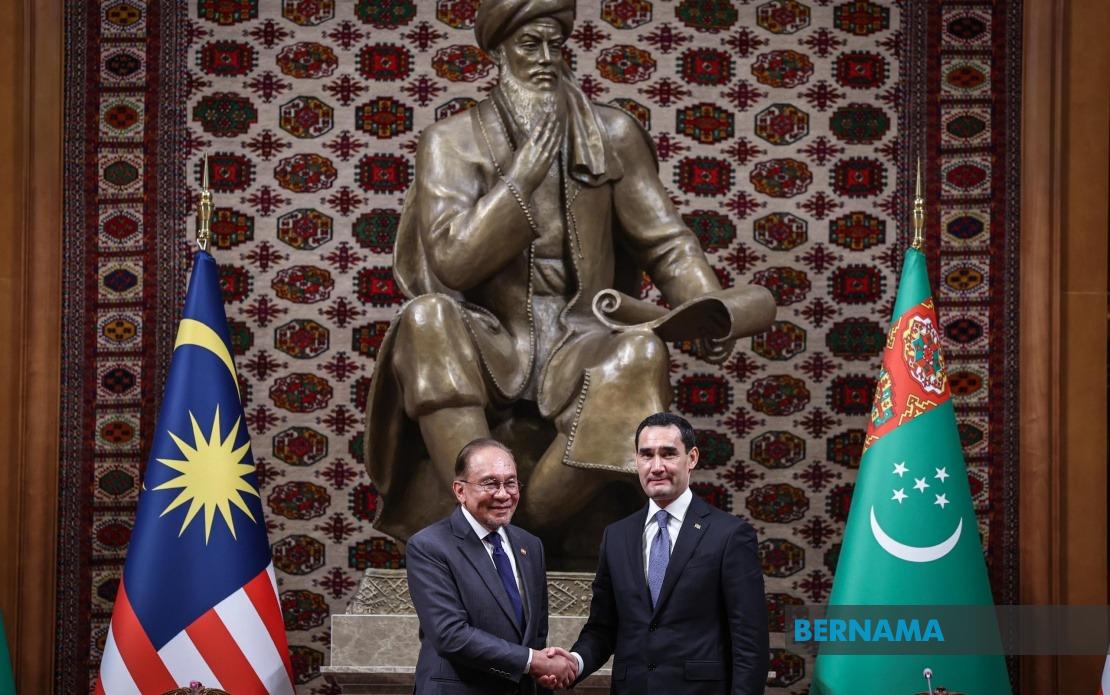
Prime Minister Datuk Seri Anwar Ibrahim has announced a significant elevation in Malaysia's relationship with Turkmenistan following his bilateral meeting with President Serdar Berdimuhamedov, framing the partnership as one built on strategic alignment and mutual benefit. The commitment, formalised through multiple agreements and memoranda of understanding exchanged at the Presidential Palace in Ashgabat on Friday, represents a deliberate recalibration of diplomatic engagement between the two nations. Anwar characterised the relationship as progressive and complementary, emphasising that both governments would prioritise implementation rigour and transparency across all cooperative ventures.
The visit marks a milestone moment for Malaysian diplomacy in Central Asia. Conducted at Berdimuhamedov's invitation, this represents Anwar's inaugural official visit to Turkmenistan since assuming office as Malaysia's 10th Prime Minister in November 2022. The two-day engagement, which commenced on June 18, carries symbolic weight beyond routine state visits, signalling Malaysia's intent to broaden its engagement network beyond traditional Southeast Asian and Middle Eastern partners. This expansion aligns with Kuala Lumpur's broader strategy to diversify economic and diplomatic corridors in response to shifting geopolitical dynamics.
During the extensive bilateral talks, both delegations explored cooperation spanning remarkably diverse sectors. Energy emerged as a central pillar, reflecting Turkmenistan's role as a significant hydrocarbon producer and Malaysia's ongoing interest in securing alternative energy partnerships. Beyond conventional energy, discussions encompassed trade and investment frameworks, positioning both economies to exploit complementarities in their respective sectors. The halal industry featured prominently, underscoring Malaysia's positioning as a global halal hub and Turkmenistan's potential as both a producer and market for certified halal products.
Islamicbanking and financial services constituted another substantive area of engagement. Malaysia's sophisticated Islamic finance ecosystem and regulatory frameworks present opportunities for knowledge transfer and institutional partnerships with Turkmenistan as it develops its own financial infrastructure. Educational collaboration, research partnerships, and science and technology cooperation were similarly outlined, suggesting potential for academic exchanges and innovation initiatives. Tourism and air connectivity rounded out the discussion agenda, with enhanced aviation links essential for deepening people-to-people exchanges and commercial travel between the nations.
Four principal documents were formally executed during the ceremony, each tailored to specific cooperation domains. An Air Services Agreement between both governments provides the regulatory foundation for expanded flight connections, reducing barriers to direct aviation links and facilitating increased passenger and cargo movements. This agreement holds particular significance for Malaysian carriers seeking to expand Central Asian operations and for Turkmen entities interested in Southeast Asian markets. Two memoranda of understanding linked the foreign relations and diplomatic training institutions of both countries—Malaysia's Institute of Diplomacy and Foreign Relations and Turkmenistan's Institute of International Relations—creating channels for professional exchange and capacity building among diplomatic cadres.
The fourth instrument established collaborative frameworks between Malaysia's Ministry of Transport and Turkmenistan's State Service, addressing infrastructure and connectivity challenges. A further accord between the Academy of Sciences Malaysia and Turkmenistan's Academy of Sciences opens pathways for collaborative research, though the specific focus areas remain subject to detailed implementation arrangements. These institutional linkages suggest long-term commitment, moving beyond transactional diplomacy toward sustained structural engagement.
Anwar's delegation composition reflected the visit's economic and financial dimensions. Accompanying the Prime Minister were Datuk Seri Johari Abdul Ghani in his capacity as Minister of Investment, Trade and Industry, along with Minister of Economy Akmal Nasrullah Mohd Nasir and senior government officials. This high-level representation signalled Malaysia's seriousness in advancing concrete business opportunities and investment frameworks. Johari's presence particularly underscores the trade and investment component, suggesting active commercial exploration beyond diplomatic niceties.
The Prime Minister's characterisation of the partnership emphasised structured implementation and disciplined execution. This language reflects lessons learned from previous bilateral initiatives where ambitious declarations failed to translate into substantive outcomes. By explicitly committing to transparent and effective implementation mechanisms, both leaders acknowledged that strategic agreements require robust follow-through mechanisms and institutional accountability. This framing suggests establishment of joint committees or working groups to monitor progress and address implementation bottlenecks.
From a broader regional perspective, Malaysia's engagement with Central Asian nations like Turkmenistan reflects a conscious recalibration of foreign policy priorities. As geopolitical competition intensifies in Southeast Asia and the Indo-Pacific, Malaysia has recognised advantages in cultivating relationships with countries outside traditional spheres of influence. Turkmenistan, whilst geographically distant, occupies strategic importance in energy corridors, Islamic finance development, and as a counterweight to dominance by traditional powers in regional architecture. The partnership also provides Malaysia platforms for advancing Islamic finance expertise and halal certification standards in new markets.
Turkmenistan's perspective similarly benefits from these arrangements. Malaysia offers a gateway to Southeast Asian markets and investment, alongside expertise in Islamic banking, halal production, and emerging technologies. For a nation seeking to diversify international partnerships and reduce dependency on traditional allies, Malaysia presents an attractive partner combining geographic diversity, Islamic compatibility, and developed institutional frameworks across multiple sectors.
The emphasis on long-term benefits for both nations' peoples represents important rhetorical grounding, suggesting these partnerships extend beyond elite-level arrangements toward tangible improvements in bilateral commerce, employment opportunities, and cultural exchange. Enhanced air connectivity directly facilitates tourism flows, business travel, and family visits. Energy cooperation could contribute to Malaysia's energy security objectives, whilst educational exchanges build human capital and institutional ties that endure across political transitions.
Looking forward, the success of this partnership framework hinges on implementation capacity and sustained political commitment from both governments. The institutional mechanisms established through the various memoranda require adequate resourcing and administrative priority. Trade and investment provisions require compatible regulatory frameworks and dispute resolution mechanisms. Energy partnerships necessitate detailed commercial negotiations and long-term contracts. These practical challenges lie ahead, but the comprehensive nature of the agreements signed suggests serious intent to move beyond ceremonial engagement toward substantive cooperation.


