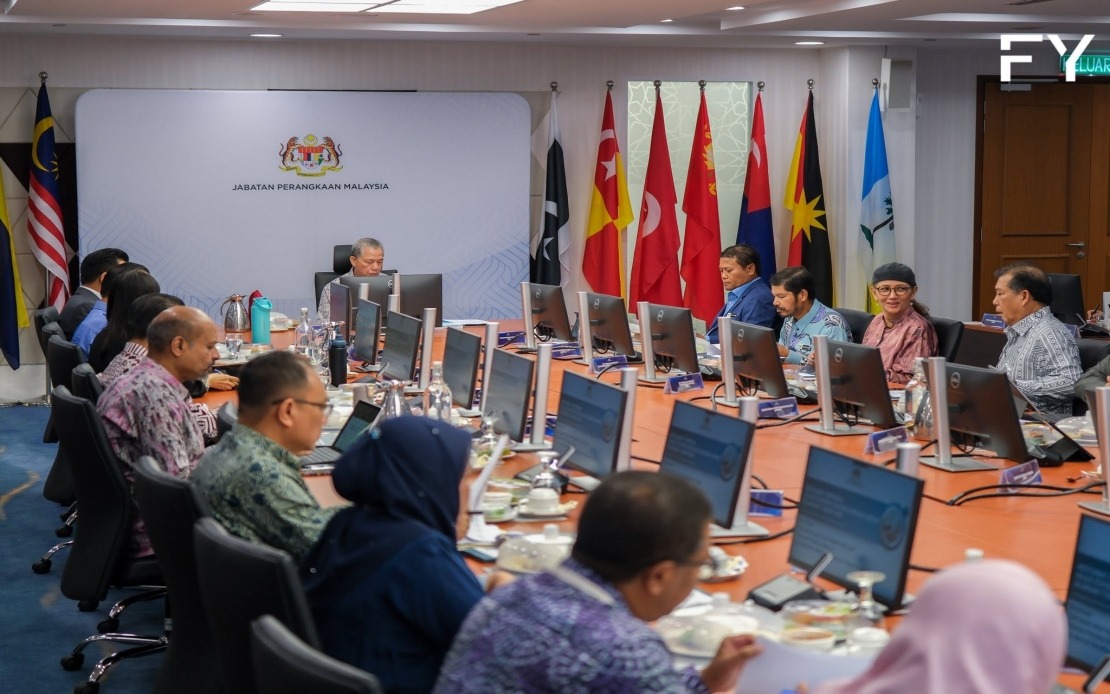
The government is positioning data and artificial intelligence as foundational strategic assets to strengthen the country's policy framework and drive the success of the 13th Malaysia Plan spanning 2026 to 2030, according to Deputy Prime Minister Datuk Seri Fadillah Yusof. Speaking after chairing a high-level meeting of the National Statistics and Data Council, Fadillah outlined how a data-centric approach to governance has become essential in an era marked by compounding global pressures, from economic volatility to climate emergencies and the accelerating pace of technological change. This positioning reflects a broader shift among policymakers towards treating information infrastructure not merely as an administrative convenience but as a critical competitive advantage for national development.
The remarks come at a pivotal moment for Malaysian governance, as the country faces mounting pressures to modernize its institutional machinery while managing complex socioeconomic challenges. Fadillah stressed that the integrity, quality and timeliness of statistical information now form the backbone of effective public administration, enabling authorities to monitor outcomes with precision and adjust interventions rapidly. The emphasis on data governance signals an acknowledgment that previous development planning, while achieving results, may have lacked the real-time responsiveness that contemporary crises demand. For Malaysian readers, this implies a potential recalibration of how central government functions will interact with citizens and businesses, particularly through more granular policy targeting and performance accountability.
Central to this agenda is the sustained strengthening of Malaysia's National Statistical System, which requires coordinated effort across traditionally siloed government departments. The National Statistics and Data Council meeting brought together senior officials including the Works Minister, Deputy Health Minister, Deputy Communications and Digital Ministers, and other economic figures, reflecting the cross-cutting nature of data infrastructure. This institutional arrangement suggests the government recognizes that robust statistics cannot be produced by a single agency but demands collaboration spanning infrastructure, health services, digital connectivity and economic policy. For regional observers, this approach mirrors efforts in other Southeast Asian economies to build more integrated data ecosystems, though Malaysia's explicit elevation of the issue through high-level council meetings indicates particular seriousness about implementation.
Fadillah highlighted Malaysia's recent economic performance as vindication of data-informed policymaking, noting that first-quarter 2026 gross domestic product growth of 5.4 percent reflected the effectiveness of development strategies built on statistical evidence. This framing is significant because it positions rigorous data collection not as a bureaucratic exercise but as a pragmatic tool with demonstrable returns. The implication is that future policy initiatives in priority areas will increasingly require robust evidence bases, potentially raising standards for project justification and evaluation. For businesses operating in Malaysia, this may translate into more stringent requirements to provide performance data and contribute to national statistical efforts, though it could also lead to more efficient government spending and clearer market signals.
Among the critical infrastructure gaps the government is addressing is the development of an integrated national database that can synthesize information from disparate sources while maintaining security and ethical standards. Fadillah emphasized that the ability to combine data streams coherently has become crucial for understanding complex challenges and accelerating governmental decision-making. This initiative directly addresses what analysts have long identified as a weakness in Malaysian administration: the tendency for different agencies to operate information silos with limited cross-agency visibility. Building such integration requires not only technological investment but also harmonization of data standards, privacy protocols and governance arrangements, a multi-year undertaking that will require sustained institutional commitment.
The role of artificial intelligence and advanced analytics features prominently in the government's agenda, with Fadillah explicitly linking AI deployment to enhanced productivity and national competitiveness. The government plans to develop big data analytics capabilities and leverage machine learning to extract actionable insights from accumulating information reserves. For Malaysia's economy, this could enable more sophisticated targeting of industrial policy, faster identification of labor market mismatches, and improved resource allocation in critical sectors. However, successful AI implementation depends on having sufficient quantities of clean, well-structured data and skilled personnel to operate these systems, areas where Malaysia faces acknowledged gaps compared to more digitally mature economies.
Several strategic initiatives under review reflect the breadth of the data modernization agenda. These include standardizing official statistical definitions across government, fortifying protocols for data governance, incorporating administrative records more systematically, building databases focused on science and technology talent pipelines, leveraging data to support youth development initiatives, and establishing comprehensive management systems for national road assets. Each of these initiatives addresses specific policy priorities while contributing to an overarching goal of creating what Fadillah termed a more integrated and development-oriented national data ecosystem. For Malaysian state governments and local authorities, these initiatives will likely generate new requirements for data submission and reporting, demanding investment in their own information technology capabilities.
The emphasis on data infrastructure becomes particularly acute in sectors explicitly identified as strategic priorities, including energy transition, climate change mitigation, water management and sustainable development. These domains involve long time horizons, significant public investment, and complex trade-offs between competing objectives—precisely the scenarios where rigorous data analysis can prevent costly errors. The government's determination to anchor these initiatives in comprehensive data support suggests a recognition that previous approaches to sector planning may have been inadequately informed by real-time evidence. For regional policymakers and the international development community observing Malaysia's approach, this signals a maturing institutional commitment to evidence-based governance in domains where political pressure can otherwise encourage suboptimal choices.
The institutional machinery assembled around data governance—the National Statistics and Data Council with its permanent members from across government—provides a structural mechanism for translating the stated priority into operational reality. By bringing cabinet-level officials and the Chief Statistician into regular coordination, the government creates accountability pathways and elevates data issues above routine administrative concerns. This arrangement distinguishes Malaysia's approach from that of countries where statistical agencies operate with minimal senior political engagement. However, the success of such councils depends entirely on the resources they command, the authority vested in their recommendations, and the follow-through from member agencies on agreed initiatives—dimensions that will become apparent only through implementation.
For Malaysian readers and businesses, the concrete implications of this data-centric governance approach will unfold gradually across the 13MP period. Enterprises may find themselves increasingly required to contribute data to government registries as part of sectoral or regulatory obligations. Policy interventions may become more precisely calibrated based on better information, potentially creating winners and losers among firms and communities. Government agencies may become more responsive to real-time evidence of policy failure, accelerating course corrections. The risks include privacy concerns if data integration proceeds without robust safeguards, or displacement of smaller businesses unable to meet enhanced reporting requirements. The potential benefits include more efficient allocation of public resources, fairer distribution of government support, and faster economic adaptation to emerging challenges.
The broader context for Malaysia's data modernization agenda includes the acceleration of digital transformation across Southeast Asia and intensifying global competition in digital infrastructure and AI capabilities. By investing in foundational data systems and analytical capacity, Malaysia positions itself to extract greater value from digital technologies and potentially participate in regional and global data-driven innovation ecosystems. The challenge will be ensuring that improvements in statistical rigor and analytical sophistication translate into tangible improvements in service delivery and economic opportunity for ordinary Malaysians, rather than remaining confined to elite technocratic circles. Fadillah's public statements emphasize this connection between data infrastructure and public benefit, though closing the gap between aspiration and operational reality will require sustained attention and adequate resourcing throughout the 13MP implementation period.


