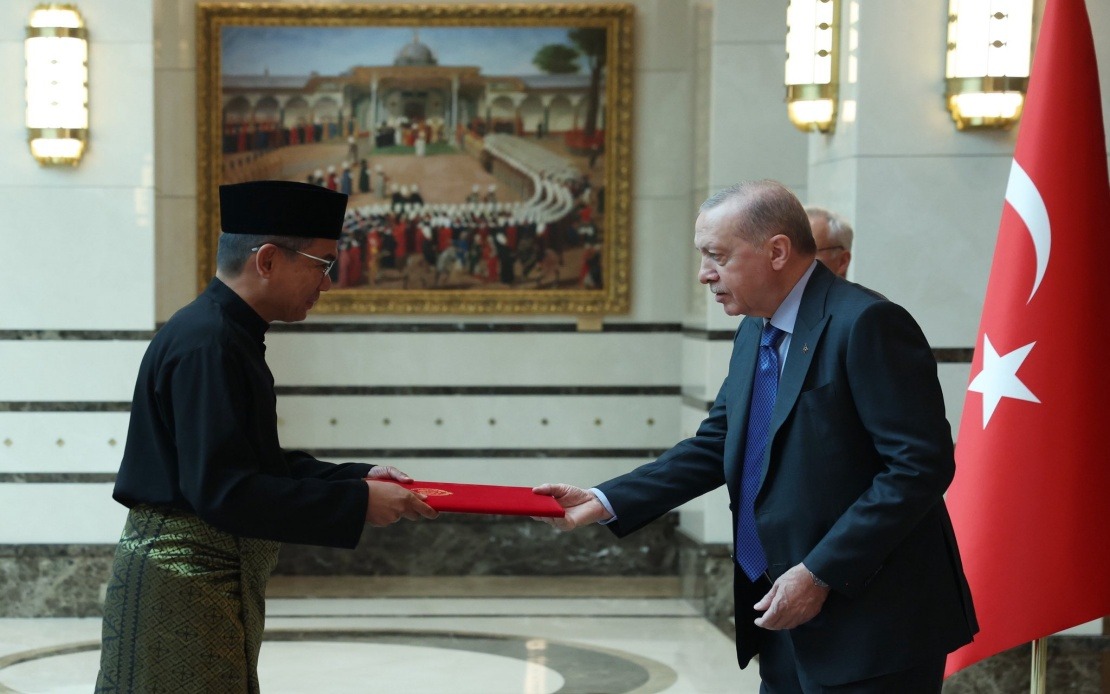
Malaysia has thrown its weight behind Türkiye's ambition to become an ASEAN Dialogue Partner, marking a significant diplomatic gesture that underscores growing strategic alignment between the Southeast Asian nation and the Turkish government. The formal endorsement was delivered when Malaysian Ambassador to Türkiye Adlan Mohd Shaffieq presented his credentials to Turkish President Recep Tayyip Erdoğan at the Presidential Complex in Ankara on June 17, with the Malaysian Embassy in the capital subsequently releasing a statement confirming Kuala Lumpur's position on the matter.
The ambassador's remarks during the credential ceremony highlighted Ankara's expanding relevance to the Southeast Asian region, framing Türkiye as an increasingly consequential partner whose influence extends well beyond bilateral relations with individual ASEAN members. According to the embassy statement, Shaffieq emphasised that Türkiye has strengthened its foothold in Southeast Asia through multifaceted engagement that encompasses not only economic initiatives but also strategic considerations and deepening connections among ordinary citizens. This characterisation reflects a broader Malaysian perspective that views Türkiye as a natural partner whose interests and values increasingly align with those of ASEAN nations.
The timing of Malaysia's public support holds particular significance given the country's standing within ASEAN and its diplomatic influence in regional forums. As a founding member of the Association and a respected voice in regional deliberations, Malaysia's endorsement carries weight in discussions about dialogue partnership applications. The statement effectively signals to other ASEAN members that Kuala Lumpur sees merit in expanding the bloc's network of official partners, particularly when such expansion involves nations with demonstrated commitment to the region's prosperity and stability.
Malaysia and Türkiye have cultivated an increasingly robust relationship characterised by regular high-level exchanges and expanding cooperation across multiple sectors. The bilateral partnership encompasses education, defence cooperation, and the halal industry—domains where both nations possess particular expertise or market advantages. Education ties have deepened as Malaysian students pursue higher learning in Turkish universities, while defence collaboration reflects shared regional security interests. The halal industry represents perhaps the most distinctive pillar of their relationship, given Türkiye's significant position as a halal products exporter and Malaysia's role as a leading halal certification and standards-setting hub.
The ambassador took the opportunity to convey greetings from both Malaysia's constitutional head of state, His Majesty Sultan Ibrahim, King of Malaysia, and Prime Minister Datuk Seri Anwar Ibrahim to President Erdoğan. This dual acknowledgement underscores the importance Malaysia places on its Turkish relationship and reflects the consensus across Malaysia's political and constitutional establishments regarding enhanced engagement with Ankara. The personal rapport between Anwar and Erdoğan appears particularly significant in driving the bilateral agenda forward, with both leaders committed to expanding collaborative frameworks.
Crucially, Malaysia emphasised its determination to deepen the longstanding friendship and strategic partnership with Türkiye, framing the relationship as one built upon enduring foundations of mutual trust and respect. The statement notes that this foundation has enabled continuous engagement at senior levels and expanding cooperation across numerous sectors. Malaysia's characterisation of the relationship as built on shared aspirations for peace, prosperity, and development speaks to commonalities in foreign policy objectives and regional vision that extend beyond transactional interests.
The ambassador articulated an important diplomatic agenda going forward, suggesting that the strong personal connections between Erdoğan and Anwar should serve as a catalyst for broader collaboration across all domains of bilateral interaction. This reflects a sophisticated understanding that high-level political relationships often provide the most effective framework for expanding engagement in technical, commercial, and cultural spheres. By anchoring expanded cooperation to the personal rapport between the two leaders, Malaysia signals that it intends to leverage political momentum to achieve substantive economic and strategic gains.
President Erdoğan's response during the credential ceremony demonstrated Turkish receptiveness to Malaysian overtures and commitment to the bilateral relationship. Notably, the Turkish president expressed optimism regarding the trajectory of trade relations between the two countries, specifically referencing an ambitious target of US$10 billion in bilateral commerce. This figure represents a significant aspiration that would substantially elevate the economic dimensions of the relationship and reflect the kind of transformative commercial engagement that dialogue partnerships often facilitate through enhanced visibility and institutional coordination.
The pursuit of ASEAN Dialogue Partner status represents a logical progression for Türkiye's engagement strategy in Southeast Asia. Such status would provide institutionalised channels for participation in ASEAN forums and enhanced access to regional decision-making processes, while simultaneously raising Ankara's profile in the region. For ASEAN members, accepting new dialogue partners involves careful consideration of the applicant's strategic alignment, economic potential, and commitment to the bloc's fundamental principles. Malaysia's backing suggests confidence that Türkiye meets these criteria and will prove a constructive addition to ASEAN's existing partnership framework.
The diplomatic development also reflects broader regional trends in which Southeast Asian nations are actively cultivating relationships with diverse global partners to enhance their strategic autonomy and economic opportunities. Malaysia's explicit support for Türkiye's aspirations aligns with this pattern while simultaneously demonstrating Kuala Lumpur's confidence in Ankara's capacity to be a reliable and beneficial partner. The emphasis on halal industry cooperation, defence collaboration, and educational exchanges suggests that Malaysia envisions Türkiye as contributing meaningfully to ASEAN's development objectives and regional stability concerns.
Looking ahead, successful elevation of Türkiye to dialogue partner status would likely accelerate the pace and scope of engagement across multiple domains. The US$10 billion trade target that President Erdoğan mentioned suggests ambitious commercial expectations on both sides, while expanded institutional access would enable more regular consultation on regional issues of mutual concern. For Malaysian companies and institutions, such deepening ties could unlock new opportunities in education partnerships, defence procurement, and halal product development. The relationship demonstrates how Southeast Asian nations are skillfully leveraging diplomatic relationships to advance economic and strategic interests while simultaneously contributing to a more multipolar regional architecture that accommodates diverse international actors.


