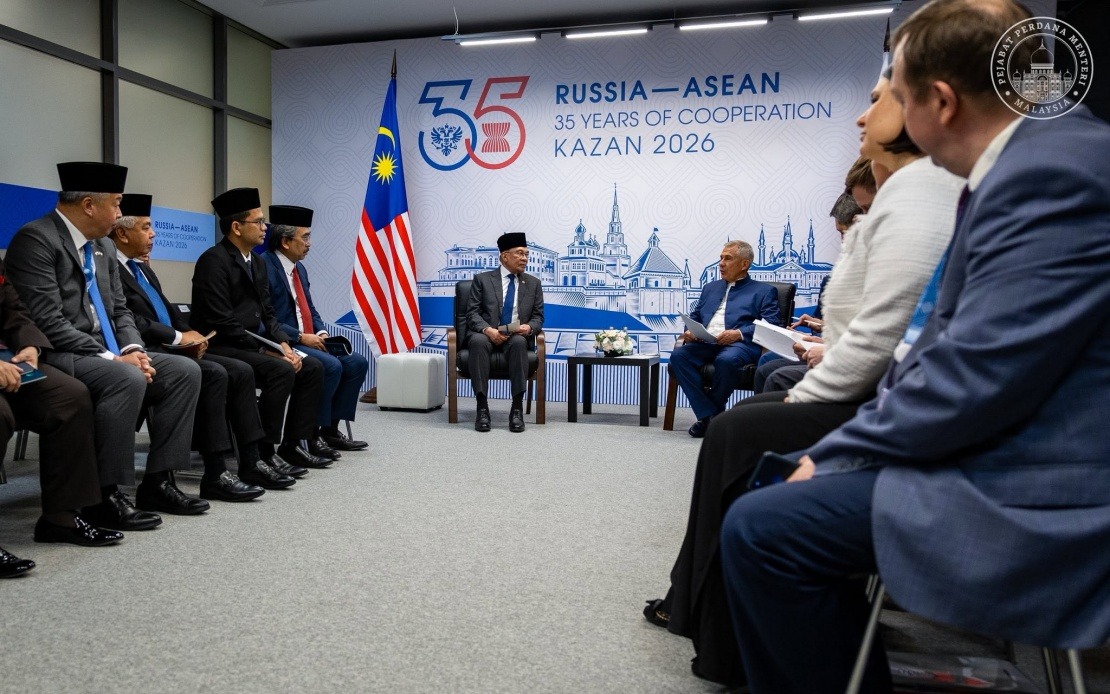
Prime Minister Datuk Seri Anwar Ibrahim has signalled Malaysia's intention to substantially deepen its engagement with the Russian Republic of Tatarstan, identifying a wide spectrum of collaborative opportunities that could benefit both economies. During a bilateral meeting held upon his arrival in Kazan on Tuesday, Anwar and Rustam Minnikhanov, the Rais or Head of Tatarstan, discussed potential partnerships spanning multiple sectors including trade, investment, education, tourism, the halal industry, technology development and workforce training.
The energy sector emerged as a primary focus in discussions between the Malaysian leader and his Tatarstan counterpart, a logical emphasis given the region's status as one of Russia's most significant oil-producing territories. Anwar, who concurrently holds the Finance Ministry portfolio, outlined Malaysia's particular interest in exploring deepened cooperation across the upstream and downstream petroleum value chain, with specific mention of refining operations and petrochemical development. This represents a natural extension of Malaysia's existing strengths in energy sector expertise and regional trading networks, positioning the country as a potential partner in expanding Russia's petrochemical output and market reach beyond traditional markets.
Beyond resource extraction and processing, the discussions encompassed the strategic role of the Kazan Forum as a mechanism for bolstering commercial linkages between the two nations. Both leaders explored mechanisms through which the platform could catalyse innovation-driven partnerships and facilitate investments in digital infrastructure and emerging technologies. The Kazan Forum has historically served as a convening space for regional business leaders and policymakers, and Malaysian participation could provide a conduit for Southeast Asian enterprises seeking entry into Russian markets and vice versa.
Anwar's presence in Kazan forms part of Malaysia's participation in the ASEAN-Russia Commemorative Summit, a two-day gathering that represents the highest-level diplomatic engagement between the ten-nation Southeast Asian bloc and Moscow. This summit reflects the maturation of ASEAN-Russia relations, which formally commenced through dialogue partnerships in 1991 before Russia achieved full Dialogue Partner status within ASEAN in 1996. The relationship was elevated further to a Strategic Partnership designation in 2018, underscoring mutual commitment to expanding engagement across political-security domains, economic cooperation, and socio-cultural exchange.
The Malaysian Prime Minister also extended congratulations to Kazan on its recent designation as the Islamic World Cultural Capital for 2026, a recognition conferred by the Islamic World Educational, Scientific and Cultural Organisation. This distinction is particularly significant given Kazan's established credentials as a centre of Islamic scholarship, cultural heritage and intellectual innovation. For Malaysia, a nation deeply committed to advancing Islamic civilisation and interfaith dialogue, Kazan's recognition creates opportunities for scholarly exchange, cultural programming and educational partnerships that could position Malaysian institutions within a broader network of Islamic learning centres.
Anwar further commended Russia's President Vladimir Putin for establishing the Strategic Vision Group, which he characterised as a meaningful institutional bridge facilitating dialogue between Russia and the broader Islamic world. This initiative reflects Moscow's strategic calculus in engaging Muslim-majority nations and communities, a positioning that Malaysia—as a major Islamic economy and influential voice within the Organisation of the Islamic Conference—can help strengthen through bilateral and multilateral channels. The existence of such formal structures creates predictable frameworks for sustained engagement beyond the constraints of geopolitical fluctuations.
The Prime Minister travelled to Kazan accompanied by a substantial delegation reflecting Malaysia's commitment to the visit's substantive outcomes. Investment, Trade and Industry Minister Datuk Seri Johari Abdul Ghani, Economy Minister Akmal Nasrullah Mohd Nasir, and officials representing the Prime Minister's Office and Foreign Ministry travelled alongside Anwar, signalling that discussions would transcend ceremonial protocol and address concrete commercial and institutional possibilities. This composition indicates Malaysian readiness to translate bilateral statements of intent into actionable frameworks involving regulatory bodies and development agencies.
Kazan itself represents a significant strategic location within Russia's economic geography. Situated approximately 800 kilometres east of Moscow at the confluence of the Volga and Kazanka rivers, the city functions as Russia's third-largest urban centre after Moscow and Saint Petersburg, with a metropolitan population approaching 1.3 million residents. Beyond its contemporary commercial importance, Kazan possesses over a millennium of recorded history and stands as one of Russia's paramount Islamic cultural repositories, a legacy that resonates with Malaysia's own positioning as a leading voice in contemporary Islamic thought and practice.
The ASEAN-Russia relationship carries particular relevance for Malaysia and other Southeast Asian states amid broader geopolitical recalibration in the Indo-Pacific region. While Western nations maintain significant economic and security partnerships with ASEAN members, Russia's designation as a Strategic Partner provides Southeast Asian countries with additional diplomatic flexibility and alternative engagement channels. For Malaysia specifically, already positioned as a non-aligned nation historically, deepening Russian ties offers opportunities to diversify economic partnerships while maintaining distinct identity within competing great-power frameworks.
The focus on the halal industry within bilateral discussions reflects Malaysia's recognised leadership in this rapidly expanding global market sector. Malaysia has cultivated substantial expertise in halal certification, production standards and supply chain management, areas where Russian businesses seeking to expand into Muslim-majority markets could benefit from Malaysian partnerships and knowledge transfer. Similarly, Malaysian interest in Russian technological capabilities and innovation ecosystems could facilitate joint ventures in digital transformation, artificial intelligence, and advanced manufacturing—sectors where both nations have emerging competitive advantages.
Educational cooperation emerged as another pillar in the discussed partnership framework. Malaysia's established universities and technical institutions have increasingly attracted international students and academic collaborators, while Russian scientific tradition remains globally respected in mathematics, physics and engineering disciplines. Structured student exchange programmes, joint research initiatives and faculty collaboration could enrich both educational systems while building people-to-people connections that underpin long-term bilateral relationships.
The timing of Anwar's visit to Kazan during the ASEAN-Russia Commemorative Summit underscores Malaysia's role as a bridge-builder within Southeast Asian diplomatic circles and Moscow's broader engagement with the region. As chair or key participant in various ASEAN mechanisms, Malaysian initiatives often influence broader regional positions on international matters. By investing high-level political attention in deepening relations with Tatarstan and Russia more broadly, Malaysia signals to the region that Moscow remains a consequential partner worthy of sustained engagement, even as Southeast Asian nations navigate complex relationships with other major powers.