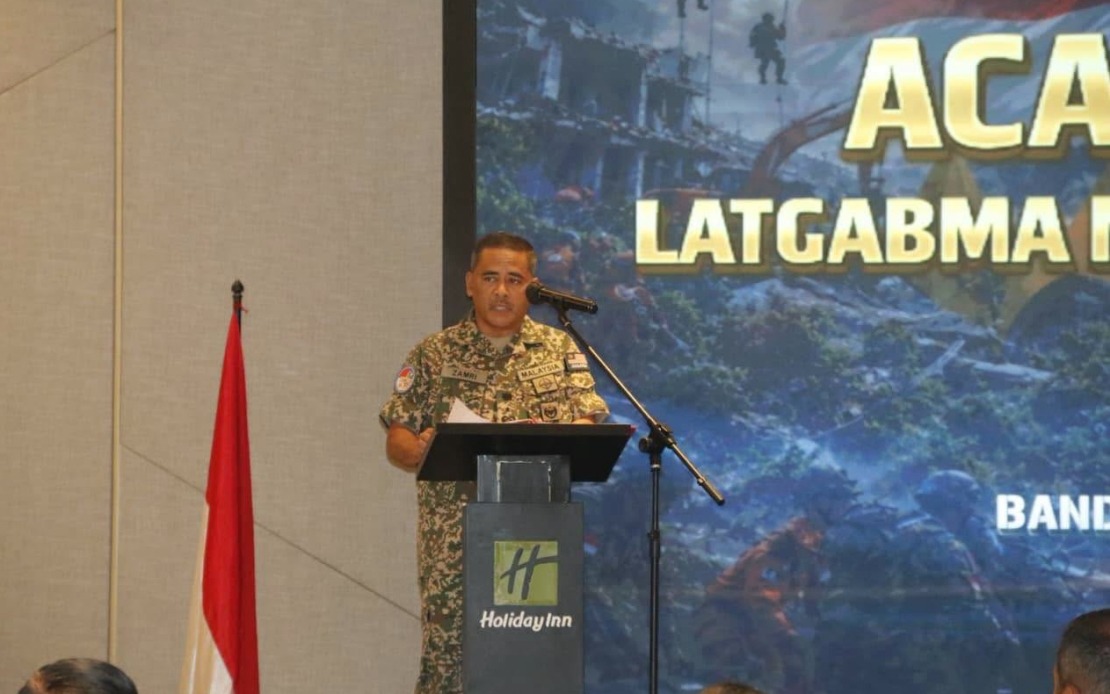
Malaysia and Indonesia have embarked on a significant defence cooperation initiative through the 12AB/2026 Malaysia-Indonesia Joint Combined Exercise Land, Sea and Air, known as LATGABMA MALINDO DARSASA. The 13-day exercise, now underway in Lampung, Sumatra, brings together 719 military and civilian personnel from both countries in a comprehensive demonstration of bilateral strategic partnership. According to the Joint Forces Headquarters statement, this exercise represents far more than routine military drills; it exemplifies the enduring fraternal relationship and mutual strategic confidence between the two nations.
Brigadier General Datuk Zamri Othman, commander of the 1st Infantry Brigade and chief of the MAF Exercise Planning Group, underscored the exercise's deeper significance beyond conventional military training. The operation tests integrated operational concepts spanning terrestrial, maritime, and aerial dimensions while simultaneously fostering mutual understanding of how each armed force approaches operational procedures. Critically, the exercise builds institutional and personal confidence among defence personnel across both militaries, establishing professional relationships that prove invaluable during actual crises or coordinated regional responses.
The contemporary security landscape compelling this cooperation has become markedly more complex and multifaceted. Beyond traditional military threats, both nations grapple with maritime piracy and smuggling networks that exploit their shared waters, transnational terrorism that recognises no border, sophisticated cyber attacks targeting critical infrastructure, and the persistent danger of natural disasters. These non-traditional security challenges demand the kind of coordinated, integrated response that only genuine bilateral cooperation can provide. Neither Malaysia nor Indonesia can effectively address these threats unilaterally, making exercises like LATGABMA essential to building operational interoperability.
The exercise's institutional history demonstrates remarkable durability and commitment. Since 1984, Malaysia and Indonesia have maintained this trilateral training format through the General Border Committee and the Malaysia-Indonesia Joint Training Committee, conducting iterations every three years on a rotating basis. The 2023 edition, held in Pekan, Pahang, emphasised counter-terrorism operations. This consistency reflects both governments' recognition that defence cooperation requires sustained institutional effort rather than episodic gestures.
The choice of Lampung as the primary exercise venue carries distinct strategic and practical advantages. The Indonesian province sits at the convergence of three major tectonic plate belts, making it an exceptionally challenging environment for disaster response training. This geological reality has not been merely theoretical—southern Sumatra has experienced devastating earthquakes and tsunamis that claimed numerous lives. By grounding their exercise in authentic disaster scenarios informed by Indonesia's lived experience, both militaries create far more realistic training conditions than conventional tabletop exercises could provide.
The exercise architecture encompasses multiple sophisticated training components. The Staff Exercise phase involves ten interconnected scenario tracks: Initial Disaster Response, Mass Casualty Incident, Infrastructure Collapse, Medical Emergency, International Assistance, Cyber Attack, Information Warfare, Mass Evacuation, Stabilisation Phase, and Transition Phase. This comprehensive scenario design forces participants to grapple with the full spectrum of challenges that emerge during major disasters, not merely isolated incidents. The academic groundwork in these staff sessions provides conceptual frameworks that participants subsequently apply during field operations.
During the Field Training Exercise phase, practical Force Integration Training brings together 463 TNI personnel, 150 Malaysian military personnel, and representatives from Indonesian disaster response agencies including the National Search and Rescue Agency, Disaster Preparedness Cadets, the Indonesian Red Cross, and Regional Disaster Management Agencies. These joint teams conduct essential training in technical rescue operations—rope work, rappelling, emergency response protocols—alongside the establishment of field medical facilities. Such hands-on coordination proves invaluable; when actual disasters strike, the personnel involved have already worked together, understand each other's procedures, and possess established communication channels.
The exercise incorporates community development components extending beyond purely military dimensions. The Engineering Civil Action Programme involves repair work on two uninhabitable houses and construction of concrete road infrastructure in selected villages, providing tangible benefits to affected communities. The Medical Civic Action Programme, conducted through local health facilities, delivers general health screenings, vision correction through spectacle distribution, and blood donation campaigns. These community-focused activities demonstrate that defence cooperation produces benefits extending beyond military circles to civilian populations.
Cyber security training represents a critical modern addition reflecting contemporary threat environments. The CyberEx component covers reconnaissance techniques, system enumeration, credential-based attacks, man-in-the-middle interception strategies, spoofing methodologies, and feed manipulation tactics. As digital infrastructure becomes increasingly central to national security and civilian services, both nations recognise that cyber defence readiness demands the same collaborative training investment as physical disaster response. Malaysian readers should note that these cyber competencies have direct relevance to protecting Southeast Asia's increasingly interconnected digital infrastructure.
The exercise composition reveals sophisticated institutional coordination. Beyond military personnel, the operation includes two National Disaster Management Agency representatives, 25 Indonesian National Police members, and 79 participants from various Indonesian civil agencies. This multiagency approach mirrors real-world disaster response requirements where military capabilities must integrate seamlessly with civilian emergency services, law enforcement, and humanitarian organisations. Malaysian defence planners are similarly learning how Indonesia structures these coordinated responses, knowledge directly applicable to Malaysia's own disaster preparedness frameworks.
For Malaysia specifically, participation in LATGABMA offers valuable exposure to how Indonesia manages catastrophic events in geologically volatile regions. Indonesia's experience managing massive earthquakes and tsunamis that have killed hundreds of thousands provides hard-earned institutional knowledge worth absorbing. Conversely, Malaysia's contributions bring distinct perspectives on maritime security and tropical disaster management in different geographical contexts. This exchange of methodologies and experience strengthens both nations' overall resilience.
The exercise underscores an often-overlooked dimension of defence cooperation: building peaceful, cooperative relationships that reduce conflict incentives while simultaneously addressing shared security challenges. By institutionalising regular joint training, Malaysia and Indonesia have created mechanisms for military-to-military dialogue that operate continuously, reducing misunderstandings and building mutual respect among defence establishments. This diplomatic function, though less visible than the operational training components, may prove equally valuable for regional stability. As the security environment becomes more complex and resources more constrained, Malaysia and Indonesia have demonstrated that addressing shared challenges cooperatively produces superior outcomes to competitive or isolationist approaches.