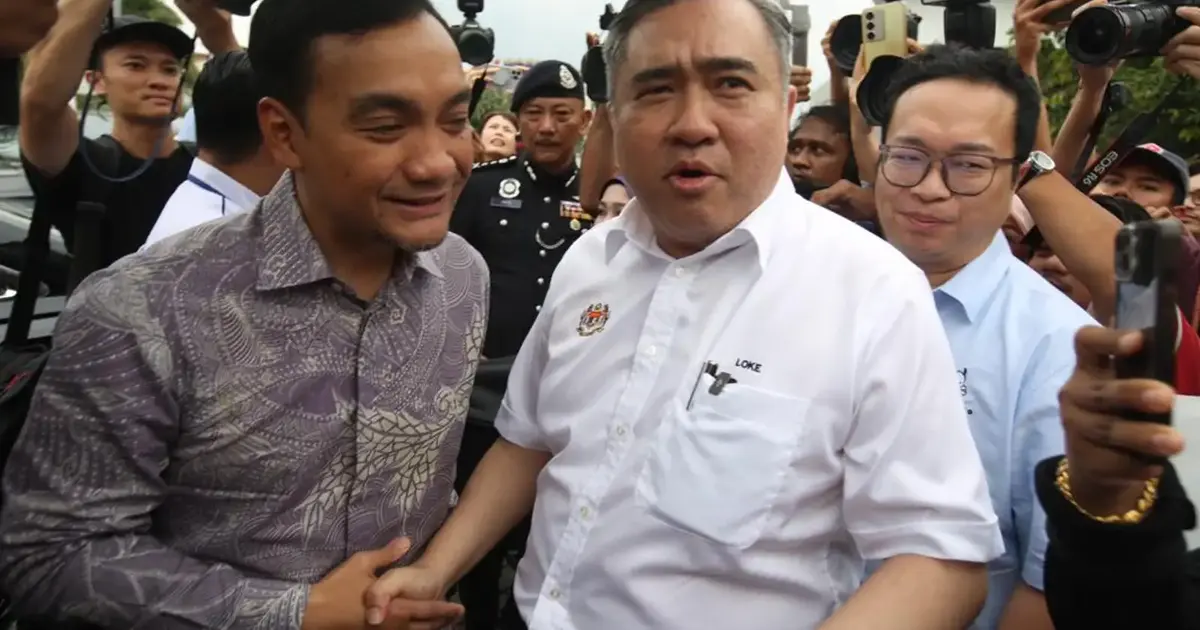
Transport Minister Anthony Loke and Johor Menteri Besar Onn Hafiz Sapian demonstrated the resilience of Malaysia's governing coalition by maintaining outward cordiality at their inaugural face-to-face meeting following a contentious social media exchange that had raised questions about internal political cohesion. The carefully choreographed encounter underscored how senior figures across different component parties of the federal and state administrations have learned to compartmentalize personal differences in service of broader political stability.
Onn Hafiz deployed subtle rhetorical messaging during his remarks at the transport ministry-hosted event, making a pointed reference to the short notice with which he had been invited to the gathering. The comment appeared calculated to convey mild displeasure about the logistical inconvenience while stopping short of overtly escalating tensions. By framing his attendance as requiring a schedule rearrangement, the Johor leader managed to register discontent without breaching the diplomatic protocols that bind together Malaysia's multi-party administration. Such veiled criticism represents a familiar tactical approach in Malaysian politics, where direct confrontation often gives way to coded messaging that preserves surface harmony while signalling disagreement to attentive observers.
The earlier online spat between the two figures had attracted considerable attention from political analysts and social media observers alike, suggesting deeper fault lines within the coalition's internal dynamics. Digital platforms have become increasingly important venues for Malaysian politicians to air grievances and signal factional alignments, often with greater candour than would emerge in formal settings. The fact that their subsequent in-person meeting proceeded without incident reflected both the maturity of Malaysia's political establishment in crisis management and the reality that coalition governments require constant diplomatic negotiation between potentially competing interests.
Johor, as one of the nation's most politically significant states with substantial representation in federal structures, occupies a particularly delicate position within Malaysia's governing arrangement. Onn Hafiz's position as Menteri Besar carries considerable weight in state affairs while his party maintains representation within the coalition government. This dual responsibility creates inherent tensions, particularly when federal initiatives may not align perfectly with Johor's perceived interests or when state-level political calculations diverge from national coalition strategy. The Johor leader's apparent irritation about short-notice scheduling likely reflected frustration over coordination mechanisms rather than fundamental policy disagreement.
Anthony Loke's ministry responsibilities encompass issues with direct implications for every Malaysian state, including Johor. Transport infrastructure projects, licensing regulations, and federal-state cooperation on connectivity initiatives all require sustained working relationships between the transport portfolio holder and state governments. The transport ministry's decision to host this particular event and extend an invitation to Onn Hafiz suggests deliberate efforts to maintain functional engagement channels despite the recent online tensions. Such relationship management reflects institutional awareness that allowing peripheral disputes to derail substantive cooperation serves no one's interests.
The public presentation of civility masks a more complex underlying reality in which different coalition partners pursue distinct agendas within the broader framework of supporting the federal government. Johor maintains particular leverage due to its political importance and the significant development projects underway across the state. Transport initiatives, whether related to new highway construction, rail connectivity, or port operations, inevitably involve both state and federal actors with sometimes competing priorities regarding timelines, financing arrangements, and implementation responsibility.
Malaysian coalition politics has evolved considerably since the Pakatan Harapan government's 2018 formation, with participants developing increasingly sophisticated mechanisms for managing internal disagreements without allowing them to rupture the broader arrangement. The cordial meeting between Loke and Onn Hafiz reflects this maturation, even as individual incidents and policy disagreements continue to generate friction. Political observers will watch for whether this particular tension dissipates or whether it signals broader complications in coalition cohesion that may merit closer attention.
The broader implications of this encounter extend beyond the two principals involved. Every interaction between federal ministers and state leaders carries symbolic weight in Malaysia's federal system, where power is distributed across multiple levels of governance. The ability to compartmentalize personal differences while maintaining functional cooperation ultimately determines whether such multi-party arrangements can deliver effective governance or whether they devolve into paralysis through internal conflict. This meeting suggests that despite provocations and frustrations, the governing coalition remains committed to working through disagreements pragmatically.
Looking forward, both figures face incentives to maintain cooperative relationships regardless of occasional friction. Onn Hafiz requires federal support for Johor's development agenda, while Loke depends on cooperation from state governments to implement transport projects that contribute to his ministry's success metrics. These structural interdependencies create powerful forces for maintaining civility even when genuine disagreements exist about specific decisions, priorities, or communication protocols. The first post-dispute meeting appears to have cleared the immediate air while leaving underlying dynamics largely unchanged, consistent with Malaysian political tradition.


