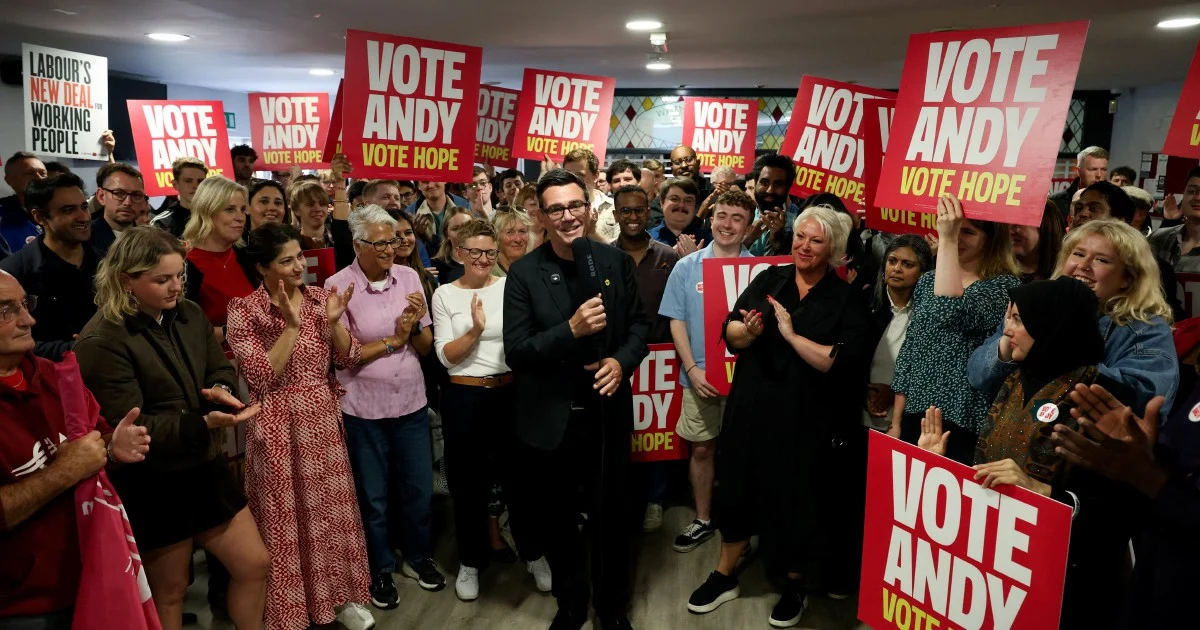
Andy Burnham's political fortunes appear to be benefiting from an unexpected source: the bitter divisions consuming Britain's fragmented right-wing opposition. As voters in the Makerfield constituency prepare for Thursday's election, the Labour figure's path toward a credible challenge against Prime Minister Keir Starmer has been substantially smoothed by the infighting between two populist movements that threaten to undermine each other's electoral prospects. Rather than Burnham's own message resonating decisively with constituents, the mechanics of a divided opposition may deliver him the parliamentary seat he requires to establish himself as a genuine contender for the nation's highest office.
Burnham's ambitions extend far beyond retaining his current position. His determination to mount a leadership challenge against Starmer depends fundamentally on securing Makerfield in this election cycle. The seat represents both his political anchor and his launchpad for higher aspirations. However, the dynamics unfolding in this northwest England constituency reveal how electoral outcomes frequently turn on calculations that have little to do with the frontrunner's actual popularity or policy platform. Instead, Burnham finds himself inadvertently advantaged by structural divisions on the opposing side of the political spectrum.
The fragmentation of right-wing populist politics in Britain has created a peculiar electoral mathematics that works decisively in Labour's favour. Two separate movements, each claiming to represent a distinct vision of populist governance and anti-establishment sentiment, are competing for the same pool of voters sceptical of mainstream politics. Rather than consolidating their collective strength to mount a unified challenge, these organisations have instead chosen to mount competing campaigns that inevitably divide the anti-Labour vote. This proliferation of populist offerings paradoxically weakens each individual faction while strengthening Burnham's relative position.
The timing of this right-wing implosion carries significant implications for Britain's broader political realignment. For years, political analysts predicted that populist movements would eventually coalesce into a single powerful electoral force capable of genuinely challenging Labour's parliamentary dominance. Instead, ideological and personality-driven conflicts have prevented such consolidation. The feuding between competing populist leaders and organisations has become increasingly bitter, creating mutual recriminations and public disputes that alienate potential supporters seeking unity and clear direction. Rather than presenting voters with a coherent alternative vision, the fractured right offers only discord and strategic confusion.
For Malaysian observers of British politics, this scenario illustrates familiar patterns visible across Westminster's regional democracies. Coalition-building and managing internal party factions remain perpetual challenges for opposition movements seeking to displace incumbent governments. The British experience demonstrates how electoral mathematics can create unexpected beneficiaries when opposing forces fail to coordinate strategically. Leaders like Burnham, who might otherwise struggle to present compelling reasons for voter support, can instead prosper when opposition energies fragment across multiple competing platforms lacking sufficient coordination.
Burnham's positioning within Labour reflects his status as a pragmatic operator more than an ideological firebrand. His previous roles in regional politics and his current prominence in party debates suggest he understands the mechanics of institutional power as well as popular appeal. A successful retention of Makerfield, particularly with an expanded majority, would constitute a powerful mandate for his subsequent leadership aspirations. The optics of winning despite challenging national circumstances, or even with reduced opposition efficiency, would nonetheless provide the parliamentary foundation necessary to mount credible leadership campaigns.
The broader context of British politics suggests that right-wing unity remains elusive for reasons rooted in personality conflicts and genuine ideological differences. Unlike historical periods when populist movements successfully consolidated around individual personalities or unifying grievances, contemporary British populism has instead fractured into competing camps with overlapping but distinct constituencies. Each movement possesses devoted followers, but the total pool of available supporters cannot sustain multiple parallel organisations each claiming majority status. This mathematical reality inevitably produces the current outcome whereby mainstream parties like Labour benefit from opposition disunification.
Thursday's Makerfield election therefore represents something beyond a conventional constituency contest. It symbolises the broader trajectory of British opposition politics and the continuing viability of Labour's position despite sustained criticism from multiple quarters. Burnham's victory would confirm that structural advantages possessed by incumbent governing parties remain formidable, particularly when opposition movements fail to present unified alternatives. The result would simultaneously advance his personal ambitions while demonstrating the continuing difficulties facing populist movements attempting to dislodge entrenched mainstream institutions.
The implications for Burnham's subsequent positioning within Labour should not be underestimated. A successful Makerfield victory grounded in strong constituent support would provide genuine legitimacy for leadership aspirations. Conversely, a victory achieved primarily through opposition fragmentation carries different political meaning. Burnham would need to demonstrate capacity for constructing his own positive coalition rather than merely benefiting from rival divisions. How he frames such a victory will substantially shape perceptions of his viability as a potential prime ministerial candidate capable of leading Labour beyond its current leadership cycle.
Looking ahead, the precedent established in Makerfield may inform how subsequent elections unfold across Britain's electoral landscape. If right-wing fragmentation continues producing advantages for Labour in marginal constituencies, this dynamic could substantially influence broader parliamentary composition and future leadership calculations. Burnham's emergence as a credible alternative to Starmer depends not merely on electoral victory but on demonstrating that he represents something beyond simply benefiting from opponents' mistakes. The challenge facing him involves converting tactical advantage into strategic political strength.


