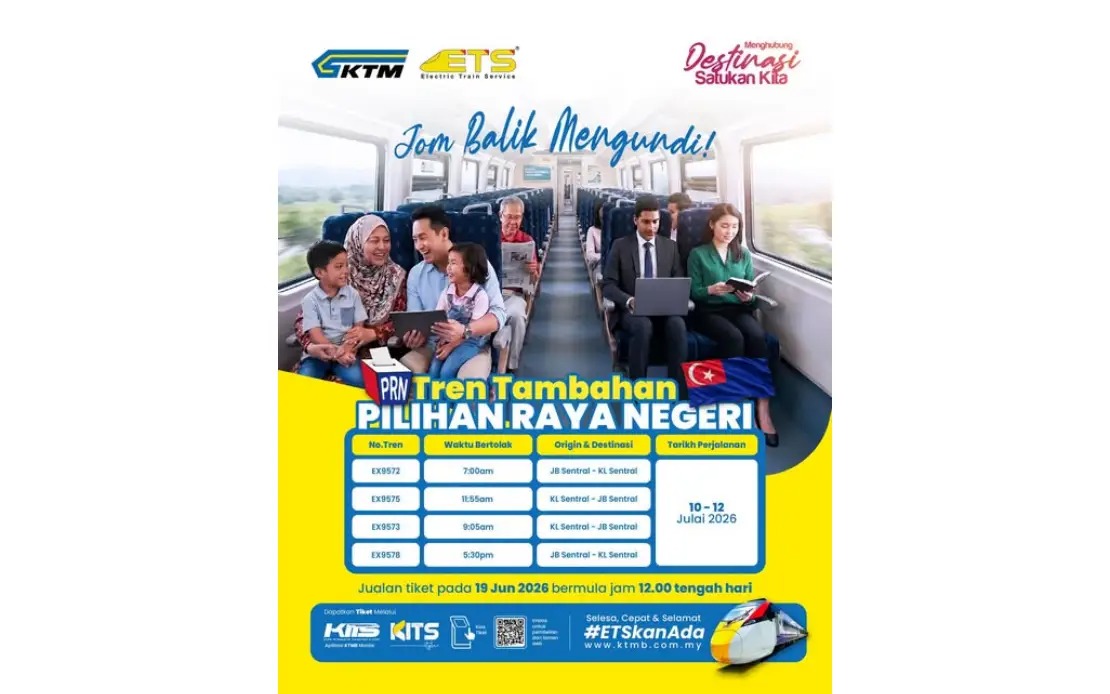
Keretapi Tanah Melayu Berhad (KTMB) has rolled out a slate of enhanced rail capacity to facilitate voters travelling to Johor ahead of the state election scheduled for July 11. The national railway operator's initiative recognises the surge in passenger demand typically experienced during election periods, when Malaysians registered in their home constituencies return to cast their votes. The expanded services will run from July 10 through July 12, bracketing polling day to accommodate both early arrivals and post-election departures.
Ticket distribution for the reinforced ETS offerings commenced at noon on June 19, providing would-be travellers with a four-week window to secure their seats. KTMB has streamlined the booking process by offering multiple channels—the dedicated KTMB Mobile application, the KITS Style platform, the online portal at online.ktmb.com.my, and physical ticket counters at KTMB facilities. This multi-platform approach reflects the transport operator's understanding that passengers across different age groups and digital proficiency levels require accessible options. The staggered booking availability also helps prevent platform congestion and allows the operator to manage demand systematically.
The Johor state election, held following the dissolution of the State Legislative Assembly on June 1, represents one of Malaysia's regular electoral exercises in which geographical distance creates logistical challenges for the electoral process. Johor's location at the southern peninsula's extremity means that registered voters working or studying elsewhere must undertake significant journeys to participate. The Election Commission's decision to set July 11 as polling day gave KTMB sufficient lead time to arrange the additional capacity, coordinating with its fleet management and crew scheduling systems.
For Malaysian voters, particularly those working in the Klang Valley, Selangor, or Kuala Lumpur but holding electoral rolls in Johor constituencies, the expanded ETS provision directly addresses a recurrent inconvenience. The electric train service, operating between major stations including Kuala Lumpur Sentral and Johor Bahru, represents the primary rapid transit option for such journeys. The cost-benefit calculation for voters weighs driving expenses, accommodation, and time against train fares and comfort—enhanced availability tips that balance favourably toward rail transport.
This infrastructure response reflects broader Malaysian electoral patterns and the relationship between voter participation and accessibility. Elections have historically witnessed increased transportation demand, and state governments alongside transport authorities recognise that removing logistical barriers to voting encourages turnout. The KTMB initiative aligns with Malaysia's emphasis on enabling electoral participation, though such measures remain discretionary rather than statutory obligations on transport operators.
From a Southeast Asian perspective, Malaysia's approach to facilitating voter mobility during elections demonstrates a pragmatic approach to election logistics. While some nations employ remote voting provisions or extended polling periods, Malaysia's geography and travel infrastructure make the accommodation of temporary surge capacity a practical alternative. The ETS expansion illustrates how transport planning intersects with democratic processes—a consideration gaining prominence across rapidly urbanising Asian economies where migration and internal movement create similar electoral participation challenges.
KTMB's communication strategy, utilising the Facebook announcement for public notification, reflects how Malaysian transport operators increasingly engage with commuters through social media alongside traditional channels. The emphasis on multiple booking platforms acknowledges demographic diversity within the passenger base, from young professionals comfortable with mobile applications to older voters preferring in-person interactions. This tiered approach reduces potential frustration and ensures equitable access regardless of technological adoption patterns.
The economic implications of such electoral-driven transport demand deserve consideration. Enhanced services require additional staff deployment, fuel, and maintenance, representing costs that KTMB absorbs as part of its national transport service mandate. Conversely, increased ridership generates ticket revenue and potentially justifies infrastructure investment. The predictability of election cycles allows KTMB to schedule these expansions efficiently, unlike emergency capacity additions responding to unforeseen crises or disasters.
For voters in other Malaysian states observing the Johor precedent, the expanded train services may generate expectations for similar accommodations during their respective state or federal elections. Transport operators across the peninsula will likely reference KTMB's planning model when evaluating their own electoral-period capacity. This creates an informal but influential standard for election support infrastructure, where success in one jurisdiction informs practices nationwide.
The timing of ticket sales commencement on June 19, roughly three weeks before the travel window opened, provided adequate booking lead time while avoiding premature sales that might exceed actual demand. KTMB's experience with previous electoral periods informs these scheduling decisions, allowing the operator to forecast demand patterns and allocate resources accordingly. The extended sales period also accommodates voters whose holiday schedules or work commitments confirm only closer to the election, reducing last-minute booking surges that strain booking systems.
Ultimately, KTMB's provision of extra ETS services demonstrates the practical mechanisms through which Malaysian institutions support democratic participation. Beyond policy-level commitments to electoral access, ground-level operational decisions by transport authorities materially influence whether citizens can conveniently exercise their voting rights. Such measures, though often overlooked in political analysis, constitute essential infrastructure supporting Malaysia's electoral system and warrant recognition as part of the institutional framework enabling democratic engagement across the nation's dispersed population.