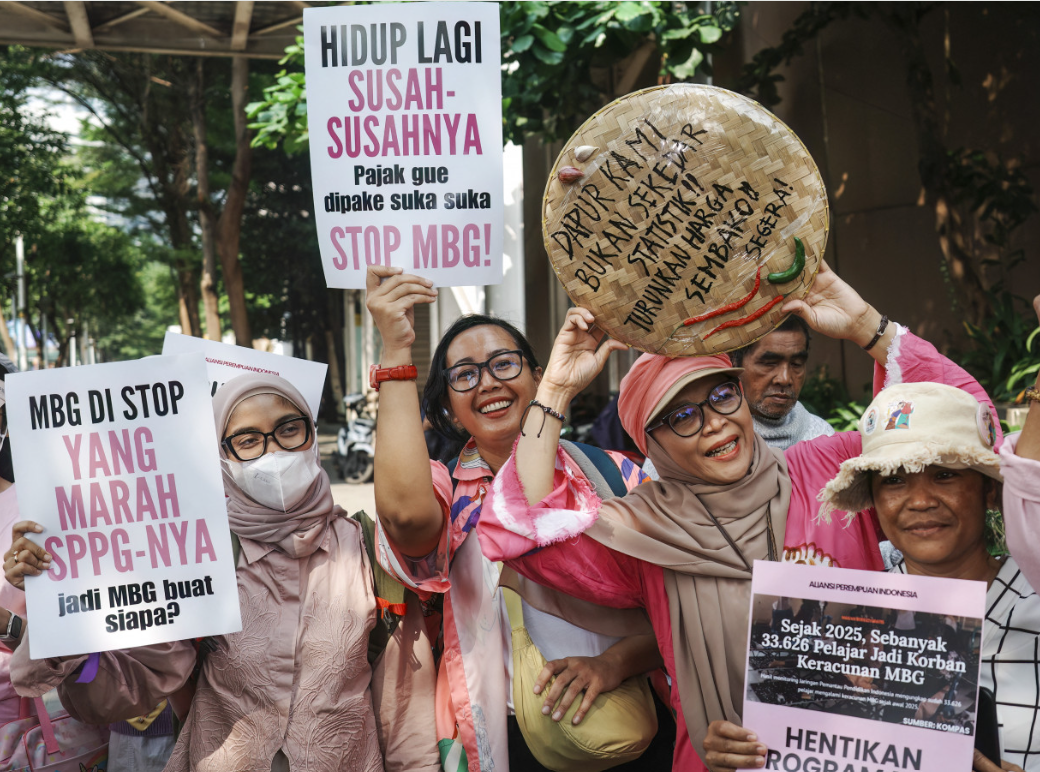
President Prabowo Subianto's flagship free nutritious meal initiative, designed to tackle childhood stunting across Indonesia, faces mounting pressure as direct beneficiaries publicly reject the assistance and demand fundamental improvements to the programme's execution. The controversy has intensified following social media revelations of substandard food quality, prompting some participants to declare they would rather forgo the government support entirely than continue receiving meals they consider unsafe or nutritionally inadequate for their children.
The quality crisis came into sharp focus when Nesti Nagari, a mother from Kediri in East Java, discovered that a meal meant for her eight-month-old baby consisted of an unidentifiable clumped paste that she deemed unsuitable for consumption. Rather than risk her child's health, Nagari fed the portion to her chickens and subsequently rejected further assistance from the programme. Her social media post documenting the incident garnered over eleven thousand reactions within days, reflecting widespread public concern about the programme's operational standards. Speaking to The Jakarta Post, Nagari explained that her family possessed sufficient financial capacity to provide adequate nutrition independently, making the poor-quality assistance more of a liability than a benefit. She advocated for either temporary programme suspension to allow comprehensive evaluation or complete termination, suggesting any freed budget be redirected toward education and healthcare services.
Similar frustrations echoed across Java, particularly in Semarang where Diah Farika, a breastfeeding mother enrolled since May, repeatedly raised concerns about meal composition and portion sizes with kitchen operators. Her complaints about nutritionally unbalanced menus, including undersized portions and unripe fruit, received dismissive responses from the nutrition fulfillment service units responsible for meal preparation. Like Nagari, Farika supported temporary programme suspension to enable the National Nutrition Agency to conduct comprehensive kitchen inspections and quality audits. Her experience highlights a critical implementation problem: even where beneficiary identification remains sound, kitchen-level execution determines whether the initiative achieves its nutritional objectives or merely distributes substandard food.
Activist organisations have channelled mounting public dissatisfaction into formal political pressure. The Indonesian Women's Alliance staged a significant rally in Central Jakarta last week, demanding governmental action to halt and comprehensively review the programme. These organised calls for reform extend beyond individual complaints, representing a broader civil society assessment that current operational structures cannot reliably deliver quality nutrition at scale across Indonesia's diverse regional contexts.
Paradoxically, while beneficiaries demand quality improvements, the programme's operational stakeholders face existential uncertainty. Private investors and SPPG kitchen operators have grown anxious following recent corruption allegations involving former National Nutrition Agency leadership, which prompted the new administration to freeze further expansion of the kitchen network currently comprising approximately twenty-seven thousand facilities. Investors who have poured hundreds of billions of rupiah into kitchen construction have reportedly sought meetings with agency officials demanding assurances about return on investment and operational continuity. Several kitchens experienced temporary closures in early June due to delayed funding, disrupting service for millions of intended beneficiaries and further damaging programme credibility.
MBG Watch, an independent oversight platform established by civil society organisations, has documented how accumulating operational failures erode public confidence in the initiative. Policy researchers from the Center of Economic and Law Studies, one of MBG Watch's initiators, have questioned whether the multi-billion-dollar budget genuinely serves its stated nutritional objectives or primarily benefits corporate operators and kitchen contractors. This scrutiny intensified as budget allocations drew public attention, with initial 2026 funding set at 335 trillion rupiah before efficiency pressures trimmed it to 268 trillion rupiah, raising questions about whether reduced budgets can maintain quality standards.
Research conducted by the Center of Economic and Law Studies has identified significant targeting inefficiencies within the beneficiary pool. Approximately thirty-four percent of current programme participants, representing roughly sixty-one million children and pregnant women, do not belong among Indonesia's most nutritionally vulnerable populations. The study identified economically secure households with adequate nutritional access receiving assistance intended for families facing genuine food insecurity and malnutrition risk. This misallocation represents not merely budgetary inefficiency but a fundamental failure to concentrate limited resources where they would generate maximum nutritional impact.
In response to mounting pressure, the National Nutrition Agency has initiated beneficiary reclassification processes designed to concentrate assistance on genuinely vulnerable populations. As of mid-June, the agency had removed seventy-six schools across Java from the programme, affecting over thirty-nine thousand previously enrolled beneficiaries. Agency deputy head Agustina Arumsari framed this contraction as necessary refocusing toward populations most requiring governmental intervention, rather than acknowledging the underlying quality problems that prompted beneficiary rejection. The reframing suggests official recognition that existing resources cannot sustain quality standards across current participant numbers, necessitating recipient pool reduction.
Complementary austerity measures aim to improve operational efficiency by eliminating daily kitchen incentives during non-operational periods and conducting performance reviews of underperforming facilities. These structural adjustments suggest the National Nutrition Agency recognises that current kitchen networks include ineffective operators who consume budget resources without delivering adequate nutrition services. However, such belt-tightening measures risk further reducing already-inadequate meal quality, potentially deepening the contradiction between programme objectives and beneficiary experience that currently drives rejection rates.
For Malaysian observers, the Indonesian experience illustrates critical implementation challenges inherent in large-scale national nutrition programmes serving diverse populations across vast, geographically dispersed territories. Indonesia's struggle to maintain consistent quality standards despite enormous budget allocations—initially 335 trillion rupiah—demonstrates how organisational capacity, accountability mechanisms, and operational oversight prove as consequential as budgetary resources for programme success. The willingness of intended beneficiaries to reject assistance when quality falls below acceptable thresholds suggests that even well-intentioned initiatives can damage rather than enhance public health when execution fails to meet standards. As Malaysia contemplates or refines its own nutrition security approaches, the Indonesian case underscores the necessity of robust quality assurance mechanisms, transparent accountability frameworks, and genuine beneficiary feedback channels to ensure that enormous public expenditures translate into genuine health improvements rather than merely expanding bureaucratic infrastructure.