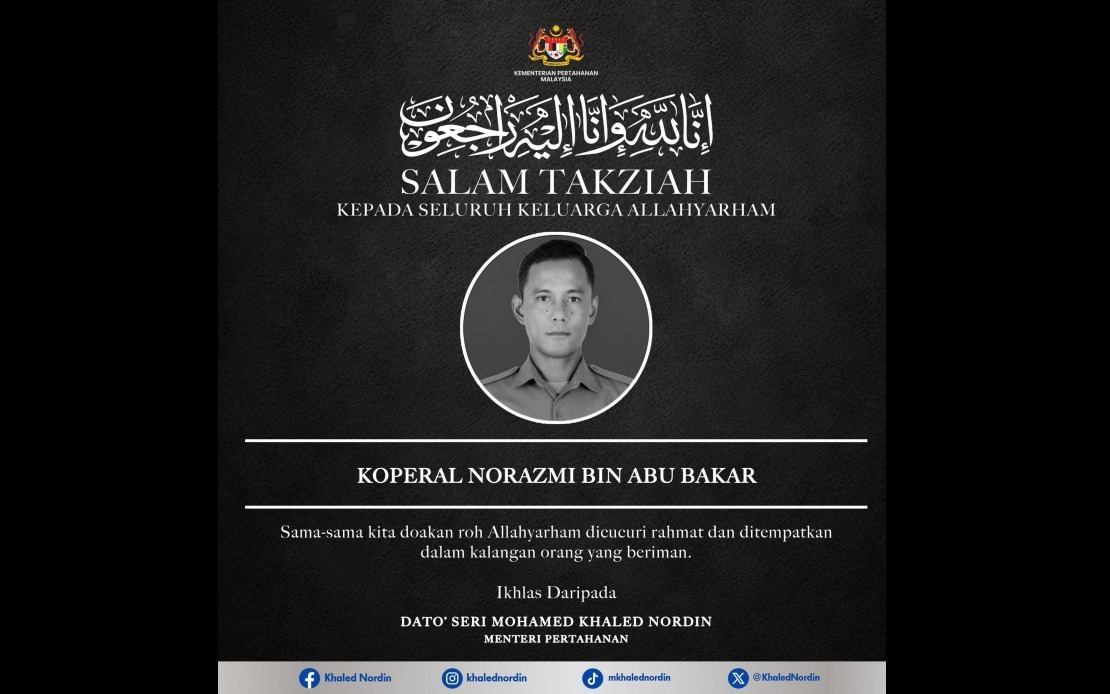
A tragic incident during routine military training has claimed the lives of two Malaysian Army personnel, prompting expressions of sympathy from the country's leadership and Defence Ministry. Corporal Norazmi Abu Bakar of the 6th Battalion, Royal Malay Regiment, and Private Siti Khadijah Sungip of the 1st Squadron, Royal Army Engineers Regiment, were fatally injured when an explosion occurred during a grenade-throwing exercise at Hobart Camp firing range in Gurun, Kedah, on June 16.
Defence Minister Datuk Seri Mohamed Khaled Nordin released an official statement expressing deep sorrow over the deaths of the two servicemembers. In his remarks, the minister extended sympathies to the grieving families, emphasizing that both the ministry and government stand with them during this difficult period. The defence leadership also offered prayers for the deceased, hoping their families would find the spiritual and emotional strength necessary to navigate their loss.
According to the Malaysian Army's official account, the fatal incident unfolded during what should have been a standard training exercise. The explosion occurred at 10.57 am, inflicting severe injuries upon both personnel. Despite immediate efforts to provide emergency medical care, the two servicemembers succumbed to their injuries while being transported to Sultan Abdul Halim Hospital in Sungai Petani, which serves as the primary medical facility for the region.
The incident has raised urgent questions about training protocols and safety procedures at military installations across the country. Grenade-throwing exercises, while essential components of infantry training, carry inherent risks that require meticulous supervision and adherence to established safety measures. The fact that two highly trained personnel could be fatally injured during such a routine drill underscores the volatile nature of explosives-based training activities and suggests a need for heightened scrutiny of procedural safeguards.
In response to the tragedy, Army Chief General Tan Sri Azhan Md Othman has initiated a comprehensive investigation to establish the precise circumstances leading to the blast. This formal inquiry represents a critical step toward understanding whether procedural lapses, equipment malfunctions, or unforeseen circumstances contributed to the fatality. The findings of this investigation will likely inform subsequent reviews of safety protocols across all military training facilities handling explosive ordnance.
The deaths mark a sobering reminder of the occupational hazards faced by military personnel, particularly those engaged in combat-oriented training. While Malaysia's armed forces maintain relatively high safety standards compared to regional counterparts, incidents such as this underscore that even well-trained soldiers operating within controlled environments remain vulnerable to accident and tragedy. The loss of trained personnel represents not only a personal and family tragedy but also a resource loss for the military institution.
For the Malaysian defence sector, this incident arrives at a time of ongoing modernization and capability enhancement across the armed forces. The casualties highlight the importance of balancing training intensity with comprehensive safety measures as the military prepares personnel for operational readiness. Both the civilian and military leadership will face pressure to demonstrate that lessons learned from this incident translate into tangible improvements in training safety protocols.
The incident also carries symbolic weight in Malaysia's broader defence landscape. As a Southeast Asian nation managing diverse security challenges, the Malaysian Armed Forces depend on a pipeline of well-trained, experienced personnel. The loss of seasoned servicemembers diminishes institutional knowledge and operational capacity, even if only marginally, and signals the costs of maintaining military readiness in a region characterized by complex geopolitical dynamics.
Family members of the deceased will likely await both the formal investigation results and any institutional reforms arising from this tragedy. In Malaysian military culture, there is typically an expectation that such incidents will prompt systemic improvements rather than being treated as isolated events. The Defence Ministry and Army leadership face the challenge of communicating both their genuine condolences and their commitment to preventing similar incidents in the future.


