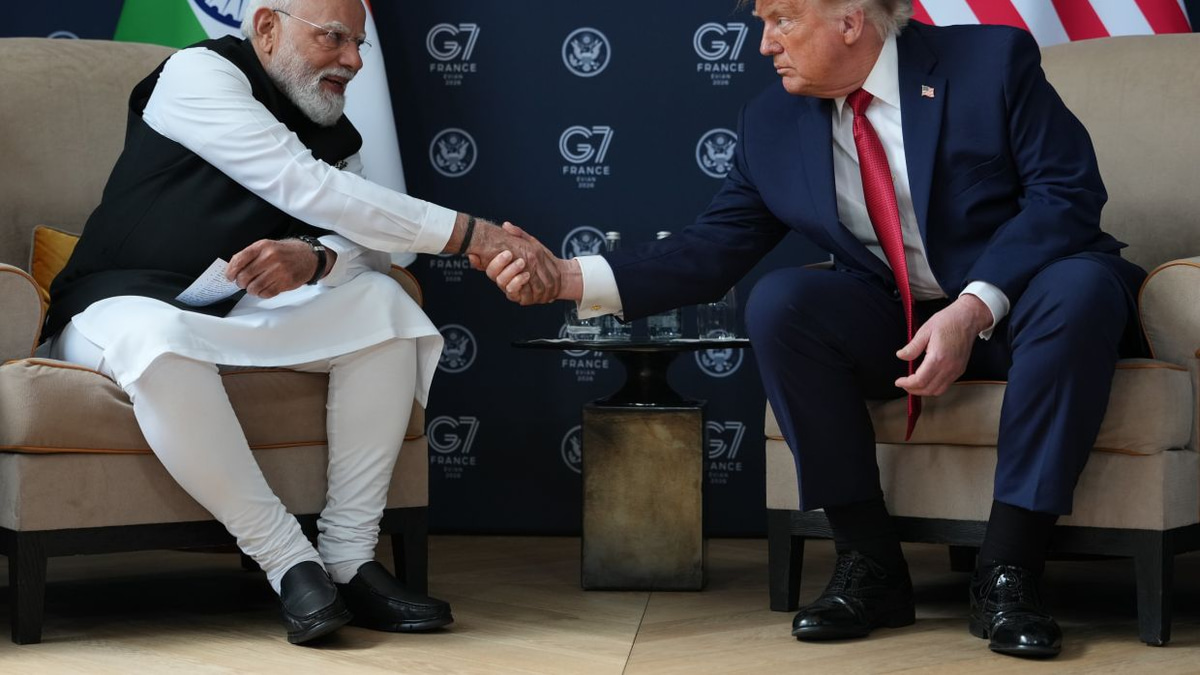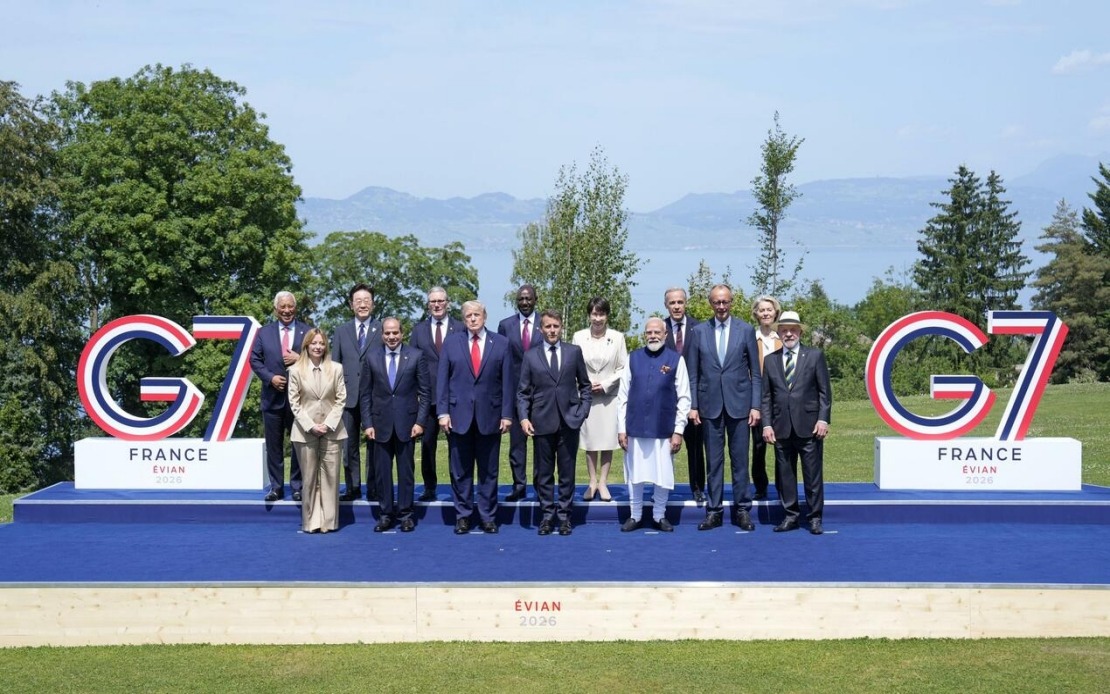
The world's seven largest advanced economies reached common ground on Ukraine at their annual gathering in Evian-les-Bains, France, demonstrating that despite widening disagreements on trade, defense spending, and geopolitical expansion, the alliance remains willing to coordinate on Russia's invasion. The summit, held in the lakeside spa town near Switzerland's border, brought together leaders determined to send a consolidated message that military aggression carries sustained diplomatic and economic consequences.
President Donald Trump, whose administration has pursued a distinctive foreign policy course that sometimes diverges from European positions, emerged from discussions with fellow G7 leaders to declare that Russia faces both an opportunity and a cost calculation. He emphasized that the Kremlin should pursue negotiated settlement given the war's human toll on both Russian and Ukrainian populations. This pronouncement carries significance beyond diplomatic rhetoric; Trump's explicit suggestion that he might reinstate sanctions relief mechanisms on Moscow signals that Washington retains leverage and willingness to modulate pressure depending on Russia's diplomatic posture.
Trump's comments about concluding the Iran war and pivoting toward Ukraine resolution suggest his administration views both conflicts as susceptible to deal-making frameworks. He referenced the opening of the Strait of Hormuz through a preliminary arrangement with Iran and indicated that energy market stabilization achieved through that agreement provides conditions for addressing other international security challenges. This sequencing reveals how Trump's negotiation strategy treats separate regional conflicts as interconnected elements of a broader reset in US Middle Eastern and European engagement.
Ukrainian President Volodymyr Zelenskyy, who participated directly in the summit discussions, articulated his country's needs with focus and clarity. His post on social media emphasized that enhanced air defense capabilities and simultaneous diplomatic pressure form a complementary two-track approach. This reflects Kyiv's sophisticated understanding that military resilience and negotiating strength derive from the same foundation—the capacity to deny Russia quick victory and therefore create incentives for settlement. Zelenskyy's framing as "making Russia end its war" rather than accepting a ceasefire from a position of weakness demonstrates how Ukrainian negotiating demands have evolved.
Japanese Prime Minister Sanae Takaichi articulated concerns extending beyond Europe's immediate security landscape, warning that Russia's deepening military cooperation with North Korea and expanding ties with China represent structural threats to the international system. Her invocation of unilateral status-quo changes by force speaks directly to Japan's own security concerns regarding China and the Korean Peninsula. This multilayered perspective demonstrates how G7 positions on Ukraine increasingly serve as proxy positions on broader Asian security architecture and the rules-based international order that underpins regional stability.
The summit's structure reveals France's presidency priorities. By inviting non-G7 members including Brazil, Egypt, India, Qatar, South Korea, and the United Arab Emirates, Paris has expanded the conversation beyond traditional Western powers to encompass developing economies and key strategic partners in contested regions. This outreach responds to recognition that Ukraine settlements cannot succeed without broader global acceptance, and that development and prosperity concerns in emerging economies require G7 engagement rather than exclusion. Southeast Asian nations, while not formally present, have interests in both European security outcomes and the development finance reforms being negotiated.
The discussion on West Asia, particularly concerning the preliminary United States-Iran agreement and its regional implications, addresses concerns critical to global maritime commerce and energy markets. The preliminary deal's opening of the Strait of Hormuz carries immediate consequences for shipping routes through the Malacca Strait and energy supplies flowing toward Asian markets. Southeast Asian economies, dependent on stable energy pricing and unobstructed maritime passage, stand to benefit substantially from conflict de-escalation in the Middle East that the G7 is working to consolidate.
Development finance reform emerged as a significant summit outcome, reflecting evolved thinking about how wealthy democracies can engage with poorer nations beyond traditional aid frameworks. The consensus that official development assistance alone proves insufficient acknowledges a reality increasingly evident in Asia and Africa: countries seek partnership arrangements that align with recipient nation strategic interests rather than donor nation preferences. This recalibration potentially creates opportunities for countries like Malaysia to negotiate more balanced development cooperation frameworks with Western powers and multilateral institutions.
The joint declaration on development partnerships emphasizes mobilizing private capital for long-term projects and ensuring mutual benefit, representing a philosophical shift from traditional donor-recipient relationships. This approach aligns with how many Asian nations have increasingly sourced infrastructure financing from multiple partners, whether China, Japan, bilateral arrangements, or regional development banks. The G7's adoption of similar reasoning suggests Western powers are adapting to contemporary realities rather than attempting to return to post-Cold War asymmetries in development relationships.
Trump's willingness to engage constructively on Ukraine coordination, despite public differences with European leaders on NATO burden-sharing and trade matters, indicates that Russia's continued aggression maintains sufficient salience in US strategy to warrant alliance management. However, the underlying tension remains unresolved: whether Trump's preference for negotiated settlements reflects genuine strategic reassessment or temporary alignment of interests that could shift rapidly. Southeast Asian governments watching these developments recognize that their own security depends partly on whether the Western alliance sustains coordination on rule-of-law principles or fragments into transactional bilateral arrangements.
The timing and content of the summit reflect transitional moments in global power distribution. The G7's decision to work for "just and lasting peace" in Ukraine while simultaneously engaging with developing economies on new partnership models suggests these wealthy democracies are attempting to reposition themselves as relevant actors capable of solving contemporary challenges. For Malaysia and other Southeast Asian nations, the summit's outcomes on Ukraine support, Iran conflict management, and development finance reform all carry implications for regional stability, maritime commerce, and future access to Western capital and technology on terms that protect national sovereignty.
Looking forward, the coherence demonstrated at Evian-les-Bains will face testing through implementation. Whether G7 countries maintain coordination if Ukraine war dynamics shift, whether the Iran agreement holds and stabilizes the Middle East, and whether new development partnership models genuinely benefit recipient nations while serving G7 interests will determine whether this summit represents enduring repositioning or temporary tactical alignment. For Southeast Asia, these questions matter because they determine whether the international environment will sustain open markets, stable supply chains, and rule-based dispute resolution, or fragment into competing spheres of influence where smaller nations have diminished agency.