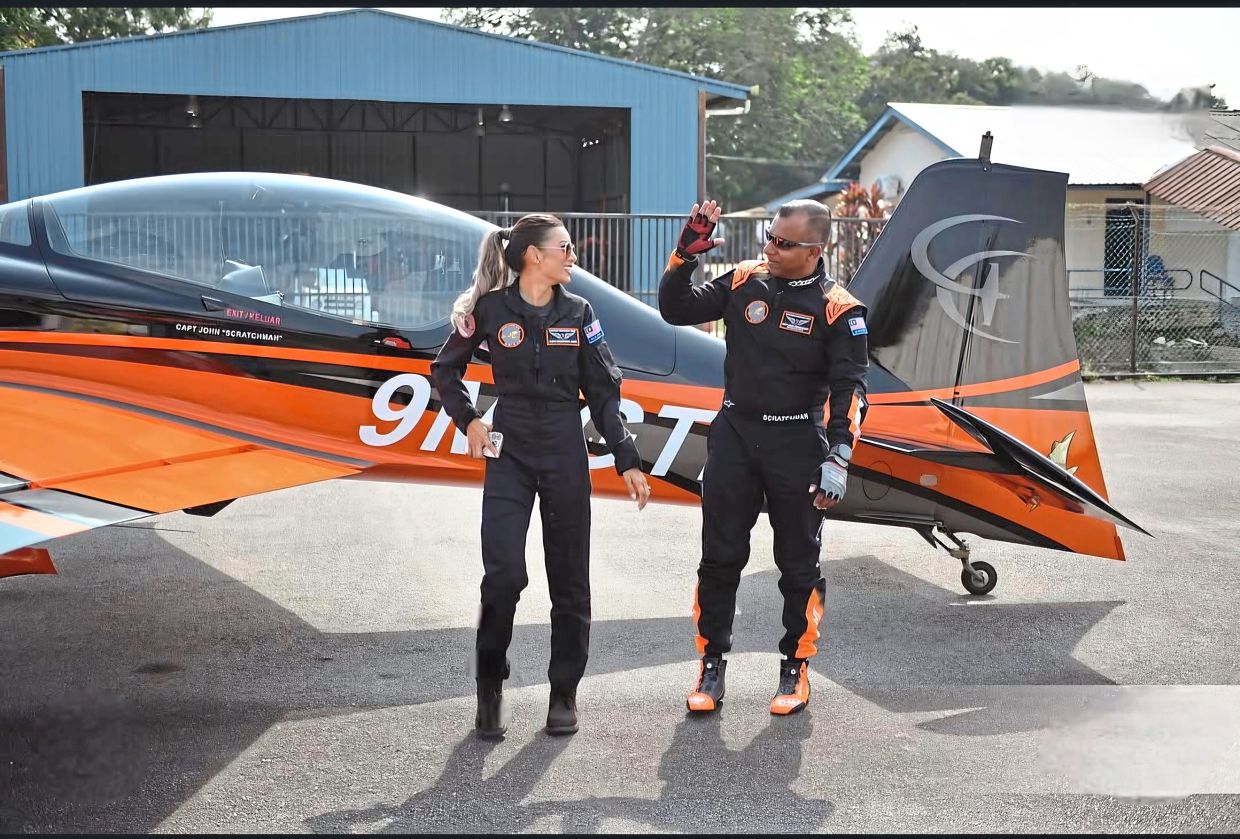
At 26, Samantha Laura John has achieved what many dream of but few accomplish—she earned her commercial pilot's licence after graduating from flight school in Ipoh in 2025. What makes her achievement particularly remarkable is not merely the accomplishment itself, but that she chose to walk a path already forged by her father, retired Royal Malaysian Air Force (RMAF) fighter pilot Lieutenant-Colonel (Retired) John Sham Alagarsamy, 54. For this Malaysian family, aviation represents far more than a career choice; it symbolises a shared passion, values, and a profound connection that spans decades and miles.
Samantha's gravitational pull toward the skies began in childhood, shaped by what she calls her "extremely formative" years growing up on military bases across Malaysia. She watched her father prepare for combat readiness training and navigation exercises, experiences that instilled in her not just admiration but a deep sense of national pride. "I have always been fascinated by aeroplanes and people in uniform," she reflects. The frequent postings—from Labuan to Kuantan, Alor Setar, and Butterworth in Penang—created an unconventional childhood marked by relocation and discipline, yet these very circumstances fostered her appreciation for purposeful living and service to the nation. Rather than viewing constant moves as disruptive, she credits the air force environment with exposing her to structured routines and an ingrained understanding of collective responsibility.
John's own career trajectory demonstrates the depth of commitment required in Malaysian aviation circles. Over 26 years, he served as a fighter pilot, instructor, and examiner before transitioning to commercial aviation in 2019. Beyond his RMAF service, he holds a distinction that underscores his expertise: he is Malaysia's first and only civil aviator formally recognised by the Civil Aviation Authority of Malaysia for aerobatics. This specialisation has taken him to prestigious platforms, most notably the biennial Langkawi International Maritime and Aerospace Exhibition (Lima), where he has piloted the GB1 GameBird aircraft in breathtaking aerobatic demonstrations. His achievements extend beyond the cockpit; John also pursued advanced military education in Australia when he was attached to the Australian Defence Force while completing his master's degree in military and defence studies at the Australian National University in 2012.
Particularly intriguing is that John's talents span far beyond aviation. He is an accomplished musician and professional deejay operating under the stage name "Scratchman," a moniker earned through his 1992 Malaysian Open DJ Competition victory during the vinyl and turntablism era. This multifaceted nature—combining military discipline with creative expression—provides insight into the kind of role model Samantha grew up observing. His philosophy on parenting reflects this balanced worldview. "I always hoped my children would follow in my footsteps, but I never forced them," he explains. His approach centred on inspiration rather than prescription: "I always told them that if they aim for the stars, at least they'd reach the sky. The bigger your dreams, the greater your success—you have to dream it before you achieve it."
Samantha's path to the pilot's seat was not straightforward, however. After completing her International General Certificate of Secondary Education (IGCSE), she initially diverged from aviation, enrolling in a two-year cadet pilot programme with an airline in Sepang, Selangor, in 2018. The programme proved rewarding but ultimately misaligned with her deeper aspirations. She describes the realisation as a moment of clarity: her true passion for aviation had never diminished, merely lay dormant beneath the practical demands of an alternative career track. "I've always wanted to be a pilot," she says with characteristic candour. "Sure, I tried a different path, but deep down, I always knew I would come back to aviation." This capacity for self-reflection and course correction speaks to her maturity and demonstrates that following parental footsteps requires genuine personal conviction rather than mere dutiful imitation.
Interestingly, Samantha's aviation credential now coexists with an entirely different professional life. Based in Kota Kinabalu, she operates an event management company alongside her husband, David Chong, 30, and provides vocal coaching as a secondary pursuit. Rather than viewing her pilot's licence as an immediate gateway to commercial flying, she regards it as a long-term aspiration—something to which she plans to return once her current entrepreneurial ventures reach appropriate milestones. This pragmatic approach reflects the influence of parents who encouraged exploration and independent decision-making rather than rigid adherence to predetermined trajectories.
The family's trajectory also intersects with broader patterns in Malaysian aviation. The examples of sisters Safia Amira Abu Bakar and Safia Anisa Abu Bakar, who both pursued careers in aviation following their father Captain Abu Bakar Shafie into the field, suggest that the phenomenon of multigenerational aviation families is not isolated. Research from Universiti Teknologi Malaysia's social science journal, specifically a study titled "Parental Influence and Undergraduates' Career Choice Intentions," provides empirical backing for what the Sham Alagarsamy family demonstrates intuitively: strong parent-child relationships characterised by open communication and mutual trust significantly influence career decisions by fostering exploration and encouraging long-term vision. The study underscores that parental influence operates most effectively when it creates space for autonomy rather than imposing constraint.
When Samantha discusses her experience in the cockpit, her language shifts—becoming more technical, more focused, more precise. "Once you're in the cockpit, you have to be fully focused and aware of your surroundings," she explains. "You're always looking ahead, thinking ahead, and staying situationally aware. It's almost like working in six dimensions." This description captures something essential about flying that extends beyond technical skill: it demands a particular orientation toward reality, a heightened consciousness that elevates routine activities into something transcendent. She describes the experience as therapeutic, suggesting that for her, as perhaps for her father, aviation represents not merely employment but a form of purposeful existence.
The respect evident in Samantha's demeanour toward her father—evident not just in her words but in her carriage and tone—reflects values deliberately cultivated throughout her upbringing. John attributes this to consistent modelling of discipline and principled conduct. "It is measured by the positive impact we leave on others, especially our children, who often learn more from what we do than what we say," he reflects. This philosophy, earned through decades of military service and subsequently formalised through the Most Gallant Order of Military Service (Kesatria Angkatan Tentera) recognition he received, suggests that parenting itself constitutes a kind of mission requiring the same dedication and strategic thinking he once brought to defending Malaysian airspace.
Their recent family gathering—a weekend reunion where John travelled from Ipoh, where he now heads training operations at a flying school, to meet Samantha visiting from Kota Kinabalu, while their mother Lynda Shanti Ganesaguru, 45, and younger brother Shayne Zacchaeus John, 22, remain based in the Klang Valley—underscores how modern Malaysian families navigate geographical dispersion without losing connection. Over lunch at an Indonesian restaurant, the father and daughter exchanged stories and laughter, their reminiscences traversing the landscape of air force postings and international experiences that have shaped their collective identity. For this family, such moments represent continuity amidst change, a reaffirmation of bonds forged not through proximity but through shared values and mutual respect.


