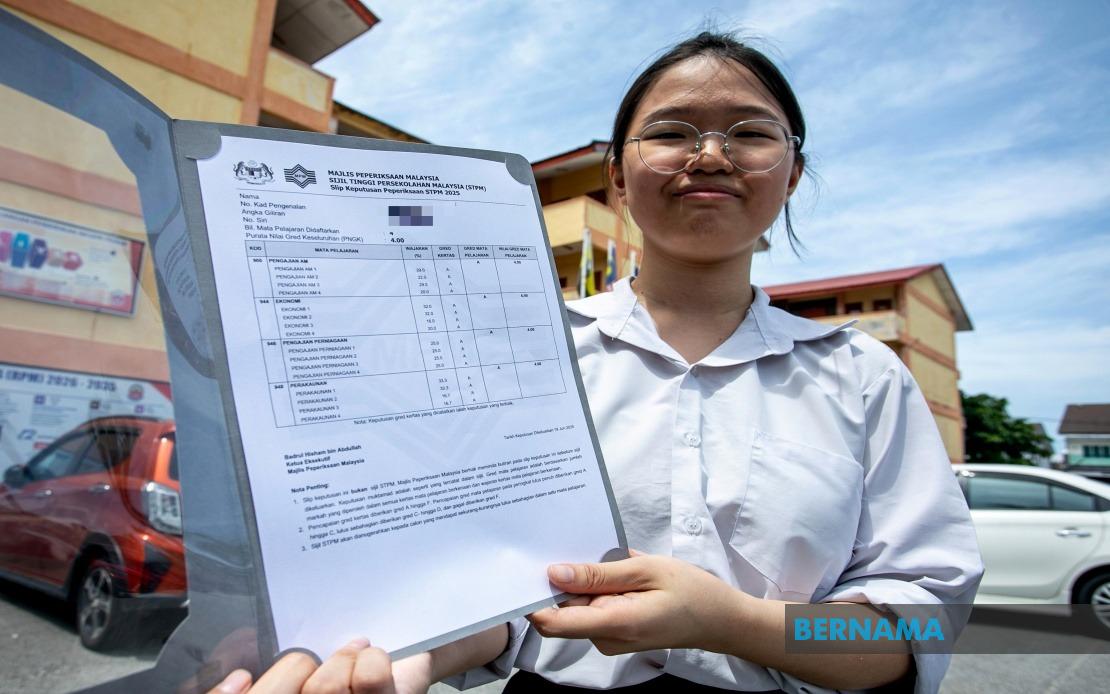
Yong Xin Yi, a 20-year-old student at SMK Jalan Tasek in Ipoh, has emerged as a standout performer in the 2025 Sijil Tinggi Persekolahan Malaysia (STPM) examination, securing an impressive four A grades across all her subjects. Her achievement represents not merely individual academic excellence but also provides a compelling blueprint for Malaysian students navigating the increasingly competitive landscape of pre-university education. The consistency of her performance—earning a cumulative grade point average of 4.00—underscores that such outcomes are seldom matters of innate talent alone but rather the product of methodical planning and unwavering commitment to structured learning.
Xin Yi's approach to examination preparation centred on a carefully regimented daily schedule that commenced at 5:00 pm each afternoon and extended until 10:00 pm, providing five uninterrupted hours dedicated exclusively to revision and consolidation of classroom material. This temporal commitment, maintained consistently throughout her study period, reflects a strategic understanding that sustainable academic progress emerges from regular, incremental effort rather than sporadic cramming sessions. The particular timing of her study window—occurring after standard school hours—allowed her to capitalise on the momentum generated during the day whilst maintaining the mental energy necessary for deep learning. Such a regimen demands considerable self-discipline, particularly for teenagers who face competing social pressures and entertainment distractions.
However, what distinguishes Xin Yi's methodology from conventional study practices is her explicit prioritisation of attentiveness during classroom instruction. She emphasises that absorbing explanations directly from teachers reduces subsequent confusion during independent revision, thereby making her evening study sessions more efficient and productive. This insight challenges a widespread misconception among Malaysian students that examination success depends primarily on after-school grinding; instead, she advocates for a bidirectional approach where classroom engagement forms the foundational layer upon which independent revision builds. Her observation reflects broader pedagogical research suggesting that students who maintain focus during lessons require substantially less supplementary study time to achieve mastery of concepts.
Another critical component of her study strategy involved meticulous completion of all assignments set by her teachers. Rather than viewing homework as administrative busywork, Xin Yi recognises it as a practical mechanism for reinforcing conceptual understanding and identifying gaps in knowledge before examinations arrive. This disciplined approach to assignments likely prevented the accumulation of unresolved academic weaknesses that could compound during high-pressure examination periods. For Malaysian students accustomed to treating homework with variable commitment, her perspective offers a practical reminder that assigned work serves pedagogical purposes beyond grade collection.
Among her four subjects—General Studies, Principles of Accounting, Economics, and one additional subject—Xin Yi identified General Studies as presenting the most formidable challenge. The subject's emphasis on sophisticated writing skills, adherence to specific formatting conventions, and precise understanding of marking criteria created obstacles that demanded targeted intervention. Rather than accepting this weakness as immutable, she deliberately channelled additional attention toward the problematic subject, effectively front-loading effort where it would yield maximum returns. This capacity for self-diagnosis and strategic resource allocation represents a metacognitive skill that frequently distinguishes consistently high-performing students from those whose achievements plateau.
Xin Yi's background as the only child of a clerk and phone salesman provides important context for understanding her achievement within Malaysia's socioeconomic landscape. Her parents' occupations place her family firmly within the working class, a demographic for which educational advancement often represents the primary pathway to improved economic circumstances. This reality likely contributed to the intensity of her academic commitment, as she consciously views her STPM success not as a personal accomplishment alone but as a vehicle for elevating her family's overall fortune. She articulates a desire to justify her parents' sacrifices through future achievements, suggesting that her motivation extends beyond the pursuit of grades into a broader framework of familial obligation and aspiration.
Her aspiration to study economics at Universiti Putra Malaysia (UPM) and pursue a career as an economist reflects a career pathway selection grounded in thoughtful self-assessment rather than parental pressure or societal convention. Xin Yi's deliberation about her field of study demonstrates awareness that sustainable career satisfaction emerges from alignment between personal interests and chosen profession. The economics sector's relatively broad career opportunities likely appealed to her pragmatic evaluation of future employment prospects, suggesting that her decision-making process incorporates both intrinsic motivation and realistic assessment of labour market conditions.
The broader context of SMK Jalan Tasek's 2025 STPM results indicates that five students from the institution achieved four A grades, placing Xin Yi within a cohort of high achievers at her school. This clustering of excellence suggests that institutional factors—teacher quality, school leadership, resource availability—may create conditions conducive to high academic achievement. For other Malaysian secondary schools seeking to replicate such outcomes, examining the practices and systems operating at this institution could yield valuable insights. The presence of multiple top achievers from a single school indicates that excellence is not purely an individual phenomenon but potentially reflects collective institutional competence.
Xin Yi's explicit acknowledgment of her parents' continuous support and encouragement throughout her studies highlights the often-underestimated role of family dynamics in academic success. Beyond financial provision, parental emotional support and belief in a student's capabilities create psychological foundations essential for sustained effort over extended study periods. In Malaysian culture, where family values remain deeply rooted, this dimension of achievement merits greater recognition in discussions of examination success. Students studying in environments characterised by parental indifference or active discouragement face substantially higher barriers to achievement regardless of their intellectual capacity or work ethic.
For Malaysian policymakers and educators observing Xin Yi's success, several transferable principles emerge. First, structured daily routines with clearly demarcated study periods appear more effective than ad hoc revision approaches. Second, classroom engagement during instruction represents foundational investment that reduces subsequent revision requirements. Third, systematic completion of assigned work serves practical pedagogical functions beyond administrative convenience. Fourth, identifying specific areas of weakness and deliberately concentrating effort toward improvement yields better outcomes than dispersed attention across all subjects equally. Finally, connecting academic achievement to meaningful personal objectives—in Xin Yi's case, family advancement—sustains motivation during challenging periods.
Her achievement also underscores broader questions about educational equity within Malaysia. That a student from a working-class background achieves perfect grades demonstrates that socioeconomic circumstances, whilst materially relevant, do not determine academic destiny. Yet this should not obscure the reality that many equally motivated students face barriers—inadequate school resources, tutoring costs, home environments unsuitable for study—that Xin Yi either did not encounter or successfully overcame. Her success story, whilst inspirational, should prompt Malaysian society to examine systemic factors ensuring that such outcomes become more representative rather than exceptional achievements meriting special attention.