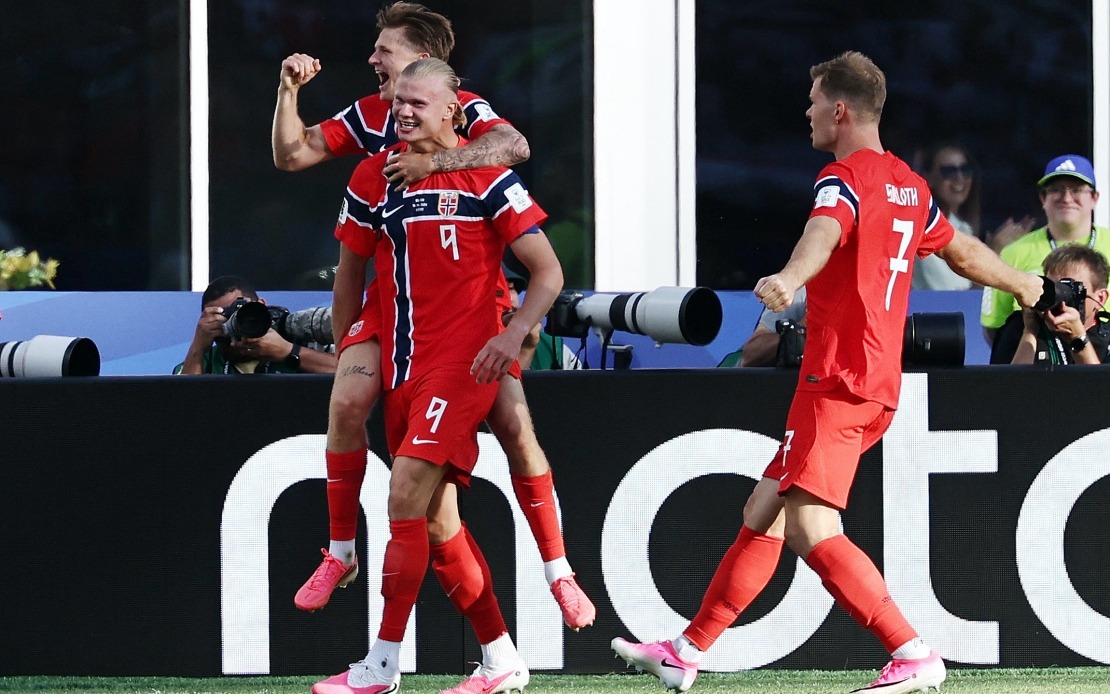
Three Norwegian players are carrying more than just national pride into the World Cup. Erling Haaland, Alexander Sørloth and Kristian Thorstvedt are competing in the tournament with the unspoken goal of completing what their fathers began three decades ago, after Alf-Inge "Alfie" Haaland, Gøran Sørloth and Erik Thorstvedt were eliminated in the group stage of the 1994 World Cup held in the United States.
Norway's remarkable 4-1 victory over Iraq in their opening match has injected genuine optimism into their campaign, suggesting that this generation possesses the quality to venture further than the previous one. The contrast is striking—where their fathers' tenure ended in disappointment, the sons have announced themselves with a statement performance that has captured public imagination across Scandinavia and beyond. Haaland, in particular, brings a different dimension to Norwegian football, with his elite-level experience at Manchester City providing the kind of international exposure and competitive sharpness that separates modern world-class talent from previous generations.
The emotional weight of this connection weighs lightly on Haaland, who has found humour in the historical parallels. When presented with photographs of his father from the 1994 tournament, the Manchester City forward's amusement was evident, struck by how youthful and long-haired his father appeared. This candid reaction reveals a player comfortable in his own skin, yet acutely aware of the symbolic importance his lineage carries in Norwegian sport. That Haaland himself has followed his father's path to Manchester City adds another layer of symmetry, though under vastly different circumstances and with incomparably greater individual acclaim.
Sørloth, now plying his trade at Atletico Madrid, has been more reflective about the generational connection. He has spoken movingly about how his father has shaped not merely his understanding of football but his approach to the game's fundamental principles. His earliest memory of international football traces back to the 2002 World Cup in Japan and South Korea, a tournament he experienced through his father's eyes while the family holidayed in Denmark. Those formative moments—watching the World Cup alongside his father—have crystallised into a deeper motivation, transforming what could be a mere sporting endeavour into something closer to a family legacy moment.
Thorstvedt, meanwhile, represents the third thread in this narrative tapestry. Like his teammates, he carries the weight of knowing what his father achieved and the manner in which that achievement concluded. Whether consciously or subconsciously, these three players are driven by a desire to ensure that their own World Cup journey extends beyond the preliminary stages, thereby honouring the pioneering efforts of their predecessors whilst simultaneously establishing their own imprint on the international stage.
Norway's next challenge arrives Monday against Senegal, a fixture that could prove decisive in determining whether they progress to the knockout rounds. Success in New Jersey would represent a watershed moment not merely for the current squad but symbolically for these three players in particular, as it would mean surpassing the achievement of their fathers. The stakes are pitched at a level where sporting outcomes intersect with family pride and generational aspiration.
The group stage concludes with a daunting encounter against France, one of the tournament's elite contenders. This fixture presents both an opportunity and a test—should Norway secure qualification before facing the French, they would do so having overcome Senegal, placing them in a position where they could compete against stronger opposition whilst already assured of progression. The narrative arc of this campaign continues to build, each match adding texture to the broader story of fathers and sons in international football.
Beyond the playing field, Norwegian society has mobilised behind the team in ways that transcend typical international football support. Hereditary Princess Ingrid Alexandra and Prince Sverre Magnus, the children of Crown Prince Haakon and Crown Princess Mette-Marit, are anticipated to attend Monday's match in New Jersey, underscoring how football has penetrated the very fabric of Norwegian national life, even at the highest institutional levels. This royal presence signals the cultural significance accorded to the team's performance.
The phenomenon extends further into Norwegian political life. Members of parliament from across the entire political spectrum participated in a co-ordinated show of support for the national team on Thursday, demonstrating rare unanimity in legislative chambers. This cross-party endorsement indicates that Norway's World Cup campaign has transcended partisan politics, becoming instead a unifying national endeavour. The parliamentary display of solidarity, drawing on Viking heritage and cultural symbolism, reflects how deeply embedded international football has become in Norwegian identity.
What emerges from this context is a competition wherein Norway's three young stars face an opponent far more complex than traditional adversaries. They compete not only against international rivals but against history itself, against the shadows of their fathers' unfulfilled aspirations, and against the accumulated expectations of a nation that has imbued their tournament participation with historical resonance. The pressure, though undoubtedly present, appears to have been transformed by these players into motivation, evident in Norway's dominant opening performance and the evident cohesion within the squad.
%22%2F%3E%3C%2Fpattern%3E%3C%2Fdefs%3E%3Crect%20width%3D%22100%25%22%20height%3D%22100%25%22%20fill%3D%22url(%23ph3tt8dg)%22%2F%3E%3Crect%20width%3D%22100%25%22%20height%3D%22100%25%22%20fill%3D%22url(%23ph3tt8dp)%22%2F%3E%3Ctext%20x%3D%2250%25%22%20y%3D%2250%25%22%20text-anchor%3D%22middle%22%20dominant-baseline%3D%22central%22%20fill%3D%22rgba(255%2C255%2C255%2C0.95)%22%20font-family%3D%22Georgia%2C%20'Times%20New%20Roman'%2C%20serif%22%20font-weight%3D%22700%22%20font-size%3D%22226%22%20letter-spacing%3D%22-0.02em%22%3EDiesel%3C%2Ftext%3E%3C%2Fsvg%3E)
%22%2F%3E%3C%2Fpattern%3E%3C%2Fdefs%3E%3Crect%20width%3D%22100%25%22%20height%3D%22100%25%22%20fill%3D%22url(%23ph5y615g)%22%2F%3E%3Crect%20width%3D%22100%25%22%20height%3D%22100%25%22%20fill%3D%22url(%23ph5y615p)%22%2F%3E%3Ctext%20x%3D%2250%25%22%20y%3D%2250%25%22%20text-anchor%3D%22middle%22%20dominant-baseline%3D%22central%22%20fill%3D%22rgba(255%2C255%2C255%2C0.95)%22%20font-family%3D%22Georgia%2C%20'Times%20New%20Roman'%2C%20serif%22%20font-weight%3D%22700%22%20font-size%3D%22320%22%20letter-spacing%3D%22-0.02em%22%3ERim%3C%2Ftext%3E%3C%2Fsvg%3E)