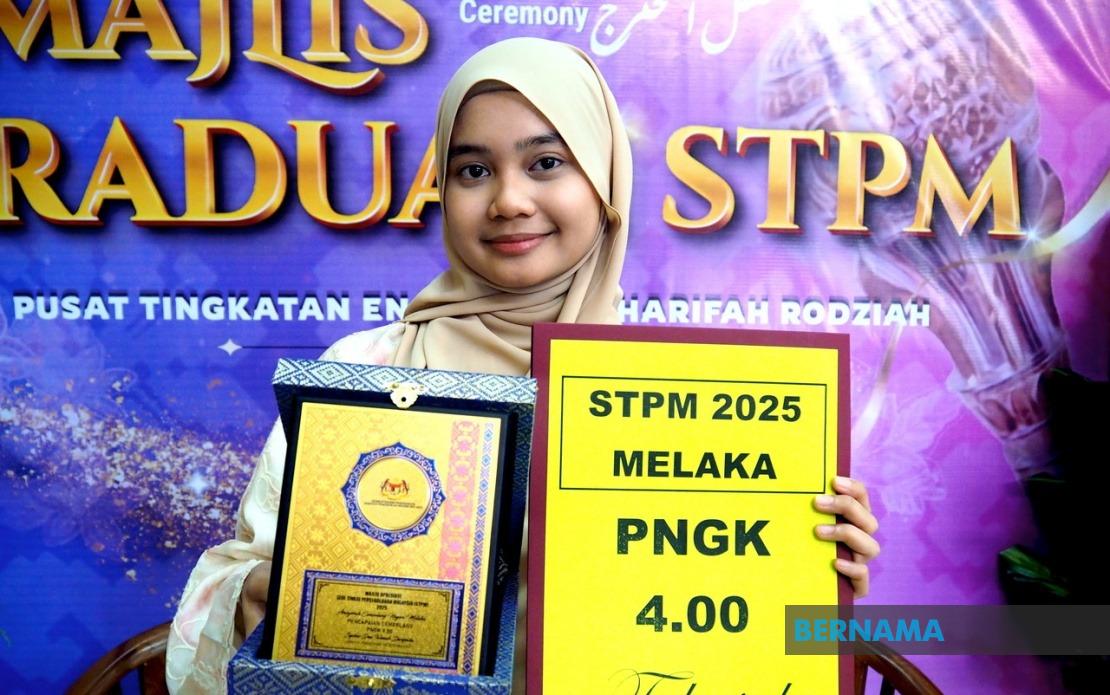
Nurfariesya Nasywa Hamedee's journey to academic excellence was forged not in comfort but in grief. The 21-year-old from Sekolah Menengah Kebangsaan Agama (SMKA) Sharifah Rodziah has achieved a perfect Cumulative Grade Point Average of 4.00 in the 2025 Sijil Tinggi Persekolahan Malaysia (STPM) examination, a milestone that carries profound meaning beyond the numbers. Her success stands as a tribute to her late father, Hamedee Asri, whose parting words became the anchor that kept her studies on course through emotional turbulence.
The circumstances surrounding Hamedee Asri's death a week before Nurfariesya's Sijil Pelajaran Malaysia (SPM) trial examination created a rupture in her academic trajectory. When her father died of a heart attack, the shock reverberated through the entire household, and for a moment, Nurfariesya considered abandoning her education altogether. The weight of family responsibility seemed too great to bear alongside schoolwork. Yet her mother, Yusnita Ruslan, became the messenger of Hamedee Asri's final, crucial instruction: that his daughter must not squander her potential through despair. This bequest, delivered during her family's darkest period, would become the philosophical foundation upon which she rebuilt her determination.
The path from contemplating dropout to achieving flawless examination results required more than motivation alone. Nurfariesya demonstrated remarkable resilience in compartmentalizing her grief while maintaining focus on her academic pursuits. She channeled the pain of loss into purposeful study, recognizing that her father's death had underscored the fragility of life and the importance of seizing opportunities for self-improvement. This perspective shift transformed her loss into a driver rather than an obstacle, creating a psychological framework within which grief and ambition could coexist productively.
What makes Nurfariesya's accomplishment even more striking is that she exceeded her own expectations. Based on trial examination performance and preliminary calculations, she had anticipated scoring approximately 3.92. The jump to a perfect 4.00 surprised even her, suggesting that her preparation had gone beyond what standardized testing protocols typically predict. This suggests a depth of understanding across her chosen subjects—General Studies, Arabic, Usuluddin, History, and Shariah—that transcended mere examination technique.
Her subject selection reveals a student with clear vocational direction. Nurfariesya harbors aspirations to become a Shariah lawyer, a field that demands both rigorous intellectual grounding in Islamic jurisprudence and analytical skills in legal argumentation. Her choice to study Shariah at STPM level reflects an ambition formed years earlier during her secondary schooling. She has already undergone interview sessions for the Bachelor's Degree program at Universiti Malaya, positioning herself well for entry into a prestigious institution known for its legal education. This intentionality distinguishes her from students who pursue subjects primarily for examination scores.
When asked about the mechanics of success, Nurfariesya offered no mystical formula or proprietary study method. Her explanation—that diligent work, perseverance, and unwavering faith are the foundations of achievement—reflects a pragmatic understanding that academic excellence emerges from sustained effort rather than innate gift. This message carries particular significance for Malaysian students navigating the pressures of high-stakes examinations. The demystification of success itself becomes valuable instruction, suggesting that peers face no insurmountable barriers to similar achievement.
Nurfariesya's decision to pursue STPM rather than other post-secondary qualifications shows strategic thinking about educational pathways. She identified STPM as offering a more efficient route to degree-level studies compared to alternative routes. This pragmatism, combined with her intellectual ambition, positions her well for success in university-level coursework, particularly in a demanding field like law. Her earlier accomplishment of obtaining 7As in her SPM examination had already demonstrated her capacity for sustained excellence across diverse subjects.
The recognition of her achievement came during the official Announcement of the 2025 Melaka State STPM Results, overseen by Datuk Rosli Abdullah, the State Deputy Exco for Education, Higher Education, and Religious Affairs. Her perfect score contributes to Melaka's showcase of academic talent during a period when Malaysian education faces ongoing scrutiny regarding quality and student outcomes. The state's celebration of such results reinforces the importance of recognizing not merely individual accomplishment but the institutional support systems and parental involvement that enable students to flourish.
Simultaneously, another high-achieving student emerged from Melaka's examination cycle. Ng Zhen Hong, aged 20, from Kolej Tingkatan Enam Tun Fatimah, secured the National-Level Best Student Award for the Science Stream, an honor that reflects Melaka's contribution to Malaysia's talented pool of future professionals. Ng's achievement of 10As in his SPM and his sustained dedication to science education—particularly mathematical and problem-solving aspects—demonstrates that academic excellence spans multiple fields and pathways across the state.
Ng's approach to science education, involving one to two hours of daily revision and viewing challenges as motivational catalysts, parallels Nurfariesya's methodology while highlighting discipline as universal to high achievement. He aims to pursue Chemical Engineering or Electrical Engineering at Universiti Malaya, continuing the pattern whereby top Melaka students aspire to entry into the nation's most selective institution. The convergence of both students toward Universiti Malaya suggests the university's reputation and selectivity drive motivational force among high-achieving students in the state.
These achievements collectively illustrate an important dimension of Malaysian education often overlooked in discussions centered on system-level reforms. Individual student success emerges from confluence of personal determination, family support, clear vocational direction, and engagement with quality instruction. Nurfariesya's perfect score and Ng's national recognition demonstrate that when these elements align, Malaysian students produce examination outcomes matching international standards. The personal narratives embedded within statistical achievements reveal the human dimension of educational success.
The implications for Malaysian educators and policymakers extend beyond celebrating individual accomplishment. When students articulate clear career aspirations connected to their subject selection, when family members reinforce academic values even during crisis, and when schools provide curricula aligned to professional pathways, the system functions optimally. Both Melaka students exemplify this alignment, suggesting that replication of such conditions across other states and institutions could yield broader improvements in national examination performance and student readiness for tertiary education and professional life.