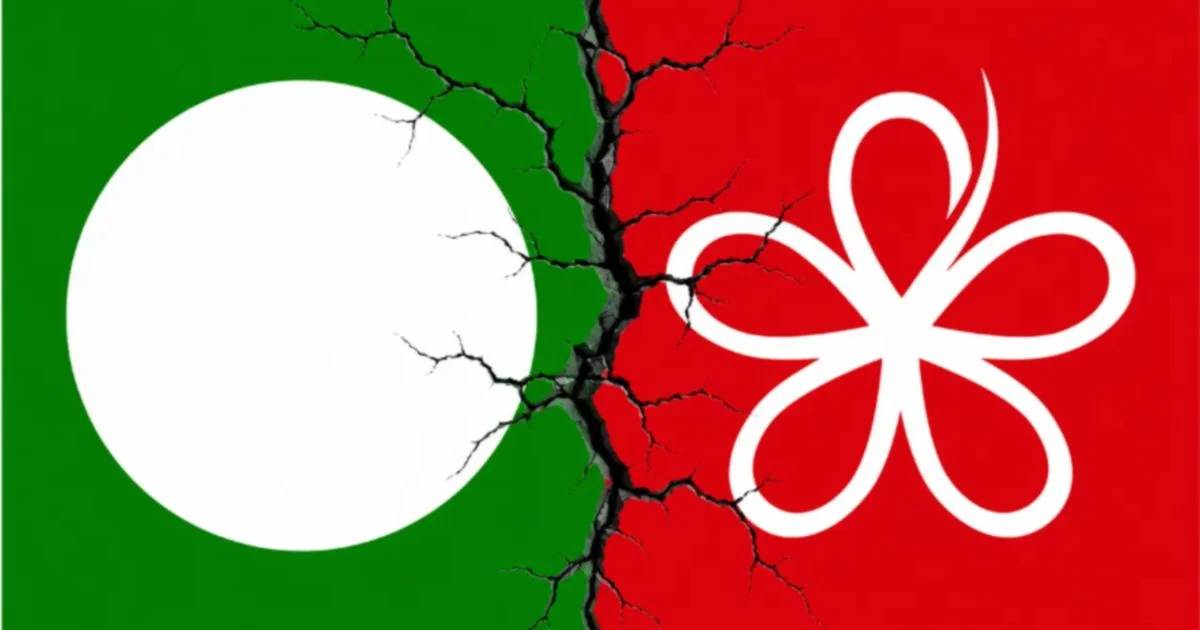
The political alliance between PAS and Bersatu, two pillars of Perikatan Nasional, faces a critical test as internal rifts threaten to destabilise the opposition coalition ahead of the 16th General Election. The deteriorating relationship between Malaysia's Islamic party and the party founded by former Prime Minister Mahathir Mohamad raises serious questions about whether the PN can maintain the electoral unity that helped it capture votes in previous contests.
The friction between these two major components of Perikatan Nasional stems from fundamental differences in ideology, strategy, and leadership vision. PAS, rooted in Islamic governance principles, has pursued increasingly assertive positions on religious matters and social policies, whilst Bersatu has positioned itself as a multiethnic, modernist alternative. These competing worldviews have created policy disagreements that now threaten to fracture the coalition from within, with each party increasingly pursuing independent campaigns rather than unified messaging.
For Malaysian voters, particularly those in swing constituencies, the spectacle of coalition partners at odds with one another sends mixed signals about PN's ability to govern effectively. Observers note that electoral success often depends on demonstrating internal discipline and presenting a coherent vision to the electorate. When coalition members publicly contradict each other or engage in factional disputes, they inadvertently provide ammunition to rival coalitions and erode voter confidence in their collective competence.
The stakes are particularly high in mixed constituencies where both Muslim and non-Muslim voters hold sway. PAS's more assertive Islamic messaging, whilst energising its core supporters in certain states, potentially alienates non-Muslim communities who might otherwise consider PN as an alternative government. Bersatu's attempts to project moderation and inclusivity can appear contradictory when standing alongside a partner perceived as advancing a narrower agenda. This internal contradiction makes PN's appeal in urban, religiously diverse areas increasingly precarious.
Regionally, the PN's troubles have implications beyond Malaysian borders. Southeast Asia's democratic nations watch how coalitions manage internal diversity and disagreement. The inability of PAS and Bersatu to resolve their differences constructively sends concerning signals about institutional maturity and collaborative governance in the region. For international observers evaluating Malaysia's political stability, such coalitional fragility raises questions about the sustainability of any government that PN might form.
The historical context matters significantly. Previous opposition coalitions in Malaysia have foundered precisely because component parties prioritised their individual interests over the larger alliance. The Pakatan Rakyat experience demonstrates how unresolved internal tensions can snowball into complete political realignment. PAS and Bersatu face similar pressures, and without deliberate efforts to bridge their differences, they risk repeating historical patterns of coalition collapse.
Campaign mechanics further complicate matters. In a multi-party electoral system with first-past-the-post voting, tactical coordination between alliance partners is essential for maximising combined vote share. When PAS and Bersatu field competing candidates in the same constituencies or offer contradictory policy platforms, they split opposition votes in ways that benefit governing coalitions. Rather than concentrating voter opposition, internal PN divisions disperse it, making electoral victory mathematically more difficult.
The timing of these divisions presents particular challenges as Malaysia approaches what may be a pivotal electoral moment. GE16 will occur in a specific political and economic context that shapes voter sentiment. Economic pressures, cost of living concerns, and governance performance issues could favour an opposition coalition that presents itself as unified and ready to govern. Conversely, a fractious and divided PN allows the incumbent government to portray itself as the more stable, experienced option despite its own challenges.
For grassroots supporters of both PAS and Bersatu, the coalition's internal divisions create genuine dilemmas. Party members must decide whether to prioritise their individual party's advancement or the larger opposition project. Activists motivated by regime change may feel increasingly frustrated if internal PN disputes undermine the coalition's electoral prospects. This demoralisation could translate into reduced campaign enthusiasm and lower volunteer turnout, compounding PN's difficulties.
The longer these tensions remain unresolved, the more difficult reconciliation becomes. Political actors invest in alternative strategies and build separate constituency machines, making unified action increasingly costly. What began as disagreement over specific policies can crystallise into deeper, more personal rivalries between party leaders that transcend policy resolution. Once relationships reach this level of deterioration, structural cooperation becomes nearly impossible.
Looking forward, PN's survival as a viable electoral force depends on whether its senior leaders can compartmentalise their differences and identify minimum terms of cooperation. This requires explicit agreements about campaign strategy, candidate selection processes, and policy non-negotiables. Without such frameworks, the coalition will continue drifting toward fragmentation, rendering it ineffectual as an opposition force and virtually guaranteeing that GE16 becomes another exercise in opposition disappointment rather than genuine political competition.


