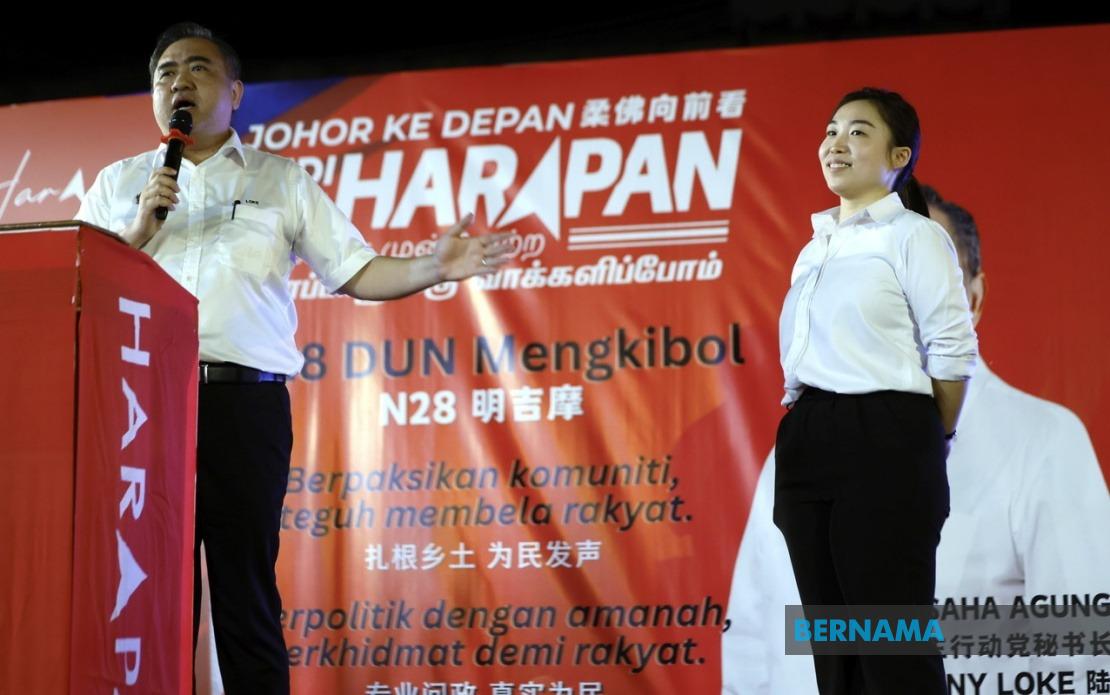
The Democratic Action Party has selected Chu Poh Yee, a 33-year-old lawyer, as its first candidate for the upcoming Johor state election, tasking her with defending the Mengkibol constituency. The announcement was made during a candidate declaration ceremony in Kluang on Monday evening, marking a significant shift in the party's representation for the traditionally contested seat.
Party secretary-general Anthony Loke explained that the nomination represents a strategic repositioning of the party's electoral machinery in Johor. The current assemblyman, Chew Chong Sin, who has represented Mengkibol for two consecutive terms, has been identified as having greater potential at the federal level. Rather than seeking re-election at the state level, Chew is being groomed as a parliamentary candidate for Labis following incumbent MP Pang Hok Liong's decision to step aside after his current term concludes.
Loke emphasised that the decision to field Chu demonstrates the DAP's commitment to nurturing fresh talent within the party ranks, particularly female candidates seeking elected office. The nomination process, he noted, involved unanimity among the party's selection committee, underscoring the confidence leadership places in her candidacy. Chu's background in legal practice, particularly her involvement in assisting local representatives with legal aid matters, formed a central component of the rationale for her selection.
The profile presented by party officials positions Chu as a competitive contender for the seat. Beyond her legal credentials, Loke highlighted her fluency in multiple languages and her established connections within the Mengkibol constituency itself—factors typically considered essential for electoral viability in Malaysian state contests. Her educational qualifications and professional standing appear designed to counter any perceptions of inexperience that often accompany first-time candidates.
The broader context for this candidacy involves DAP's sustained push to increase female representation in elected positions across Malaysia. The move reflects a pattern observed among opposition and some government parties seeking to modernise their candidate profiles and appeal to increasingly diverse electorates. Women lawyers and professionals have become increasingly prominent as candidates across major political formations, though glass ceilings remain particularly evident in state and federal legislatures throughout the country.
Loke confirmed that the DAP has finalised its selection process for all 17 state constituencies the party intends to contest in Johor. The slate comprises ten seats currently held by DAP representatives, four constituencies the party previously lost but now seeks to recapture, and three additional seats where it will contest for the first time. This configuration suggests a mixed strategy balancing defensive consolidation with offensive expansion.
Further candidate announcements will follow a staggered schedule designed to build momentum toward the election. Four additional names will be unveiled on Saturday for the constituencies of Tiram, Johor Jaya, Senai, and Bukit Permai. The remaining candidates will be presented jointly with other Pakatan Harapan partners under Prime Minister leadership the following Monday, indicating continued coordination across the opposition coalition.
The timing and sequencing of these announcements reflects broader electoral calculations within opposition circles. By spacing revelations across several days and presenting candidates through senior national figures, political strategists aim to sustain media coverage and maintain narrative control during the pre-election period. This approach also allows different party components within Pakatan Harapan to calibrate their announcements for maximum collective impact.
For Malaysian and Southeast Asian observers, this candidacy exemplifies evolving patterns in opposition party management and the emergence of professional women as political challengers. Chu's selection signals that DAP sees legal expertise and professional accomplishment as compelling electoral assets, particularly in constituencies with educated, urban or semi-urban voter bases like those in Johor's more developed areas.
The transition from Chew to Chu in Mengkibol also illustrates how Malaysian political parties manage succession planning across different electoral levels. Rather than abruptly retiring established representatives, parties frequently pivot them toward higher-level contests where their proven track records and networks offer strategic advantage. This approach maintains institutional knowledge while creating openings for new candidates.
The significance of Chu's candidacy extends beyond Mengkibol itself. As DAP's first announced candidate for the Johor election, she becomes the public face of the party's electoral effort in the state during a critical early phase. Her prominence in initial media coverage and campaign materials will substantially shape how voters and observers perceive the broader DAP campaign and its positioning on representation and renewal.
Moving forward, the extent to which Chu can translate her professional credentials and local connections into electoral victory will provide important indicators for how Malaysian electorates respond to opposition candidate profiles. Her performance will likely influence future candidate selection decisions not only within DAP but potentially across other major political formations seeking to balance experience with fresh perspectives and to broaden representation.


