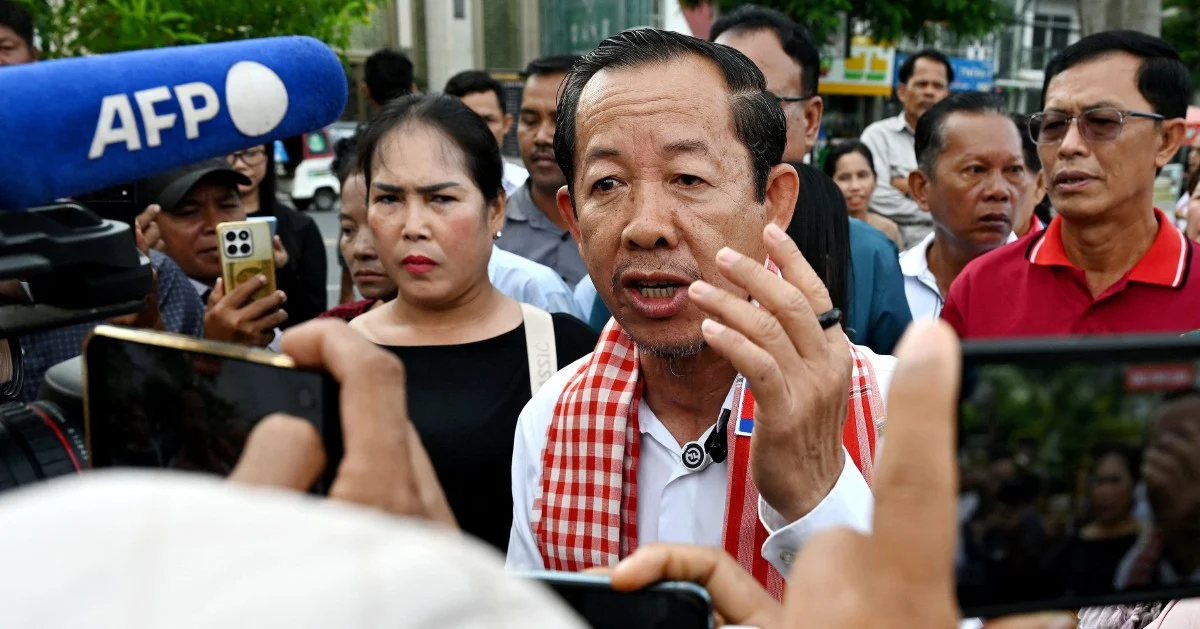
Cambodia's Supreme Court delivered a mixed ruling on Friday regarding opposition politician Rong Chhun, suspending his prison sentence while maintaining a ban that prevents him from running in elections. The decision, confirmed by Chhun's legal team, represents a partial victory for the long-serving opposition figure while simultaneously reinforcing restrictions that effectively sideline him from electoral participation—a development with potentially significant implications for Cambodia's already-constrained political landscape.
The court's decision to suspend Chhun's incarceration suggests some recognition of concerns about the severity of his original punishment. However, the preservation of the election ban demonstrates that Cambodia's judiciary continues to enforce measures that limit opposition participation in democratic processes. For Rong Chhun, who has been a prominent voice of dissent in Cambodia's parliament and beyond, the ruling effectively neutralises his ability to influence politics through electoral competition, even as it spares him immediate imprisonment.
Rong Chhun has long been a contentious figure in Cambodian politics, championing workers' rights and representing constituencies with significant populations of labourers and lower-income citizens. His positions often challenged government policies on labour standards, wages, and working conditions—issues that resonate across Southeast Asia's industrialised economies. The various legal proceedings against him have been interpreted by human rights organisations and international observers as part of a broader pattern of constraining opposition voices in Cambodia.
The election ban carries profound consequences for Cambodia's democratic framework. By preventing opposition candidates from running for office, such prohibitions undermine the fundamental premise of elections—that citizens can choose from a genuine range of political alternatives. The restriction effectively removes one of Cambodia's few consistently vocal critics from the ballot, narrowing the spectrum of choice available to voters and reducing parliamentary representation of dissenting viewpoints. This bears particular significance given Cambodia's recent political history and international concerns about the state of democratic institutions in the country.
Cambodia's approach to managing opposition politicians reflects broader regional tensions between state control and political pluralism. Neighbouring countries including Thailand, Myanmar, and others have employed comparable strategies—legal mechanisms, bans, and restrictions—to marginalise opposition figures. Regional observers note that such tactics, while sometimes dressed in judicial language, often function primarily as political tools. The Cambodian court's decision follows established patterns that concentrate power while creating the appearance of legal process.
For Malaysian observers, Rong Chhun's situation offers important comparative perspective. While Malaysia maintains more robust electoral competition and opposition representation than Cambodia, recent Malaysian debates about constitutional limits on eligibility, party bans, and political financing reveal ongoing tensions worldwide regarding how democracies balance competing interests. The boundaries of permissible political participation remain contested terrain even in more established democracies, though Malaysia's mechanisms generally operate within more transparent frameworks than Cambodia's system.
The suspension of Chhun's prison sentence may indicate evolving calculations within Cambodia's leadership regarding international perception and domestic stability. Imprisoning opposition figures generates international criticism and domestic resentment, particularly among working-class constituencies that Chhun represents. Suspending sentences while maintaining bans offers a middle path: demonstrating judicial authority and enforcing political constraints without incurring the reputational costs of actual incarceration. This strategic approach reflects sophisticated political management, though it remains fundamentally restrictive of political freedoms.
Chhun's case also illustrates how courts in certain jurisdictions become instruments of political control rather than independent arbiters of law. When judicial decisions systematically favour dominant political forces and disadvantage challengers, courts lose credibility as neutral institutions. International human rights bodies have repeatedly raised concerns about Cambodia's judicial independence, noting that high-profile political cases often reflect predetermined outcomes rather than genuine legal analysis. Friday's decision, while not entirely rejecting Chhun's position, reinforces doubts about the court system's independence.
The broader implications extend beyond Chhun personally. Opposition politicians across Cambodia face similar pressures—legal vulnerability, electoral restrictions, and the threat of imprisonment. These conditions create a chilling effect on political discourse and activism. Potential challengers to the established order become cautious about public statements and parliamentary activities, knowing that legal mechanisms can be deployed against them. The cumulative effect gradually narrows the space for legitimate dissent within political institutions.
Looking forward, Chhun's situation will likely continue attracting international attention. Cambodia's major trading partners and international donors periodically press the government on democratic governance and human rights. The United States, European Union, and various human rights organisations monitor cases like Chhun's as indicators of Cambodia's commitment to political pluralism. However, such international pressure has proven insufficient to fundamentally alter Cambodia's political trajectory, suggesting that meaningful change would require domestic political shifts rather than external pressure alone.
For Cambodia's working-class constituencies and labour movements that Chhun has championed, Friday's ruling removes their primary parliamentary advocate from future elections. Workers' issues—factory wages, workplace safety, union rights—will lack dedicated representation from opposition voices. This absence will likely shape Cambodia's labour politics and potentially contribute to increased industrial unrest or alternative forms of worker organisation outside formal political channels.
The suspended sentence offers Chhun temporary relief but not vindication. The maintained election ban ensures his political influence remains fundamentally constrained. As Cambodia navigates ongoing political transitions and international scrutiny, cases like Rong Chhun's will continue testing whether the country can maintain democratic institutions or whether it evolves further toward restricted political systems. The Supreme Court's Friday decision, whatever its immediate implications, signals that Cambodia's ruling authorities intend to maintain strict limitations on opposition electoral participation.


